
Warning: investigate before accusing
- A shaved lead is a disputed attribution or qualification outcome, not proof of fraud by itself.
- Compare your tracker, network report and operator event logs using the same cohort and time zone.
- Ask for reproducible logs, definitions and an adjustment trail.
What is a “Shaved” Lead and How to Detect It in iGaming — Detect Shaved Affiliate Leads
To detect shaved affiliate leads, start with reconciliation rather than suspicion. In affiliate marketing, a “shaved” lead usually describes a conversion that a publisher believes should qualify but that a network or operator reports as rejected, missing or lower value. The difference may indicate deliberate under-reporting, but it can also come from attribution windows, duplicate rules, delayed postbacks, invalid traffic filters or different definitions of a qualified lead.
We advise teams to make the disputed record traceable from click to event. A strong investigation compares the publisher’s tracker data with the network’s conversion report and the operator’s logs, then asks for the rule or status that explains each mismatch.
Key Definition: A shaved affiliate lead is a suspected conversion discrepancy where the reported payable volume or value is lower than the source’s expected result and the cause has not yet been established.
What does “shaved lead” mean in iGaming?
The term is common in partner discussions, but it is not a technical diagnosis. A lead can be “missing” because the click ID was lost, “rejected” because the player failed a rule, “pending” because the event is still under review, or “reversed” because of a later chargeback. Those states should not be treated as equivalent.
| Observed mismatch | Possible explanation | First check |
|---|---|---|
| Clicks match, deposits do not | Postback failure, event delay or attribution-window difference. | Compare click IDs and callback response logs. |
| Deposits match, approvals do not | Fraud, duplicate, jurisdiction or qualification rule. | Request status reason and rule version. |
| Approved leads later fall | Chargeback, refund or reversal policy. | Review state history and adjustment timestamps. |
| Payout value is lower | Currency, tier, negative carryover or revised base. | Recalculate from the signed commercial terms. |
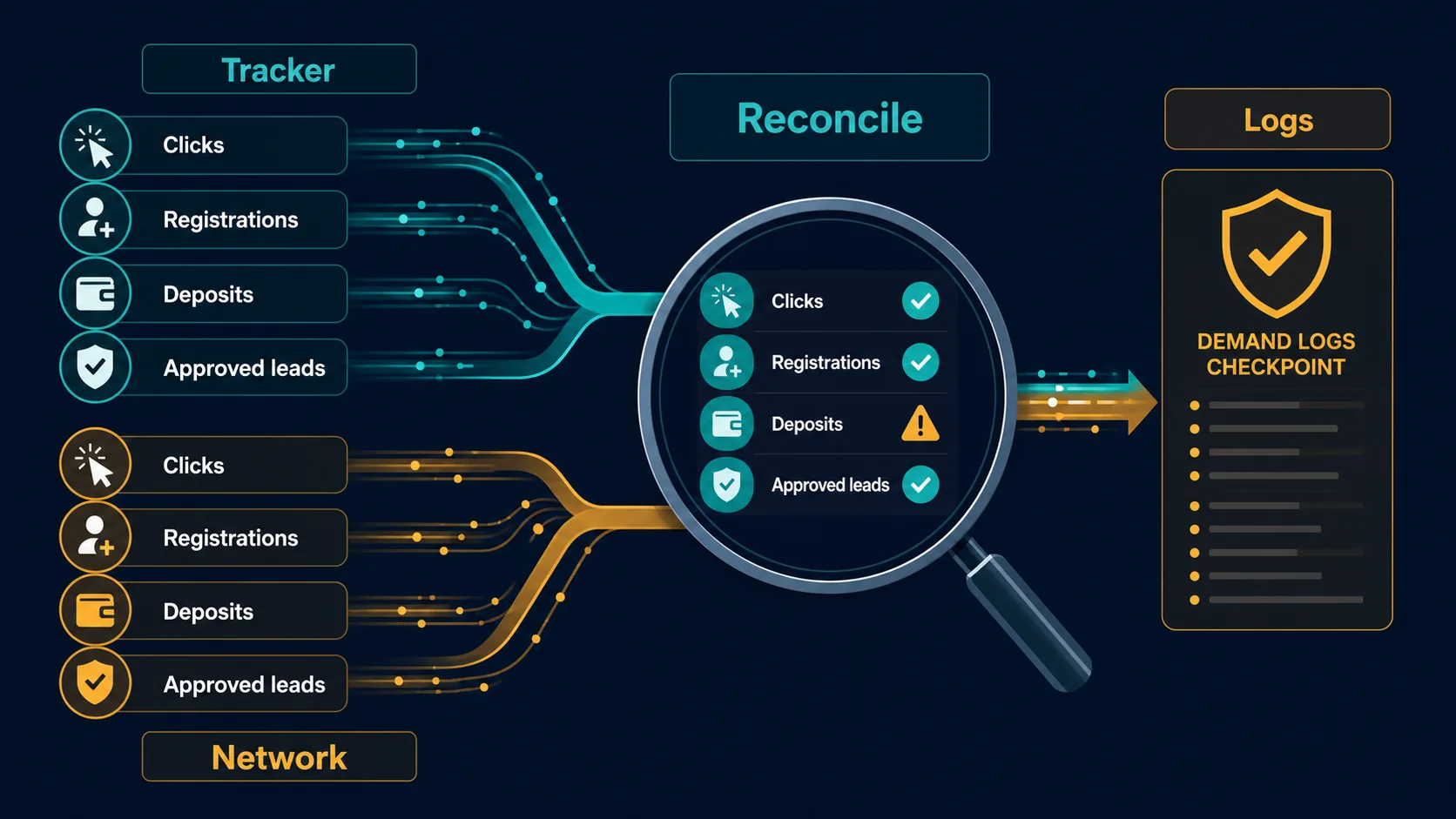
How to detect shaved affiliate leads with a three-system comparison
Compare the same cohort
Fix the date range, time zone, currency, product and source before comparing numbers. A report for calendar days in UTC can differ from a dashboard using Prague time or a rolling 24-hour window. Use a cohort identifier and record when each extract was taken.
Join records on stable identifiers
Use click IDs, conversion IDs, player pseudonyms or transaction references where permitted. Do not join only on a name, amount or date. If the network masks identifiers, ask what reconciliation key is available and how it maps to the source record.
Demand logs that answer a question
“Send the logs” is too broad. Ask for the request timestamp, callback URL or event type, status, rejection reason, rule version and adjustment history for the disputed IDs. Redaction is reasonable, but the remaining fields must allow the event to be traced.
A practical discrepancy calculation
Discrepancy rate = (source-qualified leads − network-approved leads) ÷ source-qualified leads × 100
For an illustrative cohort of 80 source-qualified leads and 72 network-approved leads, the discrepancy rate is (80 − 72) ÷ 80 × 100 = 10%. This is a diagnostic measure, not proof of shaving or an industry benchmark. Segment it by source and rejection reason before drawing a conclusion.
Investigation checklist
- Freeze the cohort and export both reports.
- Normalize date, time zone, currency and status values.
- Match stable click and conversion identifiers.
- Separate pending, rejected, reversed and missing events.
- Request rule definitions and relevant logs.
- Document the answer, owner and adjustment deadline.
Operator pro-tip: Keep a discrepancy register with one row per disputed event. A recurring implementation problem we encounter is that teams debate totals without preserving the IDs that would settle the debate.
Bottom line
To detect shaved affiliate leads responsibly, compare like-for-like cohorts across your tracker, network and operator systems. Use evidence to distinguish intentional under-reporting from ordinary attribution, qualification and timing differences.
Our platform helps teams bring partner, campaign and player-lifecycle records into one operational view. See the AI-powered CRM for iGaming.