
Key Takeaways
- Cross-device tracking should join events with a permitted, stable identity handoff rather than guess from browser fingerprints.
- Record the mobile click before the user moves to desktop.
- Require login or another first-party event when the commercial journey needs stronger matching.
- Document consent, retention and deletion behavior as part of the measurement design.
How to Set Up Cross-Device Tracking for iGaming Affiliate Traffic — Cross Device Tracking iGaming Affiliates
Cross-device tracking for iGaming affiliates connects a mobile affiliate click with a later desktop registration or deposit. The useful implementation is not a hidden attempt to follow every device; it is a consent-aware event model that joins known actions when the operator has a lawful and operational reason to do so.
A recurring implementation problem we encounter is that teams compare a mobile click report with a desktop deposit report without a shared key. The result is either under-attribution or an overconfident match based on weak signals such as IP address, timing or browser characteristics.
Key Definition: Cross-device attribution is the controlled matching of events from more than one device to an approved user, session or transaction identity.
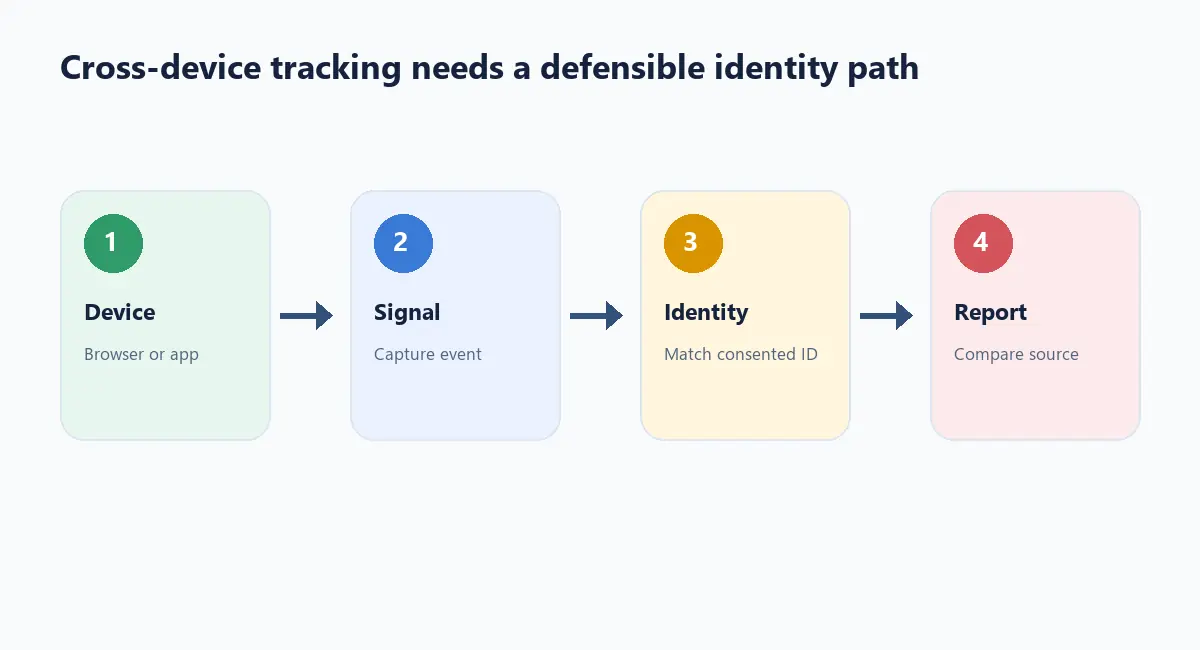
How operators apply cross device tracking igaming affiliates in iGaming
Cross-device tracking workflow
| Stage | Preferred signal | Weak signal to avoid as proof |
|---|---|---|
| Mobile click | Server-side click ID and campaign source. | Unstable browser fingerprint. |
| Identity handoff | Consent-aware login or first-party token. | Shared IP address alone. |
| Desktop event | Registration, deposit or transaction event. | Time proximity alone. |
| Attribution decision | Documented match rule and confidence state. | Forced last-click replacement. |
How to implement the handoff
- Capture the mobile affiliate click and store the source context server-side.
- Present the user with the permitted account or consent path.
- When the user authenticates, join the session to a pseudonymous first-party identity.
- Carry the identity into desktop events without exposing unnecessary personal data.
- Apply a clear attribution window and preserve the original click timestamp.
- Send the approved conversion to the network and record the match reason.
Privacy note: Do not treat cross-device tracking as permission to collect every available identifier. Define the purpose, minimize fields, document retention and support deletion or correction workflows.
Illustrative match-rate calculation
If 300 mobile clicks produce 90 account logins and 24 desktop deposits, the login-to-deposit rate is 24 ÷ 90 × 100 = 26.7%. That figure describes the illustrative matched cohort; it is not a benchmark for every operator. Keep unmatched deposits visible so the team can investigate rather than silently assigning them to another source.
Failure scenarios
Users can switch browsers, decline consent, clear storage, use an app and web account with different identifiers, or complete a deposit after the attribution window. Treat these as explicit states: matched, unmatched, consent-limited, expired or under review. We typically advise teams to report confidence alongside attribution.
Bottom line
Cross-device tracking for iGaming affiliates should be built around first-party events, explicit consent and documented matching rules. A transparent unmatched bucket is healthier than a dashboard that claims certainty from weak signals.
Our platform helps operators connect campaign and lifecycle data with the controls needed for review. See the AI-powered CRM for iGaming.