
Quick Answer
iGaming affiliate deep linking sends a user to a specific game, lobby or offer instead of a generic home page. Use a signed or controlled routing layer, preserve attribution parameters, and provide a web fallback when the app is unavailable.
Deep Linking in iGaming: How to Send Users Directly to Specific Games — iGaming Affiliate Deep Linking
iGaming affiliate deep linking is the practice of sending a user from an affiliate placement directly to a relevant game, sports market, live casino table or promotional landing page. The destination can be inside a mobile app or on the web. When it is implemented well, the user reaches the intended experience with fewer navigation steps and the affiliate click remains attributable.
Deep links are not only a conversion tactic. They are a routing system with edge cases: the app may not be installed, the game may be unavailable in the user’s market, the promotion may have expired, or consent may limit the parameters that can be retained.
Key Definition: An iGaming affiliate deep link is a tracked link that resolves to a specific in-app or web destination while preserving the routing and attribution context allowed by the operator’s controls.
How iGaming affiliate deep linking works
A publisher link first reaches a tracking or routing endpoint. The endpoint validates campaign and market information, then chooses an app destination when possible or a web fallback when necessary. The destination should receive only the parameters it needs; the server should keep the authoritative click record.
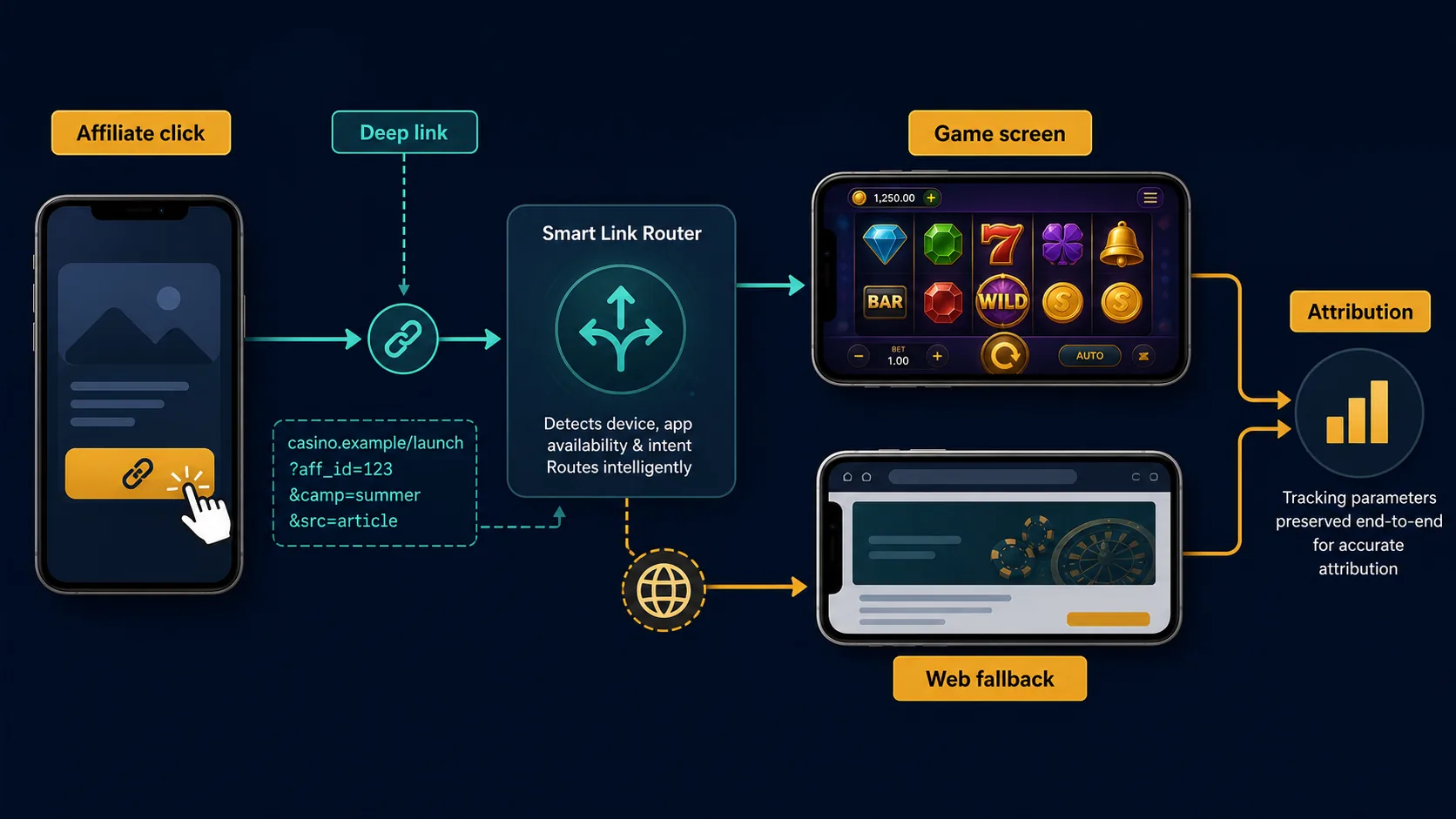
| Layer | Decision | Failure fallback |
|---|---|---|
| Click router | Is the source, market and campaign valid? | Safe landing page. |
| App resolver | Is the app installed and the destination supported? | Store page or web route. |
| Game destination | Is the game live, licensed and available? | Relevant lobby, not a dead link. |
| Attribution | Can the click context be retained lawfully? | First-party event with limited fields. |
Design rules for a reliable deep link
- Use a stable canonical identifier for the offer and destination.
- Do not hard-code a game that can be removed or restricted without a fallback.
- Validate country, device, app version and campaign status at request time.
- Keep tracking parameters separate from user-facing destination parameters.
- Test cold install, warm app, desktop web, expired offer and blocked market paths.
Implementation note: A deep link should fail gracefully. Sending a user to a blank screen because a game slug changed creates both a poor experience and a misleading attribution result.
Illustrative routing calculation
Suppose 1,000 affiliate clicks reach a router. Six hundred resolve to the app, 250 use the web fallback and 150 are rejected for market or campaign reasons. The routing completion rate is (600 + 250) ÷ 1,000 × 100 = 85%. This is an illustrative diagnostic, not a benchmark. Segment it by device and source before changing the link strategy.
Operational edge cases
App-store redirects can remove query parameters. A user can install the app hours after clicking. A game can be unavailable after a regulatory change. A user may open an affiliate link on a desktop and complete the deposit on mobile. We typically advise teams to store the click server-side and pass a controlled handoff token rather than relying on every client to retain the entire query string.
Bottom line
iGaming affiliate deep linking works when routing, destination availability, fallback behavior and attribution are designed together. The best link is not the shortest one; it is the one that still gives the user a useful destination when the ideal app path cannot be used.
Our platform helps teams connect campaign context with player journeys. Learn more about the AI-powered CRM for iGaming.