Last Updated on September 29, 2026 by Caesar Fikson
Quick answer
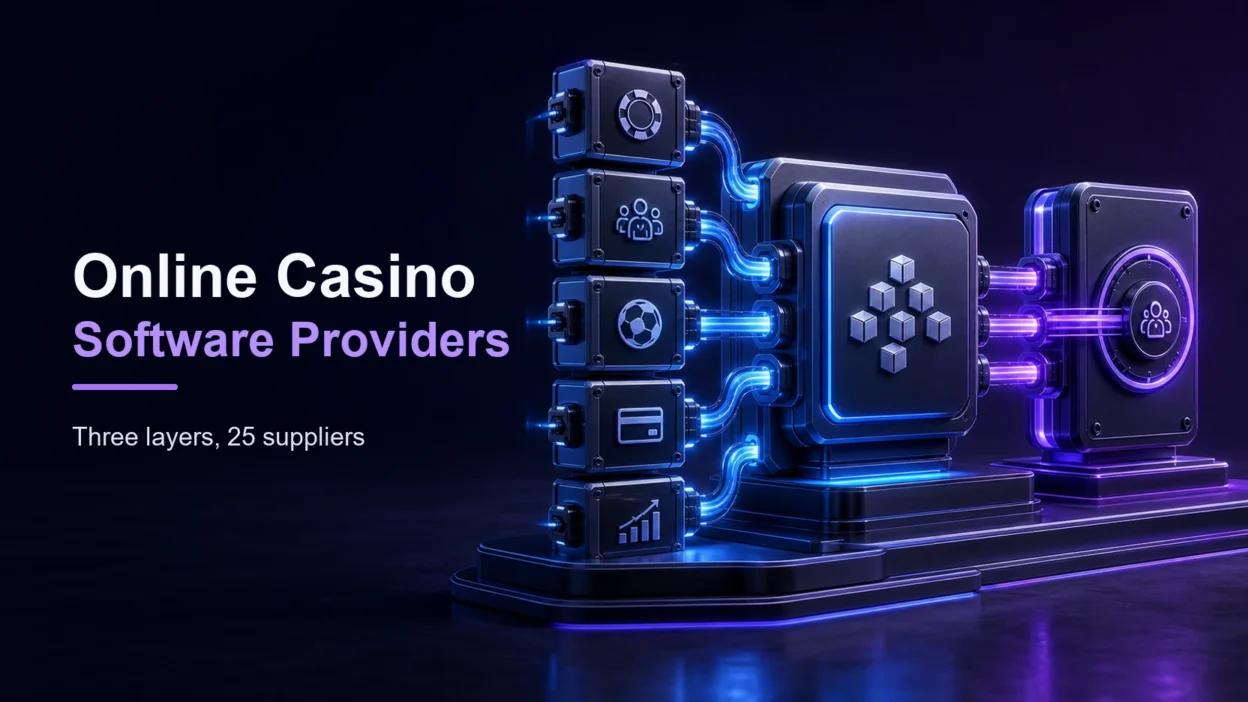
Online casino software provider describes three different businesses that are constantly listed together as if they compete: game studios that build the content, aggregators that distribute thousands of games through one integration, and platform providers that supply the casino system itself. You will almost certainly need all three, and they are bought on different commercial terms. Decide which layer you are procuring before you shortlist anyone, because a studio and a platform cannot be compared on the same criteria.
There is a problem with every ranked list of casino software providers on the open web, and it is worth naming before you read another one.
They are written by providers. The most widely cited list of the top fifteen online casino software providers places its own publisher at number one and its development partner at number two, ahead of Evolution, Pragmatic Play and NetEnt. That is not unusual. It is close to the norm in this category, and it is why the same handful of names appear in wildly different orders depending on whose blog you are reading.
NowG has no stake in this particular question. We sell a player CRM to operators; we do not build games, aggregate content or license platforms, and we take nothing from any company named on this page. That means we can say the unhelpful but accurate thing: there is no top provider, there are three procurement decisions, and the right answer depends on your licence, your market and your traffic.
The three layers people keep conflating
| Layer | What it supplies | Typical commercial model | Signal you are talking to the wrong one |
|---|---|---|---|
| Game studio | The games themselves. RNG slots, table games, crash titles | Revenue share on GGR generated by their content | They cannot answer questions about wallets, bonusing or player accounts |
| Aggregator | One integration giving access to many studios | A cut of the content revenue share, layered on the studio’s | They will not commit to roadmap or exclusivity on any single game |
| Platform provider | The casino itself. Wallet, accounts, bonusing, reporting, payments orchestration | Revenue share on NGR, or fixed monthly fee, plus setup | They talk about uptime and compliance but own no game content |
The reason this matters commercially: content revenue share stacks. If you reach a studio through an aggregator, the studio takes its share and the aggregator takes a cut on top. Going direct to a studio removes that layer but costs you an integration project and ongoing certification work per jurisdiction. Nobody goes direct to fifty studios, and nobody should reach their top five performers exclusively through an aggregator.
Game studios worth knowing
Grouped by what they are actually good at rather than ranked, because a studio that is essential for a Scandinavian audience may be irrelevant in Latin America.
The majors
- Evolution. Dominant in live casino and, through acquisition, a very large share of RNG content too. Evolution owns NetEnt and Red Tiger, acquired in 2020, plus Big Time Gaming, Nolimit City and Ezugi. When people say the market is concentrated, this is what they mean.
- Pragmatic Play. Enormous release cadence across slots, live casino, bingo and crash. Ubiquitous in emerging markets and strong on promotional tooling such as network tournaments.
- Play’n GO. Slot-focused, high release volume, exceptionally strong recognition in regulated European markets.
- Playtech. Both a studio and a platform, which is part of why category confusion persists. Owns Quickspin. Strong in regulated markets and enterprise deals.
- Games Global. The former Microgaming games business, separated in 2022. Large back catalogue including long-running progressive jackpot networks.
- NetEnt and Red Tiger. Still distinct brands with distinct catalogues, now under Evolution. Worth listing separately because operators shortlist them separately.
High-volatility and boutique studios
Smaller catalogues, disproportionate influence on player acquisition in slot-literate markets. These are the names streamers and forum communities actually discuss.
- Nolimit City — extreme volatility and distinctive mechanics; now Evolution-owned.
- Hacksaw Gaming — fast, mobile-first slots and scratch titles with strong community pull.
- Push Gaming — polished mechanics, consistent performer in regulated Europe.
- Relax Gaming — a studio and an aggregation route in one, via its partner programme.
- Big Time Gaming — originated the Megaways mechanic, which is licensed widely across other studios.
- Print Studios, Peter & Sons, ELK Studios, Thunderkick, Quickspin, Blueprint Gaming — smaller catalogues, loyal followings, useful for differentiating a lobby that otherwise looks like every competitor’s.
Crypto-native, crash and emerging-market studios
- Spribe — Aviator made crash a category rather than a curiosity, and it remains a major acquisition driver in several markets.
- BGaming — crypto-friendly, provably fair options, widely integrated on crypto-first platforms.
- Playson, Wazdan, Amusnet, Endorphina, Habanero, 3 Oaks Gaming, Betsoft — strong regional footprints, particularly across CEE, LatAm and Asia.
Pro tip
Before signing any content deal, ask which of the studio’s titles are certified for your specific licence. A studio can have four hundred games and thirty approved for your jurisdiction. Certification is per market and per title, and the gap between catalogue size and available catalogue is the number that actually affects your lobby.
Aggregators
One integration, thousands of games, a single reconciliation process. For most operators below enterprise scale this is the only sane way to build a lobby.
- SoftSwiss Game Aggregator — very large catalogue, strong crypto support.
- Slotegrator APIgrator — long-established, broad studio coverage, popular with newer operators.
- EveryMatrix CasinoEngine — enterprise-grade, heavily used in regulated markets.
- Pariplay Fusion — aggregation plus its own content and promotional tools.
- Relax Gaming Silver Bullet — curated rather than exhaustive, which some operators prefer.
Three questions decide an aggregator, and none of them is catalogue size. Does it carry your top ten revenue-generating studios. Does it support your jurisdictions and certification requirements. And does it pass through the game-level data your CRM needs, which is covered below and is the one operators discover too late.
Platform providers
The casino system: player accounts, wallet, bonus engine, payments orchestration, reporting, responsible gambling controls and regulatory reporting. Names that recur on credible shortlists include SoftSwiss, EveryMatrix, BetConstruct, Digitain, Delasport, GR8 Tech, Aspire Global, White Hat Gaming, Soft2Bet and ProgressPlay.
Several of these also sell white label and turnkey packages, which is a different commercial arrangement rather than a different technology. That distinction is set out in our guide to what a white label casino is, and the providers themselves are compared in casino white label solution providers.
The commercial terms nobody publishes
This is the section missing from every list we reviewed. Providers do not publish pricing, and the ranges below are the structures you will be negotiating within rather than quotes. Treat them as a way to tell whether a proposal is normal, not as a price list.
| What you are buying | Usual basis | Also expect | The clause that bites |
|---|---|---|---|
| Game content, direct from a studio | Percentage of GGR from that studio’s games | Integration effort on your side | Minimum monthly guarantee regardless of performance |
| Game content, via an aggregator | Studio share plus the aggregator’s margin on top | One integration, one invoice | Lower effective margin per spin, permanently |
| Platform, revenue share model | Percentage of NGR | Setup fee and monthly minimum | How NGR is defined. Bonus cost deductibility is the argument |
| Platform, SaaS model | Fixed monthly licence | Setup, plus fees per module | Modules you assumed were included |
| White label | Revenue share, typically the highest band | Lowest setup cost and fastest launch | You are on their licence. Exit is hard and the player database may not be yours |
| Turnkey | Lower revenue share | Significant setup fee, your own licence | Longer launch, and licensing is your problem |
Watch out
Get the definition of net gaming revenue written into the contract in numbers, not adjectives. Whether bonus costs, jackpot contributions, payment processing fees and gaming duty are deducted before your revenue share is calculated can move the effective rate by several points. Two providers quoting the same percentage against different NGR definitions are not quoting the same price, and this is the single most common source of disputes in year two.
Integration questions to ask in writing
Two technical decisions shape everything downstream, and both are easy to get wrong when you are focused on catalogue size.
- Seamless wallet or transfer wallet. Seamless keeps a single balance and calls your wallet for every bet and win, which is what players expect and what makes cross-product bonusing possible. Transfer wallet moves funds into a provider sub-wallet, which is simpler to build and produces the experience where a player has money in three places and cannot find it.
- What arrives in the data feed. Ask specifically whether you receive per-round data with game ID, stake, win, bonus flag and timestamp, or only aggregated session totals. This is the question that determines whether your CRM can act on behaviour or only report on it.
Ask for a sample payload before signing. You want to see, per round:

  round_id          unique, reconcilable against the provider's reporting
  player_id         your ID, not theirs
  game_id           specific title, not just studio
  stake / win       exact amounts, in currency, with timestamp
  bonus_flag        was this wagered with bonus funds or cash
  session_id        so rounds group into sessions

If the feed returns session totals only, every behavioural
model downstream degrades: churn prediction, bonus abuse
detection, game affinity and RG monitoring all lose resolution.
We have an obvious interest in operators having good data, so weigh that as you like. The technical point stands independently: a retention model built on session aggregates cannot distinguish a player working through a bonus from a player enjoying themselves, and those two need opposite treatment.
Licensing and certification
Provider choice is constrained by your licence before it is constrained by preference. A studio uncertified in your market cannot appear in your lobby regardless of how well it performs elsewhere.
| Jurisdiction | Regulator | Practical consequence for provider choice |
|---|---|---|
| United Kingdom | Gambling Commission | Strict supplier licensing. Narrower available catalogue, strict RG and advertising rules |
| Malta | Malta Gaming Authority | Broad provider support, widely recognised, common base for EU-facing operations |
| Ontario | AGCO, with iGaming Ontario | Suppliers must be registered separately. Several global studios are absent |
| Italy | ADM | Certification per title. Local technical requirements |
| Sweden | Spelinspektionen | Bonus restrictions materially change CRM and promotional design |
| Curacao | Curacao Gaming Authority | Reformed regime replacing the old master-licence structure. Verify current status of any licence presented to you |
Independent testing houses such as GLI and BMM Testlabs certify RNG behaviour and game fairness. Ask for current certificates covering your jurisdictions, with dates. Certificates expire, and a provider deck showing a certificate from three years ago is telling you something.
How to actually shortlist
- Fix the layer. Platform, aggregator or studio. Never evaluate across layers.
- Filter by jurisdiction first. This removes more candidates than any other criterion and removes them absolutely.
- Ask for the certified catalogue for your market, not the global one.
- Request a sample data payload. Five minutes of reading tells you more than a two-hour demo.
- Get the revenue definition in writing, with a worked example on your own projected numbers.
- Ask what exit looks like. Notice period, data portability, whether the player database leaves with you. Ask on the way in, because on the way out you have no leverage.
If live dealer is a significant part of your product, the supplier landscape there is concentrated differently and is covered in live dealer casino software providers. For crypto-first operations, crypto casino platform providers covers the platforms built for it.
Frequently asked questions
What is an online casino software provider?
The term covers three different businesses. Game studios build the content, aggregators distribute many studios through a single integration, and platform providers supply the casino system itself with wallet, accounts, bonusing and reporting. Most operators need all three, bought on different commercial terms, so the first step is deciding which layer you are procuring.
Should I integrate games directly or through an aggregator?
Both, in most cases. An aggregator gives one integration, one invoice and access to thousands of titles, which is the only practical route to a full lobby. Direct integrations remove the aggregator margin and make sense for your top few revenue-generating studios, where the saved percentage outweighs the integration and per-jurisdiction certification work.
What is the difference between white label and turnkey casino solutions?
White label means operating under the provider’s licence and brand infrastructure: fastest and cheapest to launch, highest revenue share, and least control, including over whether the player database is genuinely yours. Turnkey means you hold your own licence with the provider supplying technology: lower revenue share, higher setup cost, longer launch, far more control.
How is casino platform revenue share usually calculated?
As a percentage of net gaming revenue, but the definition of NGR is where the money actually is. Whether bonus costs, jackpot contributions, payment processing fees and gaming duty are deducted before the calculation can move the effective rate by several points. Insist on a numeric definition in the contract plus a worked example on your own projections.
Why do all the top casino software provider lists disagree?
Because most are published by providers who rank themselves at or near the top. One of the most widely cited top fifteen lists places its own publisher first and its development partner second, ahead of Evolution and Pragmatic Play. Check who owns the domain before weighting any ranking in this category.
What is the difference between a seamless wallet and a transfer wallet?
A seamless wallet keeps one player balance and calls your wallet for every bet and win, which is what players expect and what makes cross-product bonusing work. A transfer wallet moves funds into a provider sub-wallet, which is simpler to implement and creates the experience where a player has money in several places and cannot find it.
What data should a game provider feed pass through?
Per-round records containing round ID, your player ID, specific game ID, stake, win, a bonus-funds flag, timestamp and session ID. Ask for a sample payload before signing. If the feed only returns aggregated session totals, churn prediction, bonus abuse detection, game affinity modelling and responsible gambling monitoring all lose the resolution they need.
Does my licence limit which game providers I can use?
Yes, and it is the constraint that removes the most candidates. Certification is granted per jurisdiction and frequently per title, so a studio with four hundred games might have thirty approved for your market. Ask every provider for their certified catalogue in your specific jurisdiction, with current certificate dates, rather than their global catalogue.