
Last Updated on September 13, 2026 by Caesar Fikson
Affiliate programs account for a large share of customer acquisition in online gambling. That reality makes network selection a revenue, compliance, and reporting decision, not just a partner sourcing task.
A useful sportsbook affiliate network list should therefore rank more than offer volume. Operators need to compare market focus, commission flexibility, tracking accuracy, payment controls, and the ability to manage affiliates across several brands and jurisdictions without creating reporting gaps. Affiliates face a related problem. Visibility into clicks, FTDs, revenue share, and hold adjustments often varies by operator, which makes earnings harder to forecast.
That is why this analysis looks at strategic value for 2026 rather than treating networks as a simple directory. The strongest options increasingly combine partner access with audit trails, fraud monitoring, and reporting infrastructure that can support regulated sportsbook growth. For operators running mixed commercial terms, this also raises the importance of tools built for managing hybrid CPA and revshare affiliate models in one reporting workflow.
The practical question is not which network has the longest roster. It is which one helps operators acquire players efficiently while keeping attribution, compliance, and partner payments under control. Platforms such as iGamingXpert add another layer of value here by giving teams a way to integrate multiple affiliate channels into unified reporting, so network performance can be compared against the same operating metrics instead of being reviewed in separate dashboards.
1. Income Access Affiliate Network (Paysafe)
Income Access remains one of the most durable names on any serious sportsbook affiliate network list because it combines three things many networks separate. Tracking, network access, and managed services all sit under one operating model. That matters more in regulated sportsbook than in softer verticals because operators usually need disciplined partner onboarding and auditable payment workflows, not just a marketplace of offers.
For affiliates, the network is attractive because it supports multiple commercial models under one roof, including CPA, CPL or CPI, RevShare, and Hybrid. For operators, the bigger advantage is administrative compression. Instead of stitching together reporting, recruitment, and payment operations from several tools, they can work through a mature enterprise stack with centralized support.
Where it fits best
Income Access is strongest when an operator needs process certainty. North American and European sportsbook launches usually involve legal review, partner vetting, state or market constraints, and recurring commission logic that gets messy fast if the underlying platform is thin.
That’s also why it suits brands running mixed deal structures. If your program includes upfront CPA for media partners, longer-tail RevShare for content affiliates, and hybrids for strategic publishers, you need logic that doesn’t break as soon as contracts diverge. A dedicated layer for managing hybrid CPA and RevShare deals becomes critical once volume scales.
Practical rule: Income Access is a better fit for operators who need governance and service depth than for small teams looking for the lightest possible self-serve workflow.
A few strengths stand out:
- Broad vertical mix: Sports betting, casino, lottery, poker, and DFS support lets affiliates cross-sell audiences instead of rebuilding partner relationships from scratch.
- Centralized payments: Consolidated monthly payout handling reduces reconciliation effort for affiliates working with multiple programs.
- Regulated-market familiarity: Its long presence in licensed markets makes it easier to evaluate for operators that care about process maturity.
The main tradeoff is flexibility at the commercial layer. Public pricing for advertisers isn’t posted, and the interface tends to feel enterprise-heavy. Smaller publishers can find that reassuring or cumbersome, depending on whether they value control or simplicity more.
For 2026, Income Access isn’t the flashiest option. It’s one of the safest picks when you want durability, controls, and a network that’s built for sportsbook programs expected to survive compliance scrutiny.
2. AffiliationCloud (Raketech)
AffiliationCloud sits in a useful middle ground between platform and network. Backed by Raketech, it gives operators access to a premium publisher marketplace while reducing some of the operational friction that usually appears when affiliate programs sprawl across multiple contracts, dashboards, and payment systems.
That positioning has strategic value in sportsbook. A lot of operator teams don’t struggle to find affiliates. They struggle to monitor them consistently, align commercial terms, and keep reporting coherent across geographies. AffiliationCloud is built around that pain point, with centralized reporting, payment monitoring, publisher vetting, and negotiated operator deals inside one commercial environment.
Why operators use it
Its strongest case is brand safety plus simplification. Raketech handles compliance and KYC across the publisher side, which reduces some of the manual review burden for operators that want incremental reach without opening the door to unmanaged traffic sources.
The technology angle also matters. Integrated affiliate platforms in high-commission verticals like iGaming show a 25% boost in conversion rates compared with non-integrated setups, according to WeCanTrack’s affiliate integration statistics. That doesn’t prove any single network will deliver the same lift on its own, but it does support the broader case for consolidated tracking and faster optimization cycles.
For affiliates, the value proposition is different. A publisher working with several brands often loses time to fragmented payout schedules and uneven reporting logic. AffiliationCloud’s centralized structure reduces that fragmentation.
- Publisher marketplace: Access to vetted publishers is useful for operators that care more about quality control than open enrollment.
- Negotiated deals: Exclusive arrangements can improve commercial terms beyond standard public programs.
- Unified analytics: A cleaner view of performance helps both sides spot where a sportsbook offer converts by GEO, audience, and traffic type.
Closed networks often outperform open directories in regulated betting because curation removes some of the traffic quality risk before campaigns even go live.
The limitation is access. AffiliationCloud is curated, not fully open. That means some operators won’t be the right fit by geography or volume, and publishers should verify availability market by market. Its commercial footprint has been more Europe-led, so U.S. teams need to validate state-level practicality rather than assuming blanket suitability.
As an analyst pick, AffiliationCloud stands out less for headline commissions and more for reducing network sprawl. If you want fewer moving parts without giving up premium publisher access, it belongs near the top tier.
3. Gambling Affiliation
Gambling Affiliation is one of the more traditional entries on this sportsbook affiliate network list, and that’s not a criticism. In a market obsessed with newer interfaces, older networks sometimes still win on breadth. This one has operated since 2005 and presents a multi-brand marketplace approach that appeals to affiliates running several GEOs at once.
Its portfolio is the core reason it stays relevant. The network offers 350+ campaigns and 125+ brands across sportsbook, casino, poker, and horse racing, with a single account handling links, statistics, and payments. That setup suits affiliates who value optionality and don’t want to maintain separate logins across dozens of direct programs.
Best use case
Gambling Affiliation works best for affiliates managing broad European or Latin American traffic where offer testing matters more than deep exclusivity. The network supports CPA, RevShare, and Hybrid structures, plus centralized support and twice-monthly payouts. That’s a practical combination for affiliates rotating traffic between brands while keeping reporting under one roof.
A second advantage is operational continuity. When a portfolio spans multiple commission models, the challenge isn’t just sending traffic. It’s accurately reconciling what each player cohort generated and whether NGR-based payments map to the deal terms you agreed. Tools built around automated NGR commission calculation for iGaming affiliates become especially valuable when a network account contains many offers with different economics.
Here’s where Gambling Affiliation feels strongest:
- Campaign breadth: A large marketplace helps affiliates test sportsbook offers without renegotiating every relationship from zero.
- Mixed traffic acceptance: SEO, PPC, and social affiliates can all find room inside the network model.
- Dedicated account support: Traditional account management still matters when you’re entering new markets or troubleshooting payment logic.
Its main weakness is that the experience feels more classic than modern. Some affiliates like that because it’s familiar. Others will find the UX behind newer network products cleaner and faster.
The U.S. side is also less compelling than its European strength. If your strategy is built around regulated U.S. sportsbook launches, other networks on this list are more specialized. If your priority is broad offer access under one account, Gambling Affiliation remains a practical workhorse.
4. Touchdown Traffic
Touchdown Traffic is one of the clearest U.S.-specific picks in this group. Its value comes from focus. Rather than trying to be a giant cross-vertical marketplace, it positions itself around regulated U.S. sportsbook and adjacent sports audiences, connecting advertisers with premium publishers and creators.
That narrower scope is useful in 2026 because U.S. sportsbook affiliate strategy isn’t just a media buying problem. It’s a market-access and compliance problem. Networks that understand brand restrictions, state-by-state realities, and sports-adjacent inventory tend to create less downstream friction than broad affiliate directories.
Strategic edge in regulated U.S. markets
Touchdown Traffic lists recognizable regulated advertisers, including FanDuel, Caesars, BetMGM, and bet365, alongside DFS, lottery, streaming, and ticketing categories. For affiliates or media brands with sports audiences, that adjacency matters. It allows monetization paths that don’t rely on sportsbook offers alone, which can help preserve revenue when state availability changes or campaign windows tighten.
Fraud control is another reason this model matters. In iGaming, AI-driven fraud detection at the network level reduced invalid affiliate traffic from 11.2% of clicks in 2024 to 7.7% in 2026, according to Digital Applied’s affiliate marketing statistics for 2026. U.S.-regulated sportsbook programs have a strong incentive to push toward the same kind of server-to-server attribution and real-time filtering. If they don’t, paid conversions can get polluted before the operator catches the issue.
That’s why operator teams evaluating Touchdown Traffic should look beyond publisher logos and ask how the network handles affiliate conversion fraud prevention with AI in iGaming. In regulated sportsbook, fraud tooling protects both commission accuracy and licensing posture.
- U.S. brand relevance: The network is built for operators and publishers targeting American sports bettors.
- Creator-friendly setup: It’s useful for sports creators who monetize through content, not only traditional review sites.
- Adjacency inventory: DFS, ticketing, and streaming relationships can create wider commercial flexibility.
The tradeoff is selectivity. Smaller affiliates may not get immediate access, and public commission details aren’t posted. That makes Touchdown Traffic less transparent for comparison shopping, but potentially more effective for publishers that already have high-quality U.S. sports audiences and want direct access to recognizable regulated brands.
5. Vault Network
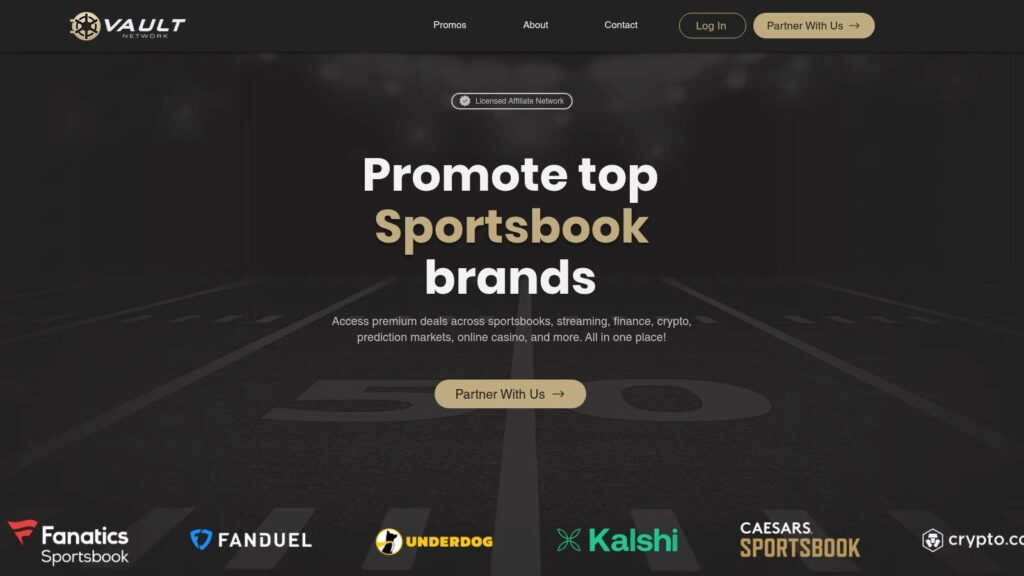
Vault Network stands out because it’s built for the current shape of sportsbook traffic, not the old one. A lot of affiliate infrastructure still assumes websites come first and creator channels are secondary. Vault leans in the opposite direction. It supports both websites and social creators through a centralized dashboard with links, creatives, and real-time stats.
Its product-market fit is strongest in regulated U.S. sportsbook and DFS. The network positions itself as licensed and creator-integrated, with access to 40+ premium brand partnerships and a mix of CPA and Hybrid structures. That’s a meaningful distinction if your traffic comes from sports content creators, communities, or social-led publishing rather than long-form SEO alone.
Who should prioritize Vault
Mid-sized publishers and creators benefit most from Vault because it reduces onboarding friction to multiple brands. A creator who would otherwise need separate discussions, approvals, and reporting environments can manage campaigns through one network relationship instead.
The economics also line up with broader industry benchmarks. Top-tier sportsbook affiliate programs in 2026 typically offer RevShare from 25% to 45% of NGR, with elite programs reaching 50%, while CPA deals for qualified depositing users fall between $50 and $500 per player, according to AffCaptain’s betting affiliate network overview. Vault doesn’t publish a universal static card across all brand partnerships, but those ranges are the right benchmark for judging whether an offered deal is competitive.
A few practical evaluation points matter here:
- Social-native support: Vault is more useful than many legacy networks for influencers and creator-led acquisition.
- Real-time visibility: Affiliates need quick feedback loops when they’re testing creative angles across social channels.
- Hybrid flexibility: That structure can be attractive when a partner wants both upfront cash flow and retained upside.
A network that’s easy for creators to use often expands inventory quality, because strong sports creators won’t tolerate clumsy onboarding or delayed reporting.
The downside is variance. Public brand lists and rates can rotate, and state availability has to be verified carefully. Vault is also younger than some enterprise incumbents, so buyers should assess depth by GEO and by vertical instead of assuming equal strength across every category.
Still, if your sportsbook affiliate strategy depends on creators as much as conventional affiliate sites, Vault earns its place near the top of the 2026 field.
6. Spotlight Sports Group Betting Affiliate Network
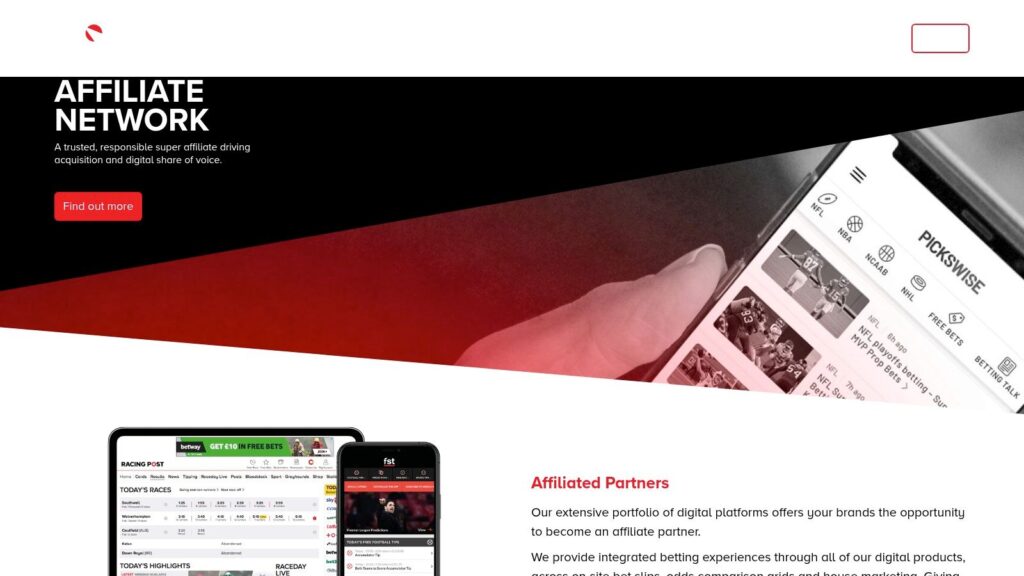
Spotlight Sports Group is different from most names on this list because it isn’t primarily selling access to an open affiliate marketplace. It operates more like a media-powered acquisition engine built around owned audiences, editorial products, and integrated betting experiences.
That distinction matters. Operators that work with Spotlight aren’t just buying traffic partnerships. They’re buying placement inside sports media environments where intent is already high. Embedded bet slips, odds grids, editorial content, email distribution, and social channels create a conversion path that can feel closer to product distribution than classic affiliate referral.
Why this model converts differently
Spotlight’s strength comes from context. The user isn’t arriving from a generic promotional unit. The user is often already consuming racing or sports content, comparing prices, or evaluating an event. That alignment can improve the quality of referred traffic, especially for sportsbook brands that care about serious bettor segments rather than only volume.
This also ties into a larger weakness in many network roundups. Too many list articles name brands but don’t explain how affiliates should match offers to GEO-specific sports preferences and local payment options. That gap is highlighted in RichAds’ guide to sports betting offers and push traffic, which notes that local sports interest and payment fit are decisive conversion factors. Spotlight’s media-led model naturally handles some of that problem better because content and audience intent are already segmented by sport and market.
For operator teams, the practical advantages are clear:
- First-party reach: Exposure through owned media and house channels can produce cleaner acquisition pathways.
- Editorial context: Content-led conversion usually beats generic placement when bettors are comparing odds or researching events.
- Multi-market capability: It’s suited to brands operating across GB&I, the U.S., and selected international markets.
The limitations are just as clear. Spotlight isn’t a lightweight self-serve network for small affiliates. Commercial terms are usually bespoke, and access tends to favor established operator relationships over open-market experimentation.
If your goal is pure marketplace breadth, this isn’t the first pick. If your goal is premium sportsbook acquisition through trusted media properties, it’s one of the most strategically differentiated options on the board.
7. Imperial Deal
Imperial Deal has a narrower strategic role than the larger affiliate networks in this list, and that is precisely why it can add value in 2026. For operators focused on European sportsbook acquisition, a smaller network with regional concentration can be easier to test, monitor, and align with local compliance rules than a broad marketplace built for every GEO at once.
Its core proposition is operational simplicity. Imperial Deal gives affiliates access to multiple brands through one account, along with standard campaign assets and tracking. That matters less for raw scale than for execution. In fragmented European markets, the hard part is often not finding offers. It is keeping campaign setup, creative approvals, and reporting manageable across countries with different language, bonus, and advertising requirements.
For operator teams, Imperial Deal fits best as a supplemental channel rather than a primary acquisition engine. A brand already working with direct affiliates or enterprise networks can use it to test new European pockets without expanding internal affiliate management headcount too quickly. That makes it relevant to the broader 2026 shift toward tighter channel governance, where operators want growth but also cleaner partner oversight and clearer reporting inputs for platforms such as iGamingXpert.
The practical strengths are specific:
- European market fit: Better suited to operators and affiliates targeting regulated EU sportsbook demand than U.S.-first campaigns.
- Multi-brand access: One login and account structure can reduce admin work for affiliates comparing several offers.
- Hands-on support: Guided campaign management may help smaller affiliates improve setup quality and promotional compliance.
The tradeoff is transparency. Public information on live sportsbook inventory, commission ranges, and underlying technology is thinner than at the best-known networks. That increases the importance of due diligence, especially for operators that need consistent postback accuracy, sub-ID visibility, and reconciliation data for unified reporting.
Imperial Deal is not the strongest option for affiliates who want maximum scale or highly documented self-serve tooling. It is more useful for teams that value regional specialization, account support, and a controlled way to add European sportsbook exposure into a broader affiliate mix.
Top 7 Sportsbook Affiliate Networks Comparison
| Network | Implementation complexity 🔄 | Resource requirements ⚡ | Expected outcomes 📊 | Ideal use cases 💡 | Key advantages ⭐ |
|---|---|---|---|---|---|
| Income Access Affiliate Network (Paysafe) | Enterprise-grade setup; moderate-to-high configuration and program management | Dedicated AM, integration and reconciliation resources | Strong regulated-market reach with stable conversions and consolidated payouts | Launching regulated sportsbook/casino programs across NA/EU with full-service needs | Mature tracking, centralized payouts, experienced program management |
| AffiliationCloud (Raketech) | Medium; API/postback integration for real-time analytics | Requires analytics/KYC coordination; curated access may need scale | High-quality vetted publisher traffic and predictive insights; reduced admin | Operators seeking premium publishers and consolidated reporting | Publisher vetting, real-time insights, faster payments |
| Gambling Affiliation | Low-to-medium; standard network onboarding and single-account management | Minimal tech overhead; benefits from AM support for multi-GEO | Broad campaign availability (EU/LATAM) and steady publisher supply | Affiliates/publishers targeting EU and LATAM multi-campaigns | Large campaign catalog, twice-monthly payouts, dedicated AM |
| Touchdown Traffic | Medium; network-managed onboarding with GEO/state segmentation | Needs state-by-state tracking and compliance oversight | Targeted U.S. sportsbook traffic with premium publisher placements | U.S.-focused operators and creators targeting regulated sportsbook audiences | U.S.-centric brand partners and creator-focused inventory |
| Vault Network | Low-to-medium; turnkey creator integrations and dashboard | Light integration for creators and mid-size publishers | Quick access to multiple brands; practical social-driven conversions | Sports creators and mid-size publishers seeking fast onboarding | Central dashboard, creator integrations, faster onboarding |
| Spotlight Sports Group – Betting Affiliate Network | High; bespoke media integrations and custom commercial setups | Significant editorial/product collaboration and custom deal management | High-intent, first-party traffic with strong engagement and conversion lift | Operators wanting media-led acquisition and embedded betting experiences | Media-owned audiences, integrated betting UX, editorial conversion support |
| Imperial Deal | Low-to-medium; established EU-focused onboarding and creatives | Standard tracking/creative support; multi-brand coordination for EU | Compliant EU traffic and multi-brand campaign reach across markets | Operators expanding across European markets needing regulated promotions | Longstanding EU focus, multi-brand access, hands-on optimization support |
Unify Your Channels for Maximum Growth
More operators now split affiliate acquisition across multiple partner types than rely on a single channel. That shift changes how a sportsbook affiliate network list should be used. The practical question for 2026 is not which network pays the highest headline rate. It is which mix of networks produces scalable, compliant acquisition with reporting that finance, compliance, and affiliate teams can reconcile.
The seven networks above serve different strategic roles. Income Access supports enterprise control and broad program management. AffiliationCloud adds scale through a large partner base and Raketech distribution. Gambling Affiliation and Imperial Deal suit operators that want established European traffic sources. Touchdown Traffic and Vault Network are better aligned with creator-led and U.S.-oriented acquisition. Spotlight Sports Group stands apart because the value comes from media context and first-party audience intent, not just affiliate volume.
High advertised CPA or RevShare rates can still underperform if attribution is weak, approval workflows are slow, or market-level compliance checks sit outside the tracking stack. The commercial gap between a strong network and a strong network strategy is usually found in operations. Teams that combine several channel types often struggle with duplicate partner records, inconsistent commission rules, and fragmented reporting across brands, states, and GEOs.
Unification becomes critical at this stage.
BettingUSA’s analysis of sportsbook affiliates highlights a related issue in the U.S. Many publishers still need clearer guidance on how to operate around state restrictions, especially in jurisdictions without live betting. That creates a real screening and reporting problem for operators. A partner that is valuable in a pre-launch state may need education-led content, email capture, and delayed monetization logic rather than direct promotional workflows. Operators need systems that can distinguish those cases instead of treating every affiliate source the same way.
In 2026, the advantage will come from coordination. The operators that perform best will not rely solely on joining more networks. They will connect the right networks, apply market-specific controls, and manage every partner through one system of record.