
Last Updated on September 13, 2026 by Caesar Fikson
Scaleo’s 2026 fit score reached 91%, ahead of Everflow’s 81% in comparative benchmarking focused on partner marketing platforms in the iGaming sector (Crozdesk comparison data).
That gap matters because regulated operators don’t buy affiliate software for prettier dashboards. They buy it to control margin, prove compliance, manage hybrid deals, and stop low-quality traffic before it pollutes player value calculations.
That’s the right lens for Everflow vs Voluum vs iRev vs Scaleo. These tools overlap on tracking, but they’re built for different operating models. One is strongest for media buyers. One is strongest for traditional partner operations. One sits in a more legacy, niche position. One is increasingly aligned with how modern iGaming programs run.
Choosing Your iGaming Affiliate Platform for 2026
Most platform comparisons miss the core problem. An iGaming operator isn’t choosing a tracker in isolation. They’re choosing the operating system for partner acquisition, revenue attribution, fraud control, and payout logic across multiple brands, GEOs, and deal types.
That’s why the Everflow vs Voluum vs iRev vs Scaleo debate can’t be reduced to “which one tracks best.” In regulated iGaming, the better question is this: which platform preserves the most usable revenue after compliance overhead, fraud leakage, reporting friction, and partner admin time?
Three factors usually separate a good general platform from the right iGaming platform:
- Commission logic: CPA is only the start. Most serious programs need RevShare, hybrid structures, and sub-affiliate visibility.
- Compliance posture: Regulated markets punish weak auditability faster than they punish weak design.
- Optimization speed: Operators need to identify poor traffic, payout distortions, and high-value placements before the month-end close.
Voluum, Everflow, iRev, and Scaleo all enter that discussion from different angles. Voluum is associated with campaign-level optimization. Everflow is built around partner-network management. iRev still appears in operator shortlists because some teams prefer familiar workflows and established setups. Scaleo has been gaining ground because its structure maps more directly to affiliate-led iGaming growth.
Practical rule: If your team spends more time reconciling deals and traffic quality than negotiating better placements, the platform is already costing you margin.
The platforms below aren’t equal substitutes. They solve adjacent problems. For a regulated operator, that distinction decides whether your affiliate program scales cleanly or becomes an expensive reporting project.
The Four Main Contenders in Affiliate Tracking
Here’s the market at a glance before getting into the operational details.
| Platform | Core identity | Best fit | Main limitation for iGaming operators |
|---|---|---|---|
| Everflow | Partner marketing platform | Affiliate program managers and partner teams | Better for broad partner ops than deep regulated iGaming specialization |
| Voluum | Campaign-level ad tracker | Media buyers and paid traffic teams | Narrower fit for full affiliate network management |
| iRev | Traditional affiliate tracking option | Teams with legacy processes or niche requirements | Less visible as a modern benchmark winner in current comparison data |
| Scaleo | Affiliate platform with strong traction in iGaming | Operators needing partner management plus real-time tracking | Fraud depth can require scrutiny for advanced abuse patterns |

Everflow and Voluum solve different jobs
The most useful starting point is to stop treating Everflow and Voluum as direct twins. Voluum functions as a campaign-level ad tracker for media buyers with entry-tier pricing, while Everflow operates as a partner-network platform designed for affiliate program managers, pricing at approximately $750+/month (ClickerVolt comparison).
That split tells you a lot. Voluum is built around traffic shaping, campaign mechanics, and buyer-side optimization. Everflow is built around partner relationships, recurring revenue visibility, reporting structure, and operational reliability. If you’re evaluating broader ad tracker software, Voluum belongs in the conversation. If you’re running an operator-side affiliate program, it’s often too narrow on its own.
Where iRev sits
iRev doesn’t show up in the verified benchmark data with the same level of current comparative momentum. That doesn’t mean it’s unusable. It means the public evidence available here doesn’t put it at the front of the 2026 buying conversation for regulated iGaming.
In practice, iRev tends to stay relevant when a team has historical familiarity with it or wants continuity more than modernization. That’s a legitimate buying motive, but it usually reflects internal preference rather than category leadership.
Why Scaleo keeps appearing in iGaming shortlists
Scaleo shows up repeatedly in iGaming-oriented comparisons because it targets the operator side of affiliate management rather than just campaign optimization. Verified comparison material places it in iGaming, Forex, and lead-gen markets and frames it as a bridge between affordability and feature depth for operators that need sub-affiliate structures and modern reporting.
Scale matters less than fit. In iGaming, a platform that models partner economics correctly will outperform a more famous tool that was designed for a different workflow.
That’s why Scaleo’s role in this four-way comparison is different from Voluum’s. Voluum helps buyers fine-tune traffic. Scaleo is closer to what an operator needs when affiliates, commission plans, and network structure are the core growth engine.
Head-to-Head iGaming Feature Comparison
The fastest way to compare Everflow vs Voluum vs iRev vs Scaleo is to use operator-side criteria instead of generic software criteria. An iGaming team should care less about broad “marketing ecosystem” messaging and more about whether the platform can support deal complexity, real-time decision-making, and regulated-market workflows without constant workarounds.
Platform Feature Comparison for iGaming Operators
| Feature | Everflow | Voluum | iRev | Scaleo |
|---|---|---|---|---|
| Core orientation | Partner marketing and affiliate program management | Campaign-level ad tracking for media buyers | Traditional affiliate tracking option | Affiliate platform aimed at iGaming, Forex, and lead-gen |
| Pricing position | Approximately $750+/month | Starts at $149/month, then $219/month for the next tier | Public verified pricing not available here | $500–$1,800/month |
| Commission model coverage | CPA, CPL, CPS, RevShare, hybrid | Better aligned with campaign tracking than partner commission depth | Public verified detail not available here | CPA, RevShare, hybrid, sub-affiliate and multi-level structures |
| Optimization style | Auto-optimization and placement-level reporting | Automizer can pause underperformers and scale winners | Public verified detail not available here | Built for affiliate operations with responsive UI and smart anti-fraud logic |
| Fraud controls | Built-in fraud detection with Suspicious Score | Anura integration and suspicious scoring | Public verified detail not available here | GDPR-compliant smart-link fraud detection with IP rules |
| iGaming depth | Strong partner infrastructure, not framed as deep regulated specialist | Too media-buyer-centric for full operator workflow | Less visible in current iGaming benchmark data | More directly aligned with iGaming operating model |
| Data retention | Public custom retention not documented, often negotiated | Deletes historical data after 3 to 12 months depending on tier | Public verified detail not available here | Public verified detail not available here |
Where Scaleo fits best
Scaleo targets iGaming markets with a lower price point of $500–$1,800/month and multi-level commission structures, but its fraud sophistication can lag in bonus-arbitrage detection compared to Everflow’s Suspicious Score. That trade-off is important, and operators should evaluate it properly.
Scaleo’s advantage is structural. iGaming affiliate programs often need layered economics: direct affiliate deals, sub-affiliate rollups, hybrid contracts, and regional exceptions. Scaleo is explicitly described around those needs. That makes it easier to map commercial reality into the platform instead of forcing commercial terms to fit a generic setup.
Where Everflow wins, and where it doesn’t
Everflow is strong when the operator wants a mature partner operations environment. Its verified positioning includes recurring revenue tracking, placement-level reporting, onboarding support, API access, and partner payment tooling. That’s a strong package for broad affiliate management.
But for iGaming, there’s a difference between being capable and being naturally aligned. Everflow was purpose-built for partner marketing across affiliates, influencers, agencies, and strategic partners. That breadth is useful. It also means the product isn’t defined by regulated gambling complexity first.
Why Voluum often becomes an add-on, not the core system
Voluum is excellent when a buyer needs granular campaign actions. Its Automizer can shift traffic weights and manage campaign rules in ways media buying teams value. But operator-side affiliate management needs more than campaign logic.
The practical issue is scope. If the platform is centered on buyer-side optimization, your affiliate department still needs other systems and processes to manage program economics, recurring partner relationships, and network structure.
Operator view: A strong campaign tracker can improve traffic allocation. It doesn’t automatically become the best system for partner accounting or affiliate program management.
The iRev problem in modern evaluations
iRev may still suit some businesses, especially those that prioritize continuity over change. But in the evidence base available here, it lacks the comparative benchmark strength and iGaming-focused positioning that Scaleo has built. That puts it at a disadvantage in a 2026 purchase decision where operators want fewer compromises, not more.
A Practical Guide to Calculating iGaming Marketing ROI
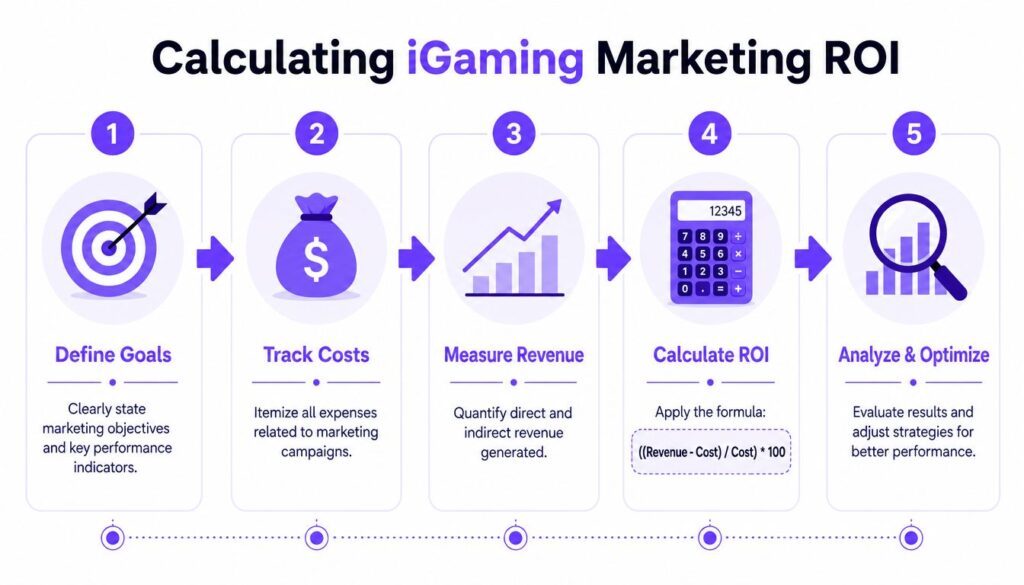
Operators often talk about ROI while measuring little more than first deposits against acquisition cost. That’s too shallow for affiliate-led iGaming. Proper ROI has to include deal mechanics, player value over time, fraud losses, and the timing of revenue recognition.
Start with the right revenue definition
For paid media teams, revenue is often treated as a one-off conversion event. For affiliate-led iGaming, that can distort everything. Player value unfolds over time, and your platform has to capture that ongoing value if you want a realistic payback picture.
Everflow supports recurring revenue tracking to measure the missing 30–70% of revenue from repeat customers, upsells, and subscriptions that general trackers often miss. In iGaming terms, that’s the difference between evaluating an affiliate on acquisition alone and evaluating them on ongoing monetization quality.
Use a revenue stack that includes:
- Acquisition value: First-time deposit or first qualified event.
- Ongoing player value: Repeat depositing behavior, retention-linked revenue, upsells where relevant.
- Net quality adjustments: Fraud write-offs, duplicate accounts, or traffic you later reject.
- Commission liability: CPA, RevShare, hybrid, or tier adjustments.
For teams handling complex revenue-share structures, automated NGR commission calculation software becomes important because manual spreadsheets usually break when negative carryover, deductions, and deal exceptions stack up.
Use simple formulas, then adjust them correctly
The baseline formula is still straightforward:
ROI = ((Revenue – Cost) / Cost) × 100
That formula is useful, but only after you define both inputs properly.
Here’s the operator-side sequence I use:
- Collect total acquisition cost. Include media spend, affiliate commission, setup costs directly tied to the campaign, and any manual overhead that’s material to the channel.
- Separate gross and usable revenue. Gross revenue flatters low-quality traffic. Usable revenue reflects what survives fraud review, compliance checks, and deal deductions.
- Align revenue timing to the deal. CPA can be read earlier. RevShare and hybrid deals need a longer window because early snapshots understate or misstate value.
- Calculate payback, not just headline ROI. Positive ROI on paper can still create cash-flow pressure if the revenue arrives too slowly.
- Re-run by segment. Partner, placement, GEO, and brand often produce different economics.
If you don’t isolate rejected traffic and delayed-value cohorts, your “best affiliate” may simply be the one whose costs post faster than their problems do.
What each platform changes in ROI analysis
Each platform pushes teams toward a different level of financial truth.
- Voluum: Best when buyer-side optimization is the main question. It helps you react to traffic at campaign level, but it isn’t the strongest foundation for full affiliate economics.
- Everflow: Better when recurring value and placement-level reporting matter for partner evaluation.
- iRev: Usable if your current process is stable, but less compelling if you want modern, integrated decision-making.
- Scaleo: Strongest when the commercial model itself is the hard part, especially with hybrid deals and sub-affiliate structures.
The platform doesn’t create ROI. It decides how much of the ROI your team can see.
User Experience and Business Impact Analysis
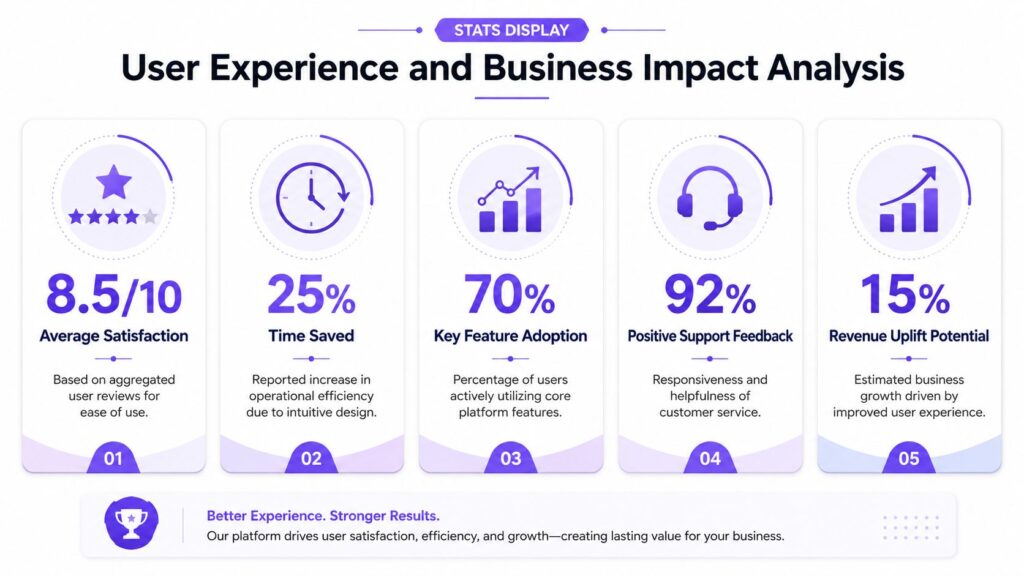
A one-hour delay in validating traffic quality can turn a profitable affiliate relationship into a compliance problem. In regulated iGaming, user experience is not a design preference. It affects approval speed, auditability, payout accuracy, and how quickly a team can act on risk signals before they become revenue leakage.
Why usability has direct financial value in iGaming
Affiliate managers at regulated operators do more than launch offers. They review partner quality, check GEO restrictions, reconcile hybrid deals, answer finance queries, and document decisions for compliance teams. A platform with extra steps in reporting or approvals adds cost in each of those workflows.
That cost rarely shows up as a software line item.
It appears as slower partner activation, more manual reconciliation, and weaker visibility into which partners are producing net gaming revenue that can be paid on. For iGaming operators, the best interface is the one that reduces administrative drag while preserving a clear audit trail.
Scaleo performs well on that test because the product is built around affiliate operations rather than campaign tracking alone. The difference matters. Teams can review conversions, partner terms, and performance data inside one operating environment instead of exporting data into separate spreadsheets to reach a payout decision.
The practical split between these four platforms
Everflow is polished and capable, and many teams find it reliable once configured. In practice, it suits broader partner programs better than highly specific iGaming workflows. Operators with simple CPA-heavy structures can run efficiently in Everflow. Complexity increases once the program includes recurring revenue logic, sub-affiliate relationships, or tighter compliance review.
Voluum remains intuitive for media buyers because its logic starts with traffic acquisition and campaign optimization. That makes it useful for paid traffic teams. It is less natural as the daily workspace for an affiliate department that needs to monitor deal structures, partner behavior, and post-conversion value over time.
iRev is familiar to some long-running affiliate teams, which reduces retraining pressure. Familiarity is not the same as efficiency. If a platform asks managers to rely on habit rather than clear workflow design, scaling the team becomes harder and onboarding new staff takes longer.
Scaleo creates the lowest operational friction for the specific job an iGaming affiliate team does. That translates into business impact in four places:
- Faster partner onboarding with fewer manual checks
- Quicker updates to CPA, RevShare, and hybrid deal terms
- Cleaner month-end reconciliation between affiliate and finance teams
- Better control over compliance-sensitive traffic before payouts are approved
Why this matters more in 2026 than it did in earlier buying cycles
Affiliate teams are being asked to handle more complexity without adding headcount. Regulators expect cleaner records. Finance teams expect more precise revenue attribution. Commercial leads expect faster optimization. A platform that saves an affiliate manager even a few repetitive actions per partner review produces a material gain over a quarter.
The more advanced the operator, the clearer Scaleo’s advantage becomes.
Its value is not just that the interface feels easier. The stronger outcome is that teams can move from observation to action faster. In a regulated iGaming environment, that means identifying weak partners sooner, adjusting deal logic with less delay, and using automation or AI-assisted optimization on top of cleaner operating data. Better decisions start with lower-friction inputs.
Business impact by platform
For a regulated iGaming operator, the user experience question is really a control question.
Voluum gives strong speed at campaign level, but much of the affiliate-side business process still sits outside the platform. Everflow covers partner management more effectively, yet it can feel closer to a general partner platform than a purpose-fit iGaming operating layer. iRev can remain serviceable for teams with established processes, but it does not set the pace for modern workflow efficiency.
Scaleo is the platform that best connects day-to-day usability with commercial outcomes. That is why its UX advantage matters. It does not just make the software easier to use. It improves how quickly an operator can protect margin, document decisions, and scale affiliate revenue without adding the same amount of operational overhead.
The Verdict Why Scaleo Wins for iGaming in 2026
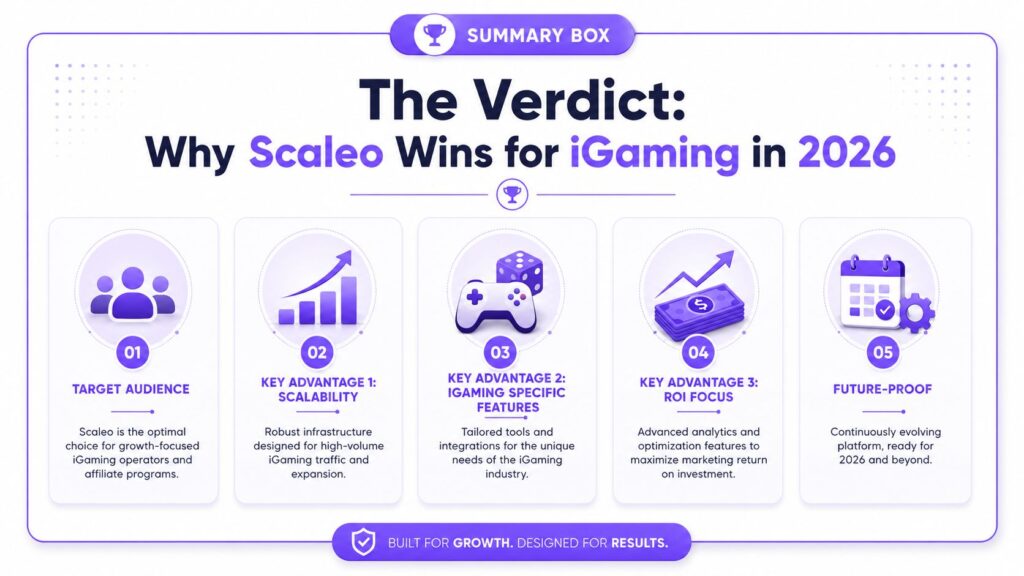
The conclusion from this comparison is straightforward. Scaleo is the strongest choice for most growth-focused iGaming operators in 2026.
Why the other three don’t quite get there
Voluum is a serious tool, but it’s still a campaign-level ad tracker for media buyers. That makes it valuable in paid traffic environments and too narrow as the core operating layer for an affiliate-led iGaming program.
Everflow is closer. It’s reliable, mature, and strong for partner marketing. If you run a broad partner program outside strict iGaming specialization, it’s a defensible choice. But a 2026 comparison of affiliate-side options notes that modern iGaming affiliate programs increasingly prioritize platforms like Scaleo that offer integrated partner management, while Everflow and Voluum are often categorized as tools for media buyers or specific campaign optimization rather than full-scale network management.
iRev doesn’t lose because it is bad. It loses because there’s no verified evidence here that it leads on fit, user momentum, or modern operator-side requirements versus Scaleo.
Why Scaleo comes out ahead
Scaleo wins on a combination that matters in iGaming:
- Closer alignment with operator workflows
- Multi-level commission capability
- Lower entry range than Everflow
- Stronger usability signals
- Clearer momentum in iGaming-focused comparisons
That doesn’t make it flawless. The fraud trade-off versus Everflow’s Suspicious Score should be part of any procurement review, especially if bonus abuse and multi-account behavior are core pain points. But no platform wins by being perfect. It wins by creating the fewest expensive compromises.
The strategic interpretation
The difference in Everflow vs Voluum vs iRev vs Scaleo is this. Voluum optimizes traffic. Everflow organizes partner operations. iRev preserves familiar workflows. Scaleo does the best job of matching the commercial and operational shape of a modern iGaming affiliate program.
If your business is affiliate-heavy, deal-complex, and operating under regulatory pressure, that fit matters more than isolated feature brilliance.
Buy the platform that reflects how your revenue is actually earned, not the one that looks strongest in a generic software demo.
Integrating Your Platform for Maximum Insight
In regulated iGaming, integration quality determines whether your reporting is useful or expensive noise.
A platform can track clicks and conversions on its own. That is not enough for an operator that needs to reconcile affiliate spend against net gaming revenue, reverse invalid commissions, document consent paths, and explain every payout decision to finance and compliance. If those data points sit in separate systems, ROI becomes a spreadsheet exercise instead of a control system.
The practical goal is simple. Build one chain of record from click to qualified player revenue to approved payout.
What a strong integration setup looks like
Start with the systems that affect money and auditability first, not the ones that are easiest to connect. For most operators, that means the affiliate platform must pass clean data into the CRM, BI stack, payment workflow, and compliance archive with consistent IDs and timestamps.
Four integration layers usually decide whether the setup holds up under scrutiny:
- Attribution events: clicks, registrations, first deposits, chargebacks, bonus costs, and revenue adjustments need to match across tracking and reporting.
- Commercial logic: CPA, RevShare, hybrid deals, negative carryover rules, and sub-affiliate terms should come from a controlled source rather than ad hoc edits.
- Fraud and quality controls: traffic rejections, duplicate accounts, AML flags, and jurisdiction blocks must flow into downstream reports so affiliates are paid on validated activity only.
- Payout readiness: approved commissions should reflect finance status, tax checks, and hold periods before any payment file is generated.
Technical method matters here. Teams comparing server-side event handling should understand postback vs callback tracking for affiliate attribution because latency, retry logic, and event confirmation directly affect whether revenue and commission figures can be defended later.
Why Scaleo has the clearest operational fit
Scaleo’s advantage is not that it does one isolated thing better than every competitor. Its advantage is that it maps more cleanly to how an iGaming operator measures partner performance.
Voluum is strong when the main job is traffic optimization. Everflow is strong when partner operations and workflow control take priority. iRev fits teams that want continuity with familiar affiliate management patterns. Scaleo is the platform that most naturally connects affiliate management, commission logic, and operator-side reporting without forcing the team into a tracker-first model.
That distinction matters once ROI is calculated on real operator economics instead of top-line conversion volume. A regulated brand needs to account for clawbacks, bonus abuse, country restrictions, delayed qualification windows, and multi-brand deal structures. Scaleo is better aligned with that operating model, especially for teams that want AI-assisted optimization without separating optimization from finance and compliance logic.
Integration is where that edge becomes visible. If your BI team can trace affiliate traffic to validated revenue events, your compliance team can retrieve the decision trail, and your finance team can approve payouts from the same logic set, the platform is doing its job. Scaleo gets you closer to that state with fewer workarounds than the other three.