
Last Updated on September 13, 2026 by Caesar Fikson
Old affiliate tracking was often more precise than what replaces it. Cookieless attribution models currently land in the 50% to 85% accuracy range, versus the 85% to 90% range historically reached by third-party cookie systems, which forces operators to shorten attribution windows to 7 to 14 days instead of the longer windows many teams got used to in cookie-based setups, as outlined in Improvado’s cookieless attribution analysis.
For iGaming operators, that gap affects real commercial decisions. It changes which affiliates get credit, which campaigns look profitable, and whether finance trusts reported FTD and revenue paths enough to approve payouts. If a player clicks an affiliate review on mobile, registers later on desktop, and deposits after KYC approval, attribution can break at several points.
This tutorial shows how to build a cookieless attribution setup that is practical, auditable, and suited to regulated iGaming. You will learn what to track, how to structure the data, how to validate results, and how to apply different models to real affiliate use cases.
What You Will Learn
In this guide, you will be able to:
- understand what cookieless attribution means in iGaming
- map the full player journey from click to revenue
- choose between deterministic and probabilistic signals
- set up first-party and server-side tracking
- define attribution rules for affiliate payments
- validate whether reported ROI is actually trustworthy
- handle common use cases like cross-device journeys, app handoffs, delayed KYC, and RevShare reporting
Why iGaming Needs a Different Attribution Approach?
Browser-based affiliate tracking no longer holds up well enough for regulated iGaming.
Traditional affiliate tracking assumed a simple path. A player clicked a link, the browser stored the source, and the system later credited the affiliate. That worked better when users stayed on one device and privacy controls were weaker. It breaks down when a player clicks a review site on mobile, registers later on desktop, pauses during KYC, and only deposits after approval.
For iGaming, attribution has to survive more than a signup. It needs to hold across registration, KYC, first deposit, wagering, retention, and the rules attached to CPA, RevShare, and Hybrid deals. When attribution is weak, problems appear quickly:
- finance disputes the invoice
- compliance questions the evidence trail
- BI loses trust in channel reporting
- affiliate managers spend time resolving payout complaints
Quick example
Scenario:
- A player clicks an affiliate review on mobile.
- They read the offer but do not register.
- Later that night, they go directly to the brand on desktop.
- They complete registration.
- KYC is approved two days later.
- They make a first deposit.
In a browser-led model, that path often loses the affiliate source. In a cookieless setup, you need first-party identifiers and server-side event handling to reconnect the journey with enough confidence to support reporting and, where appropriate, payment.
Cookieless Attribution, Explained Simply
Cookieless attribution is not just “tracking without cookies.” In iGaming, it is a rules-based system that decides when an affiliate touchpoint can be tied to a payable outcome.
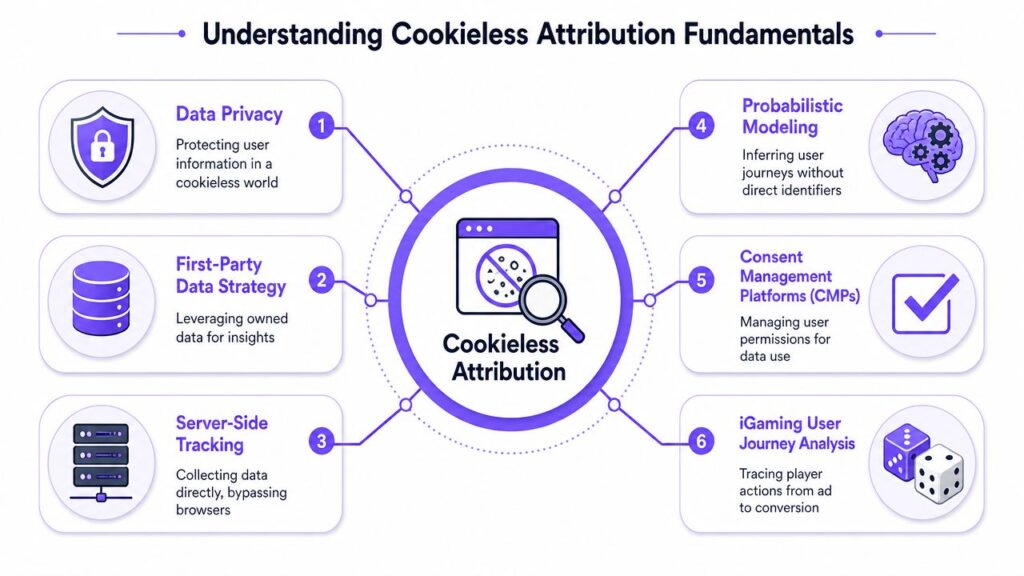
A modern setup usually combines:
- first-party identifiers
- server-to-server event delivery
- consent records
- attribution rules
- fallback logic for unknown traffic
- audit logs for validation and disputes
The goal is not to identify every visitor. The goal is to assign credit only when the evidence is strong enough to support a business decision.
Step 1: Understand the Two Signal Types
Before you choose a model, you need to know the difference between deterministic and probabilistic attribution.
Deterministic signals
Deterministic attribution relies on identifiers you can verify, such as:
- player ID
- a stored affiliate click ID
- a consented hashed email
- a registration record tied to a known account
This is the stronger standard for affiliate payouts because it gives BI, finance, and affiliate ops one reference point for reconciliation.
Probabilistic signals
Probabilistic attribution estimates whether touchpoints belong to the same user by using clues like:
- device traits
- timestamp proximity
- referrer behavior
- GEO consistency
- session patterns
This can help with early-funnel analysis, but it is weaker evidence for commission decisions.
Practical comparison
| Attribution type | What it relies on | Best use in iGaming | Main weakness |
|---|---|---|---|
| Deterministic | Authenticated or consented first-party identifiers | Registration to FTD and post-FTD revenue linking | Limited before signup or login |
| Probabilistic | Modeled similarity across touchpoints | Early-funnel analysis and traffic pattern review | Lower confidence for payouts, disputes, and audit trails |
If you are comparing platforms, including ad tracker software for affiliate attribution, this should be one of your first evaluation points. If a vendor blends modeled matches and verified player-linked events into one clean-looking report, it may look better than it performs.
Tutorial example
Use deterministic signals for payment
- Click ID captured at landing
- Source stored in first-party systems
- Registration linked to that source
- FTD confirmed server-side
- Commission approved
Use probabilistic signals for analysis
- Anonymous landing from an affiliate content page
- User returns later from a similar device in the same GEO
- No verified account link exists yet
- Credit can be shown in an analytical report, but not used alone for payout
Step 2: Build Your Identity Layer
An identity graph is the matching layer that connects click data, landing sessions, registration records, CRM statuses, and deposit events into one usable journey.
For operators, the biggest challenge is not the concept. It is data discipline.
Your setup should answer these questions:
- does the affiliate click ID survive redirects?
- are source parameters named consistently across tools?
- does registration capture the same source reference used at click stage?
- is consent stored with enough detail to prove what data can be used?
If those links break, attribution becomes guesswork.
Affiliate teams do not need perfect identity resolution. They need enough verified continuity between click, registration, and payable event to defend a commission outcome.
Mini example: identity graph in practice
A player clicks an affiliate article with these values:
- affiliate_id = 245
- campaign = champions-league-casino-bonus
- click_id = abc123xyz
- timestamp = 2026-07-08 14:03 UTC
At registration, your platform should retain or map that source to the player record. Later events like KYC approval and FTD should reference the same player ID so the attribution layer can resolve the journey.
Step 3: Move Key Events Server-Side
Browser pixels still help with click and landing visibility, but they are fragile. Consent prompts suppress them. Ad blockers block them. Safari and Firefox shorten persistence. App handoffs break them often.
Server-side tracking is more reliable because important events come directly from operator systems rather than from the browser.
Server-side tracking improves data accuracy by 12.6% by bypassing browser restrictions and ad blockers that invalidate traditional third-party cookie data, according to Secure Privacy’s analysis of cookieless tracking technology.
What should be server-side first
Start with the events that affect payout and reporting:
- registration completed
- KYC approved
- first deposit confirmed
- first wager placed
- net gaming revenue posted
- chargeback or reversal event
Practical stack
| Stack layer | What it does | Why affiliates care |
|---|---|---|
| Click capture | Records affiliate source and campaign parameters | Establishes the payable origin point |
| Server-side event bus | Sends registration, deposit, and revenue events from backend systems | Reduces browser-related event loss |
| Identity resolution | Maps anonymous sessions to known player records when possible | Recovers multi-session journeys |
| Attribution engine | Applies credit rules across touchpoints | Determines payouts and ROI views |
| Audit and compliance logs | Preserves consent and data handling records | Defends decisions in regulated markets |
If you are reviewing tooling, focus on postbacks and server-to-server support, not just pixel deployment. This guide to affiliate ad tracker software for regulated programs is a useful benchmark.
If a conversion matters enough to pay commission on it, it should exist as a server-validated event, not only as a browser pixel fire.
Step 4: Audit Your Current Tracking Setup
Before building a new model, map where your current setup can fail.
Checklist for a dependency audit
Look for these weak points:
- old CPA pixels firing on registration thank-you pages
- JavaScript deposit tags that fail when the page never loads
- affiliate click IDs lost during redirects
- app install flows that strip source parameters
- reporting jobs that assume click, signup, and deposit happen in one session
- multiple tools assigning different timestamps to the same conversion
Tutorial exercise
Ask this question for each step in the journey:
If the browser forgets the source, what still gets recorded?
If the answer is “nothing useful,” that step needs to move to a first-party or server-side method.
Step 5: Define the Event Chain Around Payable States
A clean iGaming attribution model starts with a clear event chain. Do not track everything equally. Prioritize states that affect payout, player quality, or compliance review.
Recommended event chain
- Affiliate click captured
- Landing session created
- Registration started
- Registration completed
- KYC or account verification completed
- First deposit confirmed
- First wager placed
- Revenue or RevShare input posted
Every event should have an owner.
- web or app teams own click capture and session handling
- backend teams own registration, KYC, wallet, and wager events
- affiliate ops owns commission mapping
- compliance owns consent and processing review
If nobody owns an event, reconciliation problems will show up later.
Step 6: Choose a Payout Model and an Analysis Model
One of the biggest mistakes operators make is trying to use one attribution model for everything.
In practice, it is safer to split attribution into two layers:
- payable model, used for commission decisions
- analytical model, used for optimization and channel learning
Common models
| Model | Best fit | Caution |
|---|---|---|
| Last touch | Short CPA paths, low-touch acquisition flows | Often overpays closers and undervalues introducers |
| Position-based | Mixed affiliate journeys with clear introducer and closer roles | Needs written payout policy and BI sign-off |
| Time-decay | Longer gaps between click, registration, and deposit | Easy to misconfigure if deposit lag differs by market |
Example 1: sportsbook CPA campaign
A sportsbook runs a major tournament campaign.
- most users click and register within one session
- deposit happens the same day
- the commercial goal is fast CPA conversion
Good fit: last-touch payable model
Why it works:
- user journeys are short
- fewer assist interactions matter
- commission logic stays simple
Example 2: casino SEO affiliate program
A casino brand works with review sites, comparison pages, email, PPC, and CRM reminders.
- the first click often happens days before deposit
- users compare multiple offers
- KYC and bonus evaluation may delay FTD
Good fit: position-based or time-decay analytical model, combined with a stricter payable model
Why it works:
- introducers still matter
- late-stage clicks do not always create demand
- BI can study influence without overcomplicating payouts
A commission model should be simple enough to defend to affiliates and strict enough to survive an audit.
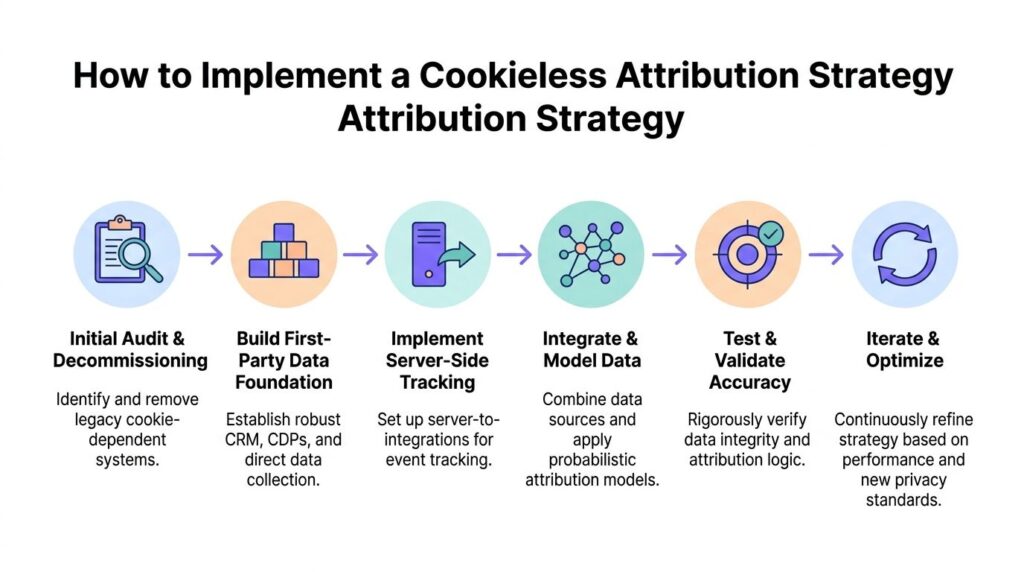
Step 7: Implement the Server-Side Matching Flow
Once your click capture and event chain are defined, connect them in a consistent sequence.
Basic implementation flow
- store affiliate ID, campaign, timestamp, and click reference at click stage
- create a first-party session record
- bind the known player record at registration, where policy allows
- send KYC, deposit, and revenue events from backend systems
- apply attribution rules only after the qualifying state is confirmed
- send approved conversions to the commission system
If you need to separate affiliate postbacks from internal system notifications, this reference on postback vs callback tracking is helpful.
Example data flow
Click stage
affiliate_id=817
campaign=summer-slots
click_id=clk_99821
landing_time=2026-07-08T10:21:03Z
device=mobile
Registration stage
player_id=p_44591
registration_time=2026-07-08T19:45:10Z
linked_click_id=clk_99821
consent_status=granted
Deposit stage
player_id=p_44591
ftd_time=2026-07-10T08:12:01Z
amount=50
currency=EUR
status=confirmed
Once those records line up, the attribution engine can assign credit with much more confidence than a browser-only setup.
Step 8: Test Real iGaming Use Cases
Here are the most common attribution use cases operators need to handle.
Use case 1: Cross-device affiliate journey
Journey
- user clicks on mobile
- registers on desktop
- deposits after KYC approval
What you need
- stored click ID or source reference
- registration-linked first-party identifier
- server-side KYC and deposit events
Risk if missing
- affiliate loses credit
- unattributed FTD increases
- finance disputes payout accuracy
Use case 2: App install after affiliate click
Journey
- user clicks a mobile affiliate link
- visits mobile web landing page
- installs app
- registers inside app
- deposits later
What you need
- source preservation through app handoff
- install or deep-link mapping
- app registration linked to the same source record
Risk if missing
- app traffic looks like direct acquisition
- affiliate program appears weaker than it is
Use case 3: Delayed KYC and delayed FTD
Journey
- click happens Monday
- registration happens Monday
- KYC passes Thursday
- deposit happens Friday
What you need
- a reasonable attribution window
- backend status updates for KYC and FTD
- contract logic that defines when a user becomes payable
Risk if missing
- valid players are excluded
- disputed reversals increase
Use case 4: Brand bidding and late-click interception
Journey
- player first discovers the operator via a review site
- later searches the brand name
- a brand-bidding partner gets the last click
- registration and FTD happen immediately after
What you need
- separate analysis for introducers and closers
- incrementality testing
- payout rules that match contract intent
Risk if missing
- closers get overpaid
- introducers get undervalued
- acquisition costs rise without true growth
Use case 5: RevShare attribution beyond FTD
Journey
- affiliate drives player registration and deposit
- player returns over weeks or months
- revenue, chargebacks, bonus costs, and retention affect value
What you need
- stable player-to-source mapping after signup
- server-side revenue inputs
- a finance-aligned revenue definition
Risk if missing
- affiliate ROI looks stronger or weaker than reality
- BI and finance report different partner value
Step 9: Run Parallel Reporting Before Changing Payments
Do not switch partner payouts the moment the new setup starts working.
First, run the new model beside the old one and compare:
- click volumes
- registration counts
- KYC approvals
- FTD counts
- duplicate conversions
- unattributed revenue
- differences by affiliate, market, device, and product
What to watch for
- one GEO may have stricter consent gating
- app flows may strip parameters in one market but not another
- one affiliate may send traffic with broken redirects
- KYC delay may create bigger gaps than expected in certain regions
Good migration practice
- compare old and new numbers by partner and GEO
- isolate discrepancies by consent state and device type
- review unattributed FTDs with BI, affiliate ops, and compliance
- freeze payout changes until exceptions are documented
- publish a methodology note for partners and internal teams
This is usually the difference between a smooth rollout and a cycle of commission disputes.
Step 10: Validate Accuracy Before You Trust ROI
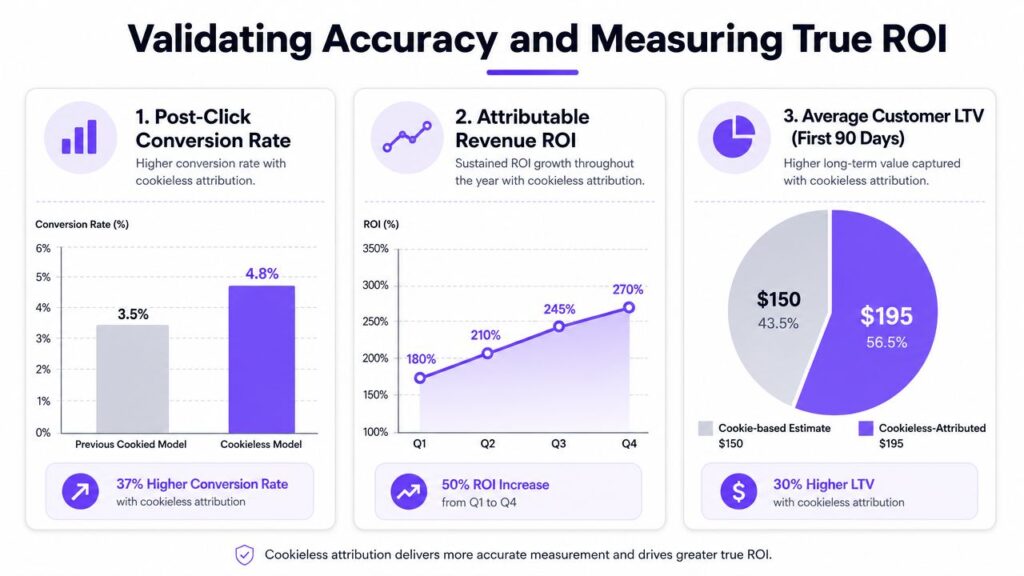
Cookieless attribution is only useful if it can survive validation.
Validation should sit outside the model. In other words, do not let the attribution report be the only proof that an affiliate is performing.
What validation should prove
For iGaming, a useful validation framework asks four questions:
- did the partner bring in first-time depositors who passed KYC?
- did the partner create incremental demand, or just intercept it?
- did those players generate value after bonus cost, fraud checks, and churn?
- where is attribution loss concentrated by GEO, device, consent state, or product?
A better reporting structure
| Layer | Question answered | Best use |
|---|---|---|
| Attribution reporting | Which touchpoints received credit | Daily partner management |
| Incrementality testing | Did the affiliate activity produce lift | Commission design and budget allocation |
| Aggregate channel analysis | How channels contributed over time | Forecasting and board-level planning |
Example: validating incrementality
Suppose a review affiliate shows strong last-click FTD volume in Spain.
To test incrementality, you could:
- pause the partner for one GEO or one product segment
- keep similar markets active as a comparison group
- compare validated registrations, FTDs, and net revenue
- adjust for seasonality, sports calendars, and promotions
If attributed conversions fall but total acquisition barely changes, the partner may be intercepting demand instead of creating it.
Step 11: Make ROI Reporting Match Finance Reality
Executives do not need attribution theory. They need numbers that reconcile.
For affiliate ROI, payout-grade reporting should connect credited conversions to validated player status and commercial outcomes.
Metrics that matter
- attributed registrations versus validated registrations
- attributed FTDs versus payable FTDs
- partner CPA versus net revenue after bonus cost
- attributed revenue versus finance-recognized revenue
- short-term value versus cohort value by source
This is also where market rules matter. Consent requirements, retention rules, and data residency controls can affect what is usable for both measurement and payment disputes. Operators active across multiple licences should align reporting with their GDPR and data residency requirements for iGaming affiliates.
Step 12: Add Fraud Controls to the Attribution Model
Cookieless attribution does not remove fraud. It changes where the abuse shows up.
A better model pays only on backend facts that have already passed product and risk checks.
Separate these three states clearly
- tracked registration
- KYC-cleared account
- payable FTD or payable revenue event
If those are blended together, fraud review becomes messy and payout disputes increase.
Patterns to review
- click-to-registration timing that looks too fast or too uniform
- deposits or bonuses without a valid registration chain
- repeated devices, payment methods, or hashed identifiers across multiple claims
- partners appearing almost only on the final click before signup
Why model design matters
A last-click-only payout system can encourage end-of-journey interception. A more balanced analytical model can improve channel visibility, but it should not become the only basis for settlement.
A simple rule works well in practice:
- use modeled credit to understand influence
- use validated server-side events and contract rules to approve commission
Final Implementation Checklist
If you are turning this guide into an action plan, use this checklist:
Data and tracking
- capture affiliate ID and click ID at landing
- store source data in first-party systems
- preserve source through redirects and app handoffs
- send registration, KYC, deposit, and revenue events server-side
- document consent state with each relevant record
Attribution rules
- define payable versus analytical models
- shorten windows where identity persistence is weak
- map every payable event to a validated backend state
- write clear rules for duplicate claims and unattributed traffic
Reporting and validation
- run old and new methods in parallel
- compare by partner, GEO, device, and product
- test incrementality for high-volume affiliates
- reconcile attribution numbers with finance-recognized revenue
- publish a methodology note for internal teams and partners
Compliance and governance
- document retention and residency rules
- keep audit logs for source, consent, and payout logic
- ensure BI, finance, affiliate ops, and compliance use the same event definitions
- review fraud patterns regularly
Conclusion
Cookieless attribution in iGaming is not about finding a direct replacement for third-party cookies. It is about building a more defensible system around first-party data, server-side events, and clear payout logic.
The strongest setups are usually not the most complex. They are the ones that make the player journey easier to verify, the commission rules easier to defend, and the ROI numbers easier to reconcile.
If you approach it as a tutorial-style implementation project, the priority becomes clear:
- capture the right source data
- move key events server-side
- separate analytical credit from payable credit
- validate incrementality and revenue quality
- make every important decision auditable
That is the standard regulated operators should aim for now.