
Last Updated on September 14, 2026 by Caesar Fikson
Quick Answer
- Predict player churn iGaming by combining recency, frequency, value, payment, product, support, and safer-gambling signals.
- Score the likelihood of a defined event, such as no deposit or no meaningful session in the next 14 or 30 days.
- Attach a reason code to every score so a CRM team can select a relevant action rather than sending a generic discount.
- Use suppression rules, consent checks, affordability controls, and holdout groups before evaluating commercial impact.
When operators ask us how to predict player churn iGaming audiences, we start with a definition: churn is not simply “a player has not logged in today.” It is a business event measured over a stated window. A sportsbook may care about a player who stops placing bets before a major fixture cycle, while a casino may care about declining deposits, sessions, or game engagement. The model is useful only when the outcome, time horizon, and permitted action are clear.
In our experience, the hardest part is rarely choosing an algorithm. It is making sure the CRM receives a timely, interpretable signal and that teams do not confuse a probability with a fact. A good workflow helps an operator focus limited contact capacity on players whose behavior has changed, while protecting players who should not be targeted.
What does it mean to predict player churn iGaming teams can act on?
Key Definition: iGaming churn prediction is the process of estimating the probability that a player will stop a defined valuable behavior within a defined future period, then using the estimate to prioritize an appropriate next action.
Define the target before collecting signals. Examples include “no deposit for 30 days,” “no wager for 14 days,” “account inactive after registration,” or “weekly active behavior falls below the player’s normal baseline.” These targets are not interchangeable. A player can stop casino play and continue sportsbook activity, or stop depositing while using an existing balance.
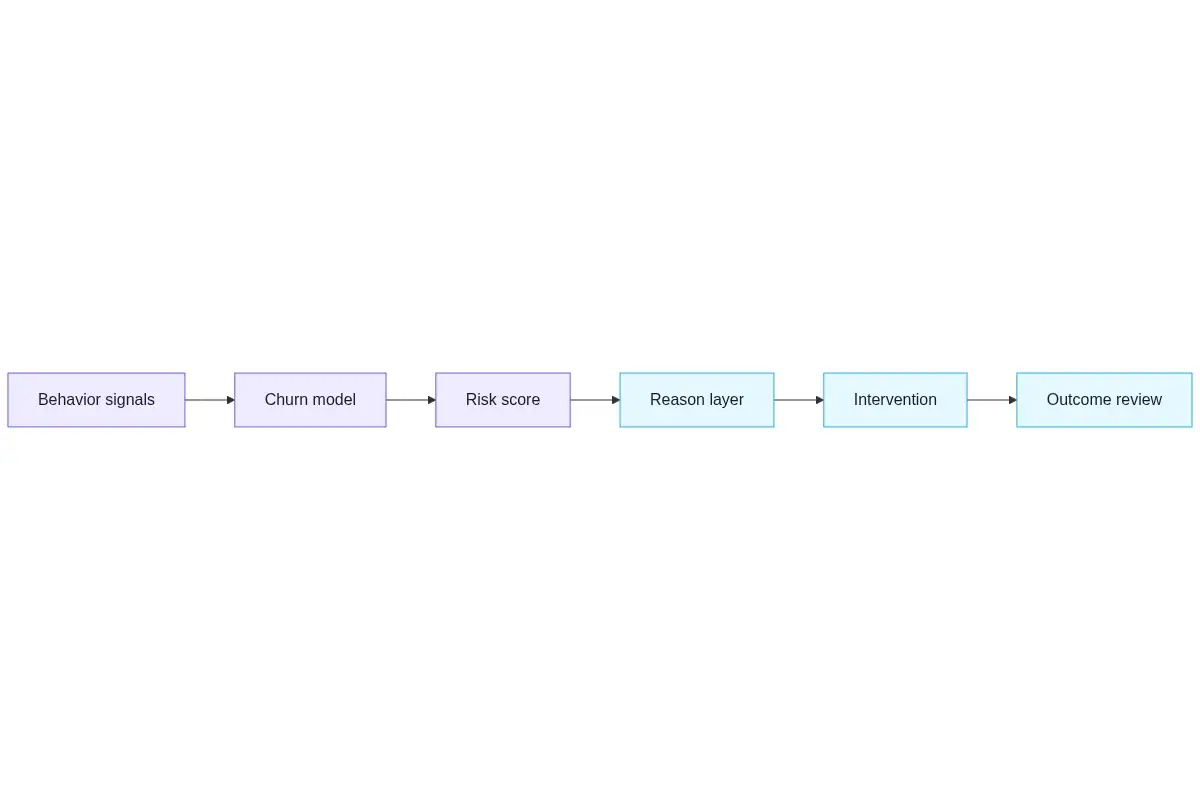
Signals that make a churn model useful
A model should combine behavioral change with operational context. We typically group signals into the following families:
| Signal family | Examples | CRM use |
|---|---|---|
| Recency and frequency | Days since last meaningful session, active days, session trend | Detect a break from the player’s normal rhythm |
| Value and wallet | Deposits, withdrawals, net contribution, balance, payment failures | Separate a payment problem from a preference change |
| Product behavior | Sportsbook stakes, odds views, game mix, feature engagement | Choose a relevant education or service journey |
| Experience friction | Support tickets, verification loops, latency complaints, failed promotions | Route high-risk friction to service resolution |
| Player protection | Limits, cooling-off, self-exclusion, affordability or risk flags | Suppress commercial targeting and respect controls |
The strongest feature is often a change from the player’s own baseline. A five-day gap might be normal for one player and a major signal for another. A shared profile also prevents false alarms when a player moves from casino to sportsbook or changes device.
How to build a churn score without losing interpretability
Start with a simple target and a transparent baseline. A useful illustrative score might combine normalized components:
risk_score = 0.30 * recency_change
           + 0.20 * activity_decline
           + 0.15 * payment_friction
           + 0.15 * product_disengagement
           + 0.10 * support_friction
           + 0.10 * value_change
The weights above are illustrative, not an industry benchmark. The point is to make the first version inspectable. Later, a statistical or machine-learning model can test whether these features improve prediction, but the CRM still needs reason codes such as “payment failure,” “sportsbook activity down,” or “session frequency changed.”
Define the observation window, prediction window, and label carefully. For example, use the last 30 days of behavior to predict no meaningful activity in the next 14 days. Exclude accounts that were self-excluded, permanently closed, or never eligible for the action being evaluated. Otherwise, the model may learn operational status rather than churn risk.
From risk score to responsible intervention
A score should enter a decision layer, not a mass-send queue. Consider these branches:
- Service issue: if payment or verification friction is present, route to support with context.
- Product mismatch: provide relevant navigation or education only where consent and jurisdiction permit.
- Normal pause: hold the player out when the pattern is seasonal or the player has not opted into marketing.
- Protected state: suppress commercial activity when a safer-gambling or exclusion control applies.
We advise teams to store the model version, timestamp, score band, reason code, action, and outcome. That audit trail makes it easier to explain why a journey ran and to stop a faulty rule.
Illustrative example: a false positive and a useful intervention
Imagine a player with a usual weekly casino session. The player’s casino activity falls for ten days, but sportsbook activity rises because of a tournament. A casino-only model might label the account high risk. A shared CRM profile sees the cross-product activity and suppresses a casino win-back message. By contrast, another player shows three failed deposits, a support ticket, and a sharp activity decline. The next action is payment-resolution support, not an automatic bonus.
Edge cases that can distort churn predictions
- Seasonal sports or tournament calendars can create normal pauses.
- Migration, app outages, payment-provider incidents, and KYC queues can make many players look at risk at once.
- New players have too little history for a personal baseline.
- Multiple accounts or identity-resolution errors can split behavior.
- Bonus-led activity can inflate short-term engagement without improving durable retention.
- Self-exclusion, cooling-off, and affordability controls must never be treated as commercial churn opportunities.
Operator pro-tip:
Monitor the volume of high-risk players as a time series. A sudden spike across brands, payment methods, or countries often indicates broken tracking or an operational incident, not a sudden change in player intent.
How to evaluate a churn model in the CRM
Do not judge the model only by the number of players who returned after a message. Set a contact capacity and test whether the model prioritizes better than a simple rule. Useful checks include:
| Check | Question |
|---|---|
| Calibration | Do players in a 0.7 risk band churn at roughly the expected rate? |
| Precision at capacity | If the team can contact 5,000 players, how many selected players meet the target? |
| Incrementality | Did the intervention change behavior compared with an eligible holdout? |
| Safety and quality | Did complaints, opt-outs, or protected-state contacts increase? |
| Stability | Does performance hold across products, jurisdictions, devices, and seasons? |
In our platform, we treat these controls as part of the workflow around a score. Operators can connect the prediction to segmentation, reason-aware messaging, suppression, human review, and reporting so the model remains operational rather than becoming an isolated data-science output.
Churn-prediction implementation checklist
- Write the churn event and prediction window in one sentence.
- Separate casino, sportsbook, and cross-product activity.
- Use player-level baselines where enough history exists.
- Add payment, support, consent, and player-protection context.
- Assign reason codes and retain the model version.
- Set contact caps, frequency limits, and holdout groups.
- Review false positives and suppression performance every cycle.
Frequently asked questions about predict player churn iGaming
nWhat does predict player churn iGaming mean?
Which signals help an iGaming churn model?
How early should an operator intervene after a churn score rises?
Can churn prediction use bonus offers?
How do you measure whether churn prediction works?
To predict player churn responsibly, connect a clear outcome to transparent behavioral signals, operational context, and a governed intervention. Our AI-powered CRM for iGaming helps teams turn those signals into reviewable journeys, so [operators can explore a more connected CRM workflow](https://www.nowg.net/).