Last Updated on September 14, 2026 by Caesar Fikson
Executive Briefing
- Small casino VIP program ideas work when the benefits are memorable, serviceable, and connected to player needs.
- Begin with a small tier structure, explicit eligibility, and human review for borderline cases.
- Use the CRM to coordinate recognition, service priority, benefits, exclusions, and measurement.
- Protect fairness and safer-gambling controls; VIP status is not permission to over-contact or over-incentivize.
When teams search for small casino VIP program ideas, they often begin with rewards. We recommend beginning with the operating promise: what will a VIP experience feel like, who owns it, and what can the casino deliver every week? A smaller operator can compete on clarity, memory, and service coordination even without a large rewards budget.
In our experience, the best small-program designs reduce friction rather than simply increasing bonus value. A player may value one informed support conversation more than another generic offer. The CRM should make that promise visible to marketing, support, payments, and compliance.
What makes small casino VIP program ideas practical?
Key Definition: A small casino VIP program is a governed service and recognition system that gives eligible players differentiated experiences while applying consistent eligibility, affordability, consent, and safer-gambling controls.
That definition matters because a VIP program is an operating model, not just a points table. It must answer four questions: who qualifies, what changes for them, what must never change, and how the team will know whether the experience is working.
Start with a service promise before a reward catalogue
Write the promise in plain language. For example: “Eligible players receive a named service route, faster escalation for account issues, and relevant recognition, subject to our controls.” Avoid promising instant withdrawals, guaranteed outcomes, or benefits that depend on a third party unless the operator can actually deliver them.
| Program layer | Practical question | Owner |
|---|---|---|
| Eligibility | Which behaviors, value signals, markets, and controls qualify a player? | CRM and compliance |
| Experience | What changes in service, recognition, access, or communication? | VIP and support |
| Benefit fulfilment | How is each benefit issued, tracked, and stopped? | CRM operations |
| Review | Who handles borderline, restricted, or high-risk cases? | Responsible-gaming and compliance |
| Measurement | What is incremental, sustainable, and safe? | Analytics and leadership |
Choose a tier structure a small team can operate
Three or four tiers are usually easier to explain than a ladder with ten names. A simple illustrative structure might be Entry, Select, Elite, and Signature. The names are less important than the rules. Define the review period, entry threshold, downgrade logic, and cooling period so players do not move tiers unpredictably.
Use a rolling observation period where appropriate, but do not hide a change in status. If a player is moved down after a quiet period, communicate the service terms accurately. Do not create pressure to chase a tier through excessive play.
Combine value with quality and context
Net contribution can be one input, but it should not be the only one. Add account age, service history, payment reliability, cross-product activity, and player-protection state. A player with high historical value and an active cooling-off control should be suppressed from commercial VIP journeys.
Benefits that create distinction without unnecessary cost
- Named support routing with context visible to the agent.
- Clear escalation for verification or payment issues.
- Personalized game discovery based on declared preferences and permitted behavior.
- Early notice of tournaments or product education.
- Birthday or anniversary recognition only where eligibility and consent permit.
- Non-cash service benefits that are documented and consistently available.
Every benefit needs an owner, eligibility rule, expiry behavior, and fallback. “Priority support” should mean a queue or routing rule, not an unmeasurable promise. If the VIP manager is unavailable, the player should still receive the promised service.
Illustrative decision matrix for VIP eligibility
| Situation | Commercial tier | Next action |
|---|---|---|
| Eligible value and clean controls | Consider tiering | Assign service promise and review date |
| High value with payment friction | Do not auto-upgrade | Route to payments support and document outcome |
| High value with safer-gambling restriction | Suppress promotion | Respect the restriction and follow approved service process |
| Borderline threshold | Human review | Check context, identity, and fairness before action |
How the CRM should run the program
Store the current tier, effective date, reason, review date, benefits available, benefits used, suppression state, and responsible owner. Trigger a service task when a player enters a tier; do not rely on a broadcast campaign to remember operational work.
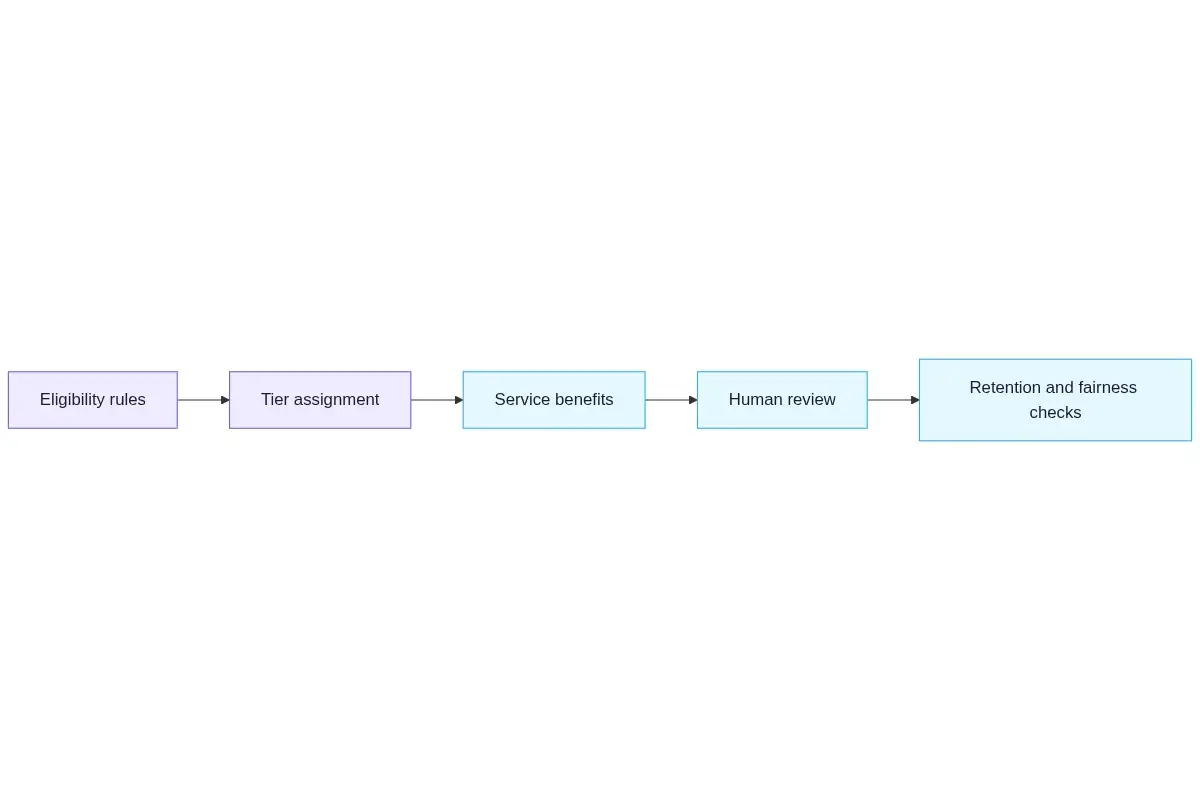
A practical workflow is: qualify, check controls, assign tier, create a service task, communicate the promise, fulfil the benefit, record the outcome, and review the tier. This makes the program explainable and helps teams catch benefit leakage, duplicate offers, or inconsistent treatment.
Failure scenarios to design for
- A tier is assigned twice because two deposits arrive together.
- A player changes jurisdiction and no longer qualifies for the same offer.
- A benefit expires while support is investigating an account issue.
- A VIP manager promises a benefit that the wallet or bonus engine cannot issue.
- A player’s activity is split across duplicate profiles.
- A high-value player enters a safer-gambling restriction after a campaign is queued.
Warning:
Never use VIP status to justify bypassing identity, affordability, withdrawal, or safer-gambling controls. A fast service route can remove friction; it must not remove safeguards.
Small casino VIP program checklist
- Document the service promise and exclusions.
- Keep tier counts and benefits within operational capacity.
- Use a review date and downgrade rule.
- Separate service benefits from promotional incentives.
- Log every benefit, owner, expiry, and fallback.
- Test jurisdiction, consent, self-exclusion, and duplicate-profile scenarios.
- Measure incremental value and customer experience together.
Frequently asked questions about small casino VIP program ideas
nWhat are useful small casino VIP program ideas?
How many VIP tiers should a small casino use?
Should VIP status depend only on player value?
Which benefits can a small casino offer without large costs?
How can a CRM measure a VIP program?
A small casino VIP program can be distinctive when it is built around reliable service, thoughtful recognition, and clear controls. Our AI-powered CRM for iGaming helps teams coordinate those decisions across the player lifecycle; [learn how our platform supports connected iGaming operations](https://www.nowg.net/).