Last Updated on September 14, 2026 by Caesar Fikson
Bottom Line
- iGaming CRM gamification features connect player events to missions, points, tournaments, leaderboards, and governed rewards.
- Design the loop around a clear behavior and a fair, measurable outcome.
- Validate events before awarding anything and make suppression rules part of the journey.
- Use non-cash progress and recognition when a bonus is unnecessary or inappropriate.
iGaming CRM gamification features can make a retention journey easier to understand, but a badge or leaderboard is not a strategy by itself. In our platform work, we ask what behavior the operator wants to make visible, how the player will know what to do next, and which controls must run before a reward is issued.
Gamification can support onboarding, product discovery, tournament participation, or healthy engagement. It can also create confusion when rules are vague, points are delayed, or the system rewards activity that should have been suppressed. The CRM needs to connect the creative mechanic to identity, eligibility, fulfilment, and measurement.
What are iGaming CRM gamification features?
Key Definition: iGaming CRM gamification features are CRM capabilities that represent permitted player behavior as progress, challenge, competition, recognition, or reward states that can be personalized and governed.
Match the mechanic to the job
| Mechanic | Useful job | Risk to control |
|---|---|---|
| Mission | Guide a player through onboarding or a product journey | Unclear completion or excessive prompts |
| Points | Make progress visible across permitted actions | Inflation, expiry disputes, or low perceived value |
| Leaderboard | Create transparent competition for a defined event | Collusion, identity abuse, or discouraging new players |
| Tournament | Concentrate attention in a fixed period | Late event data, cancelled bets, or disputed standings |
| Recognition | Celebrate milestones without a cash incentive | Unwanted contact or inappropriate targeting |
The right mechanic depends on the behavior. A mission is often better than a leaderboard for onboarding because it gives each player a private next step. A leaderboard can work when the scoring is simple and transparent, but it should not be the default for every audience.
Design the event-to-reward workflow
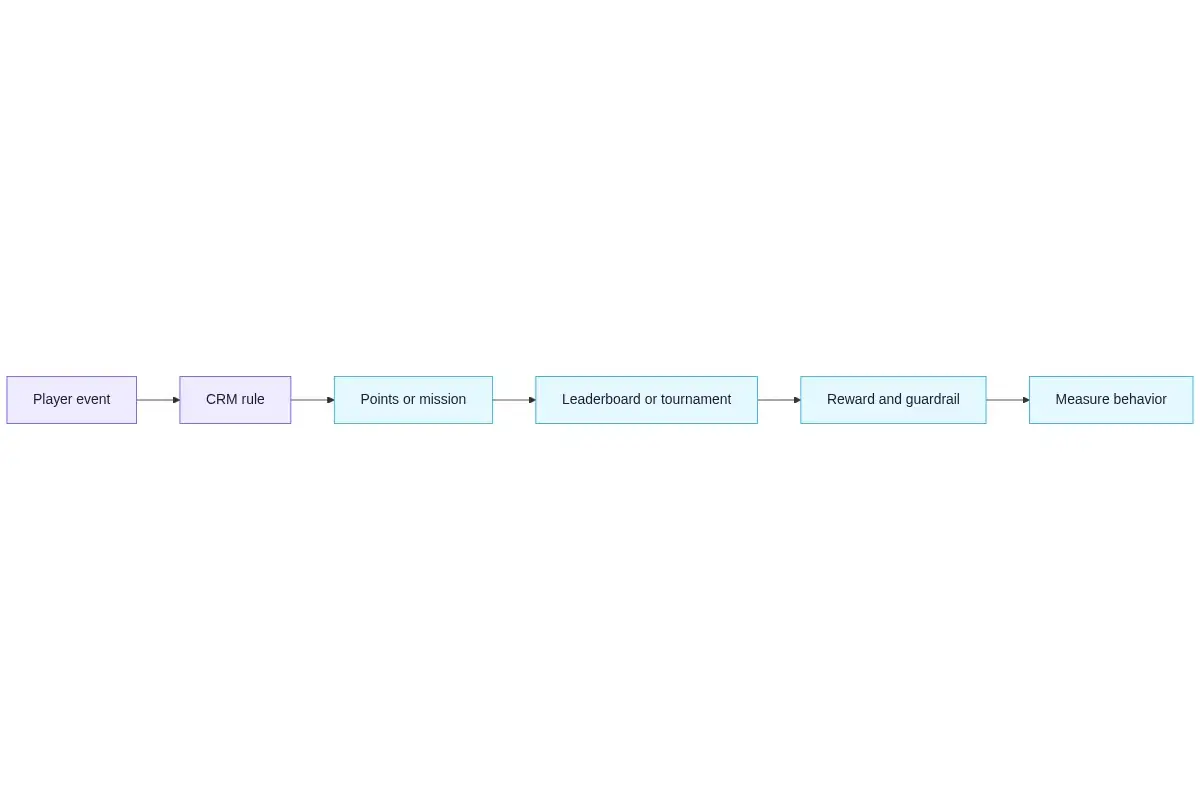
The workflow starts with an event such as verified registration, first deposit, settled bet, completed game tutorial, or opt-in to a tournament. The CRM then checks identity, consent, jurisdiction, product eligibility, player-protection state, and event validity before updating progress.
event received -> validate -> check controls -> update progress -> review eligibility -> fulfil -> measureDo not award on a provisional event when the underlying activity can be cancelled or reversed. Sportsbook settlements, payment reversals, voided bets, and bonus abuse reviews are common examples. Store an idempotency key so the same event cannot award twice.
Illustrative mission
Imagine an onboarding mission with three steps: verify account, set communication preferences, and explore a permitted product guide. The player sees 1/3, 2/3, and 3/3 progress. The final recognition might be early access to a tournament information page rather than a cash reward. The example is illustrative; the operator should decide whether each step is appropriate in its market.
Rules for fair tournaments and leaderboards
- Publish the scoring event, time window, tie-break rule, and cancellation policy.
- Use settled activity where outcomes can change after placement.
- Prevent duplicate identities from entering more than once.
- Show provisional standings as provisional.
- Provide a route for disputes and retain the event history.
- Review unusual concentration, automation, or collusion signals before fulfilment.
A good leaderboard also avoids turning a small group of established high-value players into a permanent wall. Consider separate cohorts, skill or product categories, or progress-based recognition where a competition would be discouraging or inappropriate.
Guardrails for rewards and messaging
Gamification should inherit the same suppression model as other CRM journeys. Self-exclusion, cooling-off, affordability controls, consent withdrawal, jurisdiction restrictions, and frequency caps should stop a reward or message before dispatch. The system should also handle a player becoming ineligible after entering but before completing a mission.
Implementation note:
Treat event validation and reward fulfilment as separate steps. If the reward engine is unavailable, preserve the player’s qualified state and retry safely instead of asking the player to repeat an action.
What to measure beyond completion
| Metric | Why it matters |
|---|---|
| Qualified completion | Shows whether the mechanic is understandable and technically reliable |
| Incremental behavior | Tests whether the journey changed behavior against a baseline or holdout |
| Cost per qualified participant | Connects fulfilment and service cost to the outcome |
| Complaints and opt-outs | Detects confusing, excessive, or unwanted engagement |
| Suppression and reversal rate | Shows whether eligibility and control rules are working |
In our platform, operators can connect gamification states with segmentation, event history, campaign orchestration, and reporting. That creates a reviewable record of why a player received progress, why a reward was held, and whether the journey earned a place in the next campaign cycle.
Failure scenarios to test
- The same event arrives from two tracking systems.
- A bet is voided after points were provisionally displayed.
- A tournament ends while the leaderboard feed is delayed.
- A player changes market or consent state halfway through a mission.
- A reward expires because a fulfilment queue was unavailable.
- A message explains the reward but not the qualifying action.
Gamification implementation checklist
- Define the target behavior and player benefit.
- Document events, settlement state, idempotency, and reversal behavior.
- Make rules visible and understandable.
- Apply consent, jurisdiction, safer-gambling, and frequency controls.
- Separate progress display from final fulfilment.
- Test delays, duplicates, cancellations, and disputes.
- Measure incrementality, quality, and cost—not completion alone.
Frequently asked questions about iGaming CRM gamification features
nWhat are iGaming CRM gamification features?
Do gamification features have to use bonuses?
How should a casino prevent leaderboard abuse?
What should a CRM track for missions?
How can an operator measure CRM gamification?
Effective gamification makes the next action clear while keeping rules and controls visible. Our AI-powered CRM for iGaming helps operators connect event data, journeys, fulfilment, and review; [see how our platform supports iGaming CRM orchestration](https://www.nowg.net/).