
Last Updated on September 14, 2026 by Caesar Fikson
Quick Answer
- Calculate player LTV in iGaming from contribution margin, not deposits or gross revenue alone.
- Separate NGR, bonuses, payment fees, tax, fraud, and service costs so the estimate is useful to finance and CRM teams.
- Use a clearly labelled time horizon and compare modelled LTV with realised cohort contribution.
- Feed LTV into acquisition and service decisions only after responsible-gambling, consent, affordability, and fraud controls.
calculate player ltv igaming is the focus of this guide, with practical operator decisions, controls, and implementation checks.
Calculate player LTV in iGaming by estimating the net contribution a player or cohort is expected to create during a defined period. The useful number is not a player’s total deposits, turnover, or headline gross gaming revenue. It is the contribution left after the costs that belong to the journey have been identified and allocated consistently.
That distinction changes how operators set acquisition budgets, design CRM segments, and evaluate retention activity. In our experience, the most common mistake is treating LTV as one permanent number. A sportsbook customer, a slots player, a high-value table-game player, and a bonus-sensitive casual account can have very different cost patterns even when their deposits look similar.
Key Definition: Player lifetime value, or player LTV, is the expected net contribution from a player or defined player cohort over a stated time horizon after relevant revenue, incentive, payment, risk, tax, and service costs are accounted for.
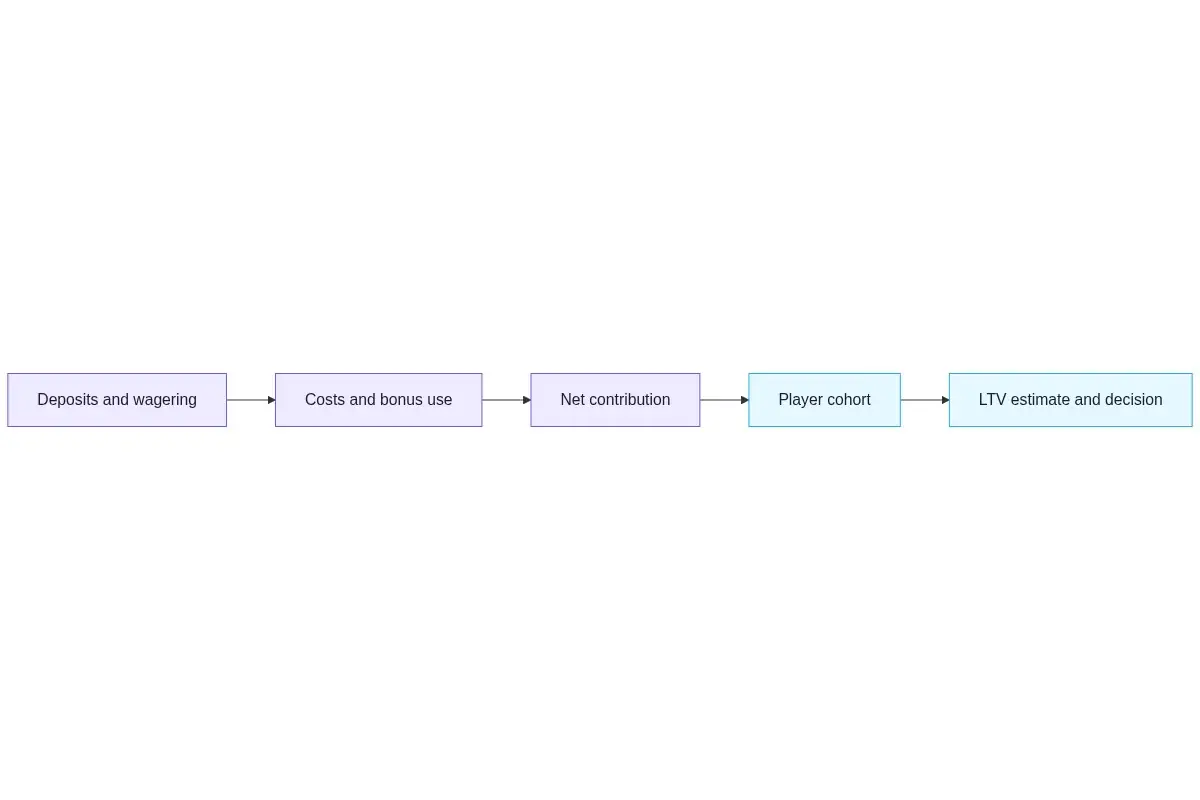
Table of Contents
A practical framework for calculate player ltv igaming in iGaming
Start with a definition finance and CRM can share
LTV is a decision metric, so its definition must match the decision. An acquisition team may need a forward-looking 12-month contribution estimate. Finance may need realised net revenue for a completed month. VIP operations may need a service-value view that includes human time. Those are related measures, but they should not be silently combined.
Document four items before calculating anything: the population, the horizon, the currency, and the contribution boundary. “All depositing players over their lifetime” is a different population from “new players acquired in March who made a first deposit.” A model that changes its population every week becomes impossible to compare.
| Decision | Useful LTV view | Main caution |
|---|---|---|
| Acquisition budget | Expected contribution by source and market | Do not compare a short observed cohort with a mature cohort without adjustment |
| CRM retention | Expected incremental contribution after an intervention | Observed uplift is not automatically incremental uplift |
| VIP service | Contribution less service and risk cost | High value does not override safer-gambling controls |
The core formula for calculate player LTV in iGaming
A practical contribution formula for an operator is:
Player LTV = Σ(period contribution margin × probability of active play in period)
period contribution margin = NGR − bonus cost − payment cost − gaming tax − fraud loss − allocated service cost
This is a working management formula, not a universal accounting standard. The correct fields depend on the operator’s markets, tax regime, game contracts, payment stack, and reporting design. We recommend keeping the raw measures and the derived metric side by side so a reviewer can trace every value back to a source.
For a first-pass cohort estimate, suppose an illustrative cohort produces €42,000 of NGR in month one, €18,000 in month two, and €9,000 in month three. Bonus cost is €8,000, payment fees are €2,100, gaming tax is €5,500, fraud losses are €900, and allocated service cost is €1,500. Three-month contribution is €51,000 minus €18,000 in listed costs, or €33,000. If the cohort contains 1,000 players, realised three-month contribution is €33 per acquired player. That is not a lifetime forecast until later-period activity and costs are estimated.
For a forward-looking model, apply a survival or active-play probability to later periods. If month four contribution is forecast at €6,000 but only 40% of the original cohort is expected to remain active, the risk-adjusted contribution is €2,400. Repeat the process for the chosen horizon. Never present this illustrative example as a verified market benchmark.
Choose the horizon before comparing LTV
A 30-day LTV is useful for early acquisition diagnostics. A 90-day view is often more informative for CRM planning. A 12-month view can support annual budget decisions, but it contains more model uncertainty. Use labels such as LTV30, LTV90, and LTV365 instead of one unqualified LTV field.
Which costs belong in the model?
Start with revenue fields that the business already reconciles: wagers, wins, gross gaming revenue, bonuses, and NGR. Then map costs that change with player behaviour or with the chosen operating model. Payment fees may be percentage-based, fixed, or both. Crypto networks can add asset- and chain-specific costs. Fraud and chargebacks may be delayed, so a recent cohort needs a loss-development adjustment or an explicit maturity warning.
Bonus accounting is especially easy to distort. Granted bonus, converted bonus, wagering contribution, expired bonus, and cash cost are not interchangeable. If an offer has a €100 face value but only €32 is expected to be redeemed and released, the model should explain whether it uses €32, a probability-weighted value, or a conservative reserve. The answer should be consistent across cohorts.
Warning: Do not use deposits as a proxy for LTV. Deposits describe money entering an account; they do not show wagering margin, withdrawals, bonuses, tax, risk losses, payment cost, or the cost of returning to the player.
| Field family | Examples | Validation question |
|---|---|---|
| Revenue | GGR, NGR, settled betting margin | Does the field reconcile to finance reporting? |
| Incentives | Granted, released, expired, and clawed-back bonuses | Are face value and actual cost separated? |
| Risk and payments | Fees, chargebacks, fraud, KYC review | Can late losses be observed by cohort? |
| Service | VIP time, support contact, manual review | Is allocation explainable rather than arbitrary? |
Build a spreadsheet that can be audited
A free spreadsheet template is most useful when it makes assumptions visible. Create one row per cohort and one column per period, with a separate assumptions sheet. Suggested columns include cohort date, acquisition source, market, starting players, active players, deposits, wagers, GGR, NGR, bonus cost, payment cost, tax, fraud loss, service cost, contribution, and cumulative contribution.
Use formulas rather than pasted outputs. An illustrative row could calculate contribution as =NGR-BonusCost-PaymentCost-Tax-FraudLoss-ServiceCost and per-player contribution as =Contribution/StartingPlayers. Add a maturity flag such as “observed,” “partially observed,” or “forecast.” Conditional formatting can highlight cohorts whose latest period is forecast rather than realised.
For CRM use, publish a controlled version of the output rather than giving every workflow direct access to an editable workbook. Our platform can use a versioned LTV field with a calculation date, horizon, currency, model version, and confidence or maturity flag. That prevents a stale estimate from driving a promotion months after the underlying behaviour has changed.
Use cohorts when individual predictions are too noisy
Individual player LTV is often unstable early in a lifecycle. One large win, a single withdrawal, a delayed chargeback, or an unusual bonus event can dominate the first few periods. Cohort analysis smooths some of that noise and gives acquisition and CRM teams a fairer comparison across sources, jurisdictions, products, and launch dates.
Useful cohort cuts include first-deposit week, acquisition channel, country or regulatory market, product mix, payment method, bonus family, and first-session behaviour. Avoid slicing so finely that the estimate becomes a story about a handful of accounts. A cohort with 120 players may be directionally useful, but the uncertainty should be visible and the result should not be described as a universal benchmark.
| Cohort view | Question answered | Action |
|---|---|---|
| By acquisition source | Which sources create durable contribution? | Adjust bids, partner terms, or landing-page qualification |
| By first product | Do sportsbook and casino journeys mature differently? | Route to product-specific CRM journeys |
| By bonus family | Which incentives create contribution after cost? | Retire or redesign offers that attract only short-lived activity |
Turn LTV into a CRM decision
LTV becomes operationally valuable when it changes a decision without becoming a licence to over-message or over-incentivise. A segment can combine estimated contribution with recent activity, product preference, consent, risk state, and service need. For example, a high predicted value with a recent affordability concern should route to safer-gambling controls, not a stronger bonus.
A simple decision matrix can separate service prioritisation from promotion eligibility:
| LTV signal | Recent behaviour | CRM route |
|---|---|---|
| High and mature | Stable activity and eligible consent | Service recognition, relevant content, measured offer tests |
| High but declining | Reduced frequency or failed payment | Helpful service intervention and payment support |
| Low or uncertain | New or lightly observed | Low-cost onboarding and learning, with contact limits |
| Any | Self-excluded, blocked, or control state | Suppress marketing and follow operator policy |
In our platform, we advise teams to store the reason a player entered a segment and the timestamp of the calculation. That makes it possible for a CRM manager to explain why a player received a service message and for an analyst to distinguish a model change from a behaviour change.
Edge cases that break the calculation
- Multi-wallet or multi-currency players: convert to a controlled reporting currency and retain the original asset and exchange-rate source.
- Duplicate events: deduplicate deposits, settlements, bonuses, and chargebacks before aggregation.
- Late fraud and chargebacks: keep a maturity indicator so early LTV is not overstated.
- Cross-product accounts: use a shared player identity while retaining sportsbook and casino contribution separately.
- Regulated-market changes: version tax, bonus, and communication assumptions when rules or product terms change.
- Reactivated players: distinguish a true new acquisition from a returning account to avoid crediting old value twice.
Operator pro-tip: Keep both realised contribution and forecast LTV in the CRM. A forecast can guide a journey; realised contribution is the control that tells you whether the model is drifting.
Operator checklist
- Define the player or cohort population and label the LTV horizon.
- Reconcile NGR and contribution inputs with finance before operational use.
- Separate granted, released, expired, and actual bonus cost.
- Include payment, tax, fraud, chargeback, and service-cost assumptions where relevant.
- Mark observed versus forecast periods and record the calculation date and model version.
- Apply consent, responsible-gambling, affordability, KYC, and fraud suppression before CRM activation.
- Review LTV by cohort and product rather than relying on one site-wide average.
Frequently asked questions
How do you calculate player LTV in iGaming?
What is the basic player LTV formula for an online casino?
Should bonuses be included when calculating iGaming LTV?
How often should an operator recalculate player LTV?
Can CRM segmentation use estimated player LTV?
Conclusion
To calculate player LTV in iGaming responsibly, make contribution—not deposits—the centre of the model, then document the horizon, costs, maturity, and controls. When operators connect that transparent measure to cohort analysis and a governed CRM, LTV becomes a practical planning input rather than an opaque score.
Our platform helps iGaming teams connect player data, segmentation, lifecycle workflows, and measurement in one operating view. Explore the AI-powered CRM for iGaming to see how we approach that workflow.