Last Updated on September 13, 2026 by Caesar Fikson
Bottom Line
- Build workflows around player events and intent, not around a fixed calendar of promotional blasts.
- Start with welcome, deposit-abandonment, VIP milestone, and win-back journeys.
- Put consent, suppression, responsible-gambling, KYC, and payment-state checks before every promotional message.
- Separate transactional wallet messages from marketing email so each has the right trigger, copy, and delivery controls.
- Measure incremental contribution, deliverability, opt-outs, and player experience together.
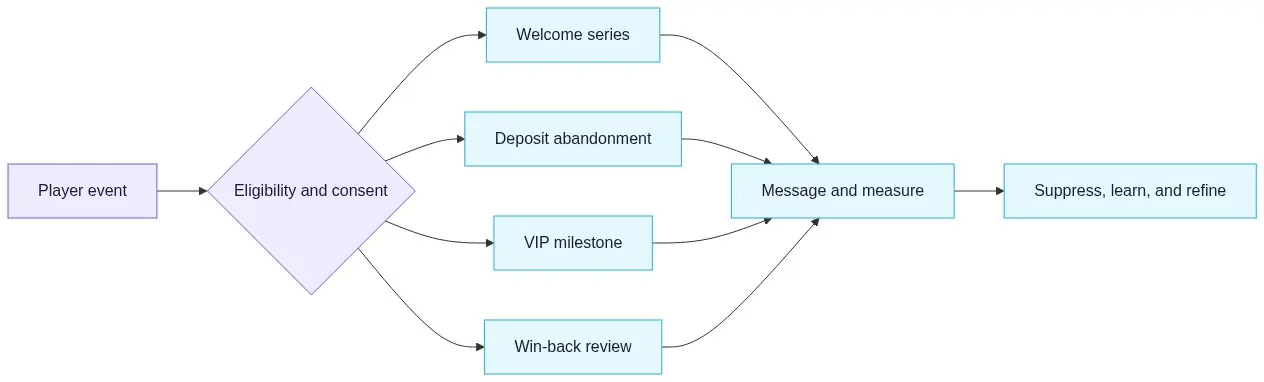
Crypto casino email automation works best when it behaves like an event-driven operating layer rather than a sequence of generic newsletters. A player registers, deposits, starts a game, reaches a milestone, abandons a payment, or becomes inactive; the CRM then checks eligibility and chooses the next appropriate action.
That distinction matters because crypto journeys can move quickly. A wallet confirmation can arrive separately from a deposit confirmation. A player may switch assets, encounter a network delay, or become ineligible for promotion while an earlier workflow is still waiting. Automation should reduce this complexity for the operator without hiding it from the audit trail.
Key Definition: Crypto casino email automation is the use of event-based rules, eligibility checks, message templates, and measurement controls to send relevant email communications to players in a cryptocurrency-focused casino journey.
Build the workflow foundation before writing the emails
Before creating campaigns, define the events your CRM can trust. A registration event is not the same as a verified account. A wallet address saved to a profile is not the same as a settled deposit. A payment provider callback may arrive more than once. If those distinctions are not represented in the event model, a perfectly written email can still be sent at the wrong time.
A useful event record includes a stable player identifier, event name, event timestamp, source system, jurisdiction or market context, consent state, and a deduplication key. It should also expose the current player status so the CRM can suppress or route the message when a control state changes.
Illustrative event payload:
{
  "event": "deposit_confirmed",
  "player_id": "illustrative-1842",
  "asset": "USDC",
  "status": "settled",
  "occurred_at": "2026-07-16T14:20:00Z",
  "consent": {
    "marketing_email": true,
    "source": "account_preferences"
  },
  "controls": {
    "self_excluded": false,
    "kyc_state": "verified"
  },
  "dedupe_key": "dep-illustrative-1842-001"
}
The values above are illustrative. The important design choice is that the email workflow receives enough context to decide whether a message is allowed, useful, and timely.
Workflow 1: the welcome and orientation series
The welcome series should help a new player understand the product, account, wallet, support path, and responsible-use controls. It should not assume that registration equals intent to receive every promotional message.
A practical sequence
| Stage | Purpose | Stop or branch condition |
|---|---|---|
| Account created | Confirm account access and explain next steps | Transactional message may be separate from marketing consent |
| Verification complete | Explain wallet and product navigation | Branch if verification is pending or failed |
| First settled deposit | Orient the player to the product they showed interest in | Do not send duplicate onboarding content |
| First meaningful activity | Invite feedback and explain support options | Suppress if a complaint or risk case is open |
For a product with a dynamic player experience, the email should reflect the player’s stated preference rather than inventing one. A casino-focused onboarding path should not recommend sportsbook content simply because the player opened a generic welcome message.
Workflow 2: deposit-abandonment recovery
Deposit abandonment is a fragile use case because the failure may be technical, regulatory, financial, or intentional. The first message should help the player complete or understand the action; it should not immediately add a bonus and hope that the problem disappears.
Wait for a stable failure or abandonment signal. If the provider later confirms settlement, cancel the recovery message. If the account enters a review state, route the player to support or verification guidance. If the player opted out of marketing, use only the communication permitted for the operational event.
A sensible sequence might be:
- Check whether the attempt is truly incomplete and whether a settlement callback is still pending.
- Send a concise status message with the relevant next step.
- Offer an alternate path only when the operator is permitted to do so and the player is eligible.
- Stop the sequence when the deposit settles, the player starts a support case, or the retry window expires.
Workflow 3: VIP milestone and service recognition
VIP automation should support service quality, not turn every threshold into a louder promotion. A milestone can create a task for a human manager, a personalized acknowledgement, a preference update, or a review of the player’s current experience.
Use multiple signals before escalating: contribution value, tenure, product preference, support history, payment state, and contact eligibility. An automated message can confirm recognition, but a high-impact reward or exception should have an approval path.
Operator pro-tip: Separate “eligible for VIP review” from “eligible for incentive.” The first is a service-routing decision; the second may require additional compliance, margin, and responsible-gambling checks.
Workflow 4: win-back for declining activity
Win-back should be based on a player’s own activity pattern, not a universal definition such as “inactive for seven days.” A frequent player and an occasional player need different baselines. A player who has withdrawn funds, failed verification, or set a limit should not be treated as a standard reactivation audience.
Before sending, check recent deposits, last settled wager, payment problems, open support cases, marketing permissions, and player-protection states. The first message can be service-oriented: ask whether the player needs help, surface a relevant product path, or provide a preference centre. An incentive is only one possible action and may be the wrong one.
Workflow 5: wallet and post-settlement communication
Crypto operations create a useful separation between transactional and promotional email. Deposit received, withdrawal requested, withdrawal completed, and settlement delayed are operational states. They should have clear, factual templates. Promotional content can be considered only after the operational state is resolved and marketing eligibility is confirmed.
When we review an automation design, we look for duplicate events, chain or asset mismatches, delayed confirmations, and messages that claim success before the operator’s system has a settled status. Those are small wording problems with large trust consequences.
Consent, deliverability, and suppression controls
For UK-facing operations, the ICO’s electronic-mail marketing guidance explains the relevant direct-marketing framework and was updated in April 2026. For EU operations, teams should review the GDPR and local implementation with counsel rather than assuming that a CRM checkbox is enough.
For Gmail delivery, Google’s Email sender guidelines distinguish marketing requirements such as authentication and one-click unsubscribe from transactional messages. Treat those requirements as an engineering input: the workflow needs the right list identity, headers, suppression handling, and monitoring path.
| Control | What to store | Failure scenario |
|---|---|---|
| Consent | Purpose, timestamp, source, and current state | Old permission is treated as current permission |
| Suppression | Opt-out, self-exclusion, limits, complaints, review holds | A queued message sends after the state changes |
| Event identity | Unique event or idempotency key | Duplicate callbacks create duplicate messages |
| Delivery | Bounce, complaint, unsubscribe, and provider status | The CRM keeps sending to a damaged address |
Measure the workflow without manufacturing performance claims
Track more than open rate. The useful measurement set includes delivery, click or response where appropriate, opt-out, complaint, support escalation, settled deposit or activity after the message, bonus cost, and incremental contribution.
Illustrative incremental contribution = treated-cohort contribution − expected contribution without the workflow
For example, if an illustrative holdout suggests €4,000 of contribution and the treated audience produces €5,100, the estimated incremental contribution is €1,100 before campaign and incentive costs. Label the result as an estimate unless the test design supports a stronger conclusion.
Avoid optimizing for a single metric. A message with a high click rate and a high complaint rate is not a success. A win-back flow that increases activity but also increases support burden or bonus dependency needs a different decision.
Crypto casino email automation workflow design
Design the workflow as a state machine with clear transitions rather than as five independent campaigns. A player can be in onboarding and deposit recovery at the same time, but the CRM needs a priority rule so two messages do not arrive together. One practical order is operational trust first, service routing second, and promotional relevance third.
Use an idempotency key for every event that can trigger a message. Store the last evaluated state, the decision reason, and the suppression result. When a provider callback is delayed, the workflow should wait or re-check rather than guessing. When a player’s permission changes, queued marketing actions should be re-evaluated before delivery.
In an illustrative test, a team might send a welcome message to 2,000 eligible new accounts, hold out 200 comparable accounts, and measure activation, support contacts, opt-outs, and contribution over a defined window. Those numbers are only an example of test design; the useful lesson is to measure the workflow against a counterfactual instead of treating every post-message event as caused by the email.
What is crypto casino email automation?
Which crypto casino email workflows should operators build first?
How should deposit-abandonment email automation work?
How can crypto casino email automation respect consent and player protection?
How should operators measure crypto casino email automation?
Conclusion
The strongest crypto casino email automation is event-aware, permission-aware, and operationally humble. It knows when to welcome, explain, recognize, or re-engage—and when the correct action is to suppress the message and route the player to a human or control workflow.
To connect player events with governed CRM workflows, visit NowG, our AI-powered iGaming CRM platform.