
Key Takeaways
- A rolling reserve in iGaming payments withholds part of settlement to cover future disputes or losses.
- Compare the reserve base, percentage, duration, release timing and trigger events—not just the processing fee.
- Use verified payment history and operational controls when negotiating a lower reserve.
- Keep reserve accounting separate from available operating cash.
Understanding Rolling Reserves in iGaming Payment Processing — Rolling Reserve iGaming Payments
Rolling reserve iGaming payments are settlements where a payment provider withholds a defined portion of processing volume for a defined period before releasing it. The reserve is intended to cover future chargebacks, refunds or other losses after a player transaction has settled.
Reserve terms can materially affect cash flow. We advise operators to model the mechanics before signing and to ask what evidence would change the percentage, release period or review status. “A reserve applies” is not enough detail for finance.
Key Definition: A rolling reserve is a contractual amount retained from payment settlements and released later according to a schedule or risk condition.
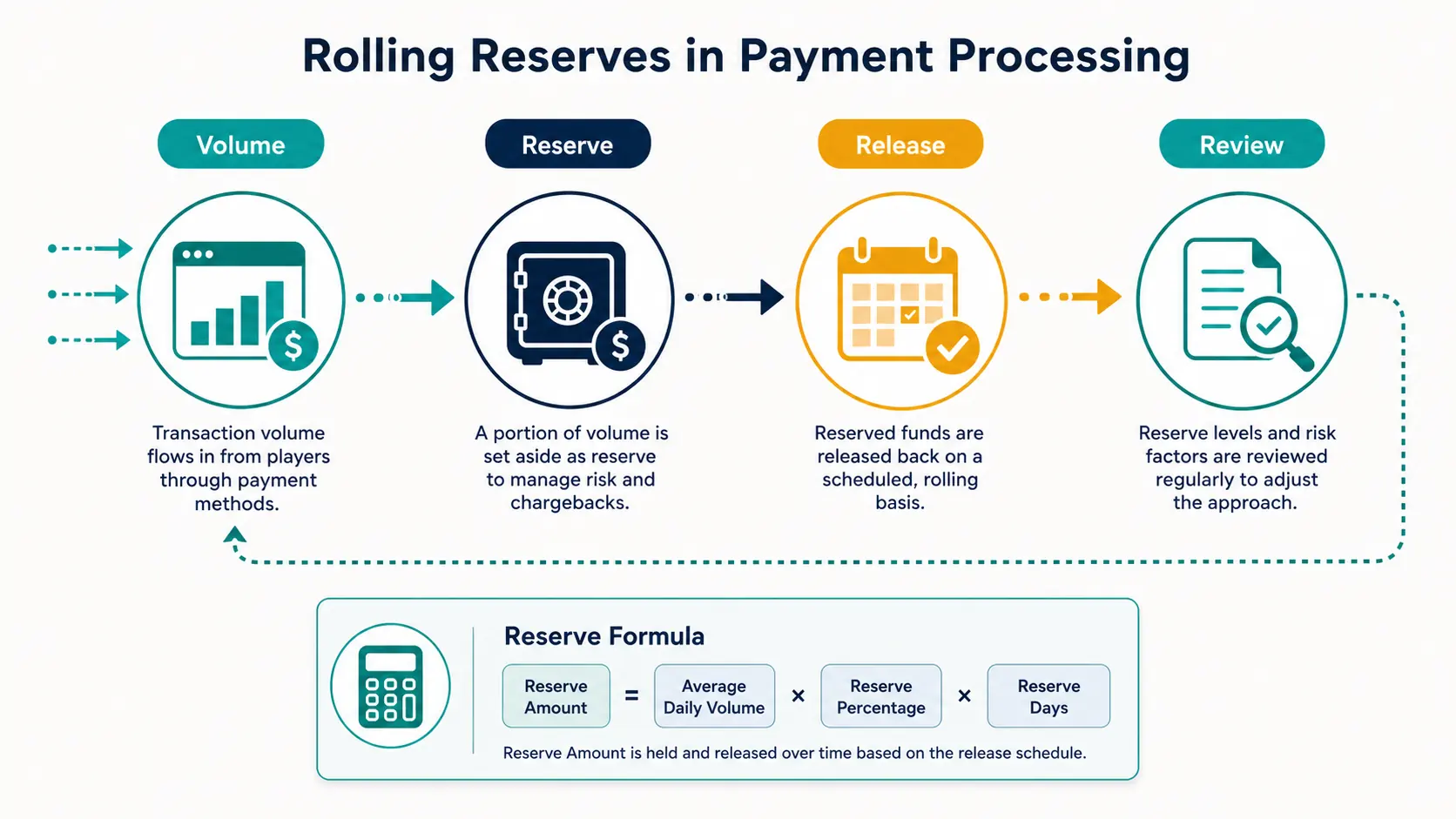
How rolling reserve iGaming payments work
| Term | Meaning | Question to ask |
|---|---|---|
| Base | Volume or settlement amount used in the calculation. | Gross captures, net settlements or another base? |
| Rate | Percentage retained. | Is it fixed, tiered or reviewable? |
| Window | Time before held funds are released. | Calendar days, transaction days or rolling days? |
| Trigger | Event that can increase or extend the reserve. | Chargeback rate, market change or processing outage? |
| Release | How retained funds return to the operator. | Automatic schedule or manual approval? |
Illustrative reserve calculation
Suppose a provider retains 8% of €150,000 in monthly eligible volume. The reserve contribution for that month is €12,000. If the provider releases funds after 120 days, the operator must model the overlap of multiple monthly contributions. The calculation is illustrative, not a market quote.
Reserve contribution = eligible settlement base × reserve rate
How to negotiate reserve terms
- Bring processing history by market, method, dispute status and settlement date.
- Show refund speed, fraud controls, customer support and reconciliation quality.
- Ask for a written release schedule and a review process.
- Propose staged limits or a lower rate after a verified mature period.
- Define what happens when a payment method or market is removed.
Operator pro-tip: Track reserve receivable as its own finance object. A recurring failure is treating held funds as available cash and then discovering that a seasonal volume spike creates a liquidity gap.
Failure scenarios
Problems arise when the base changes without notice, release dates are ambiguous, the provider applies reserve to refunds twice, or finance cannot match held funds to the original settlements. Reconcile daily inputs with a reserve ledger and escalate unexplained movements quickly.
Bottom line
Rolling reserve iGaming payments are manageable when the operator understands the formula, duration and release rules before launch. Use operational evidence to negotiate, but keep enough liquidity for the reserve to behave exactly as written.
Our platform helps connect payment status and cash-flow context with CRM operations. Explore the AI-powered CRM for iGaming.
Reserve governance for finance teams
Finance should reconcile the reserve contribution, release and adjustment as separate ledger entries. Match each movement to the provider statement and settlement period that generated it. If a provider changes the reserve rate, preserve the notice and apply the new rule only from the agreed effective date.
Operations can support a reserve review by reporting payment-method mix, refund speed, dispute reasons, fraud-review outcomes, customer-support backlog and data freshness. These signals do not guarantee a lower reserve, but they give the provider a clearer view of how exposure is controlled.
Model seasonality before agreeing to a term. A reserve that looks manageable during a low-volume month may overlap across several periods when acquisition increases. Include best-case, expected and stress scenarios.