
Last Updated on September 14, 2026 by Caesar Fikson
Executive Briefing
- iGaming CRM GDPR compliance starts with purpose, lawful processing, data minimisation, accuracy, storage limitation, and demonstrable controls.
- Map where player data enters, changes, leaves, and is deleted.
- Separate service, regulatory, responsible-gaming, analytics, and marketing purposes.
- Use access, erasure, consent, suppression, retention, and audit workflows that operators can actually evidence.
iGaming CRM GDPR compliance is not a checkbox inside a marketing platform. It is the discipline of making every player-data workflow explainable: why the data is collected, what purpose it serves, who can access it, how long it is retained, and what happens when a player exercises a right or a control changes.
We treat legal compliance as a design input rather than a final review. The European Commission’s overview of GDPR principles describes requirements including lawful and transparent processing, purpose limitation, data minimisation, accuracy, and storage limitation; operators should also obtain advice for their specific jurisdictions and role allocation. Read the GDPR principles.
What is iGaming CRM GDPR compliance?
Key Definition: iGaming CRM GDPR compliance is the documented alignment of CRM data collection, processing, segmentation, messaging, access, retention, deletion, and audit with applicable GDPR requirements and the operator’s approved policies.
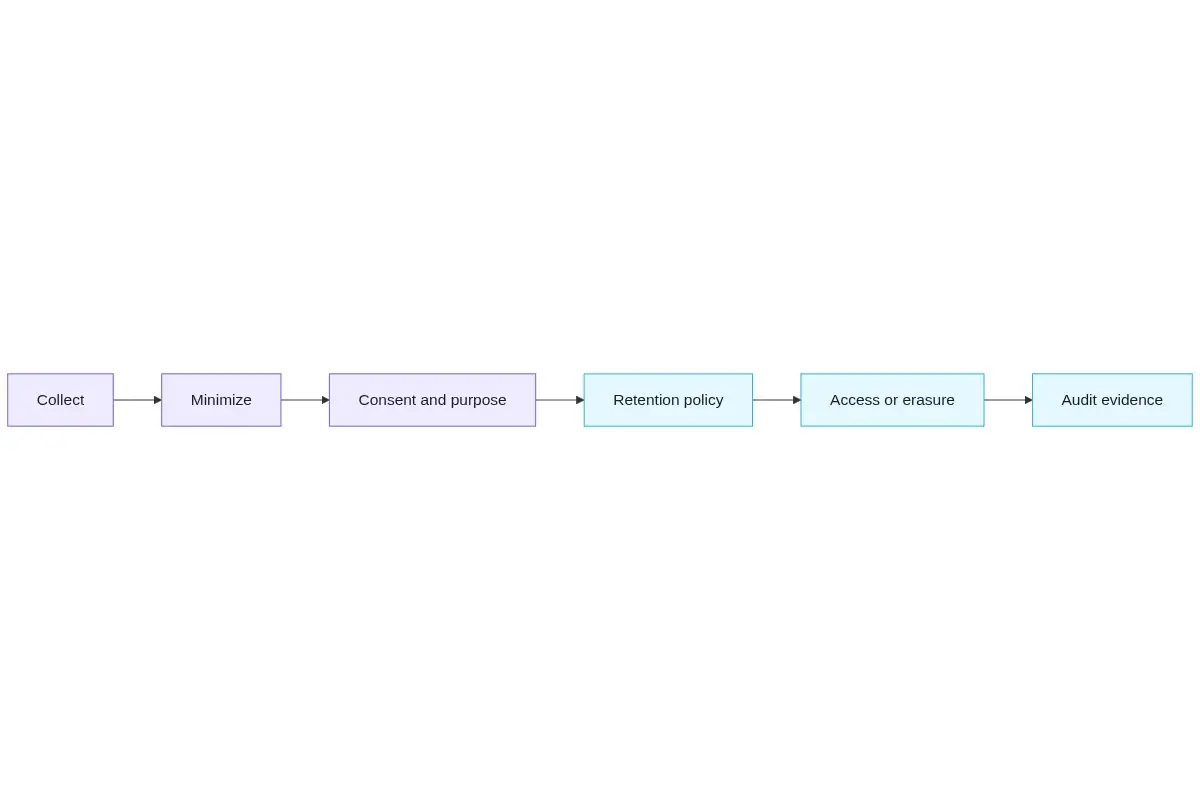
Start with a purpose and data inventory
List each CRM data category and its purpose. Registration data, verification state, payment references, product behavior, consent, support notes, responsible-gaming restrictions, and analytics attributes do not automatically share the same purpose or retention period.
| Data area | Purpose question | Control to evidence |
|---|---|---|
| Identity and verification | What operational or legal need requires it? | Access control, accuracy, retention |
| Marketing consent | Which purpose and channel does it cover? | Source, timestamp, withdrawal, suppression |
| Behavioral events | What decision or service does the event support? | Minimisation, profiling transparency |
| Support history | Who needs the context and for how long? | Role access, redaction, retention |
| Protection state | Which control must block commercial action? | Fail-closed suppression and audit |
Data minimisation in a CRM
Data minimisation means collecting and processing only what is necessary for the purpose. A campaign may need a preferred channel, language, market, and eligibility state; it may not need the full payment history. A support agent may need transaction references, not an unrestricted export of every player event.
In our platform, we advise teams to define audience fields separately from raw event history. A segment should expose the attributes needed for the decision, while access to detailed history remains controlled and purposeful.
Consent, lawful purpose, and suppression
Consent is one possible legal basis, not a universal label for every processing activity. Operators should document the relevant purpose and legal basis with their privacy counsel. Marketing consent must be channel-aware and reversible. Withdrawal should update future eligibility quickly, including queued journeys where appropriate.
Suppression is a practical privacy and safety control. It should cover opt-outs, self-exclusion, cooling-off, affordability or risk restrictions, jurisdiction restrictions, and internal do-not-contact states. Test whether suppression wins when multiple systems disagree.
Retention, access, and erasure workflows
A retention policy should state the purpose, period, owner, legal or regulatory dependency, and disposal method. “Keep forever just in case” is not a defensible CRM policy. Some records may need to be retained for regulatory, fraud, financial, or dispute reasons; document why and separate them from unnecessary marketing attributes.
For a rights request, identify the person, locate systems and processors, verify scope, apply approved exceptions, complete the action, and record evidence. Erasure may require deletion, anonymisation, suppression, or restricted retention depending on the record and applicable law. Do not promise a universal deletion outcome without reviewing the facts.
GDPR and CCPA: related but not interchangeable
The CCPA gives California consumers rights that include knowing what information is collected and how it is used or shared, deletion with exceptions, opting out of sale or sharing, and non-discrimination for exercising rights, according to the California Attorney General’s official overview. Review the CCPA overview. Its applicability, definitions, and obligations differ from GDPR, so a single “global consent” field is rarely enough.
Use a privacy matrix by market, product, purpose, channel, and data class. When an operator serves multiple jurisdictions, the CRM should preserve the source and reason for a decision rather than hiding differences behind a single boolean.
Profiling and automated decisions
Churn scores, VIP tiers, propensity segments, and next-best-action rules can involve profiling. Give the workflow an owner, reason codes, model version, input window, and review path. A score should prioritize attention; it should not silently make a consequential decision that the operator cannot explain.
Warning:
Do not treat pseudonymisation as the same as anonymisation, or a vendor contract as proof that a workflow is compliant. Check re-identification risk, access, transfers, processors, retention, and actual system behavior.
Operational failure scenarios
- A consent withdrawal updates the CRM but not the outbound messaging queue.
- An erasure request removes a profile but leaves identifiable exports in analytics storage.
- A protection state is overwritten by a later product update.
- A vendor receives more fields than the documented purpose requires.
- A model score is used for a new purpose without transparency or review.
- Retention jobs delete data needed for a documented regulatory or dispute process.
iGaming CRM privacy checklist
- Inventory data, purpose, system, owner, and processor.
- Document legal basis and market-specific requirements with counsel.
- Minimise audience fields and restrict detailed history.
- Record consent source, purpose, channel, timestamp, and withdrawal.
- Test suppression across queued and multi-product journeys.
- Define retention, deletion, anonymisation, and restricted-retention rules.
- Log rights requests and evidence of completion.
- Keep profiling and automated-decision workflows explainable.
Frequently asked questions about iGaming CRM GDPR compliance
nWhat is iGaming CRM GDPR compliance?
Does GDPR allow an iGaming operator to store all player data forever?
How should a CRM handle a GDPR access or erasure request?
What is the difference between GDPR and CCPA for iGaming CRM?
Can an iGaming CRM use player data for automated decisions?
Strong iGaming CRM GDPR compliance makes privacy visible in the daily workflow: the right data, for the right purpose, for the right time, with evidence. Our AI-powered CRM for iGaming helps operators build those controls into segmentation and orchestration; [learn more about our platform](https://www.nowg.net/).