Last Updated on September 13, 2026 by Caesar Fikson
Casino licence costs vary from under €20,000 total first-year cost (Curaçao, Anjouan) to over €500,000 (UKGC full operator licence with compliance infrastructure). Here is the honest breakdown by jurisdiction:
- Cheapest credible licence: Curaçao — approximately €15,000–€25,000 first year total, accepted by most payment processors, limited player protection credibility
- Best value tier-1 equivalent: Malta (MGA) — €25,000 application + €25,000 annual compliance contribution + €5,000–€15,000 legal fees + platform costs = approximately €60,000–€100,000 first year
- Most expensive tier-1: UK Gambling Commission — €100,000–€500,000+ first year depending on revenue tier, most demanding compliance infrastructure
- The cost nobody publishes: compliance infrastructure, legal counsel, AML programme implementation, and responsible gambling tooling add 50–150% on top of the licence fee itself — the licence fee is not the total cost
- The decision framework: your target player market, not your budget preference, should determine your jurisdiction — a cheap licence that does not allow you to accept payments from your target market is not cheaper, it is unworkable
The question “how much does a casino licence cost?” has a straightforward answer and a complicated one. The straightforward answer is the application fee plus the annual licence fee published on the regulator’s website — a number that ranges from a few thousand euros to several hundred thousand depending on jurisdiction. The complicated answer is the total first-year cost of being a licensed casino operator: application fee, annual licence fee, legal counsel for the application, compliance infrastructure, responsible gambling tooling, AML programme implementation, and the opportunity cost of the 3–12 month application timeline.
This guide provides the complicated answer, jurisdiction by jurisdiction, with 2026 numbers. It is designed to be used as an actual cost estimator — specific enough to build a first-year budget model, honest enough to avoid the surprises that cause operators to run out of capital before they reach profitability.
The Five Cost Components Every Casino Licence Involves
Before the jurisdiction breakdown, the cost structure. Every casino licence involves five cost components regardless of jurisdiction — what varies is the magnitude of each component and which ones are explicitly billed versus implicitly required.
Component 1: Application Fee
The one-time fee paid to the regulator when you submit your licence application. Ranges from €0 (some jurisdictions) to €50,000+ (UKGC, depending on application type). Non-refundable in most jurisdictions regardless of outcome. The application fee is typically the most visible cost in licence cost comparisons and often the least significant in total cost context.
Component 2: Annual Licence Fee
The recurring annual fee for maintaining the licence. Ranges from €2,000/year (Curaçao B2C sublicence) to €500,000+/year (UKGC, revenue-based). In some jurisdictions this is a flat fee; in others it scales with gross gaming revenue. Revenue-based annual fees that look modest at launch become significant costs at scale — model the annual fee at your 3-year revenue projection, not at your launch estimate.
Component 3: Legal and Compliance Counsel
Legal fees for licence application preparation, compliance programme development, and ongoing regulatory support. The most underestimated cost in most licence cost calculations. A Malta MGA application prepared without specialist iGaming legal counsel has a significantly lower approval probability — the application documentation requirements are detailed and regulator-specific, and errors or omissions extend timelines or result in rejection. Budget €10,000–€50,000 for legal counsel depending on jurisdiction complexity, and assume ongoing monthly legal support costs of €2,000–€5,000 post-licence.
Component 4: Compliance Infrastructure
The technology and processes required to meet the regulator’s ongoing compliance requirements: AML transaction monitoring systems, KYC verification infrastructure, responsible gambling tooling (deposit limits, self-exclusion, reality checks), player fund segregation banking arrangements, and regulatory reporting systems. These costs are not part of the licence fee itself but are requirements for maintaining the licence in good standing. Budget €20,000–€100,000 in first-year compliance infrastructure costs depending on jurisdiction, excluding the platform costs that may already include some compliance components.
Component 5: Platform and Operational Costs
The casino platform, payment processing, game content aggregation, and operational team costs that enable the licensed operation to function. These are covered in the platform provider guides and are not technically part of the licence cost — but they are part of the total capital requirement to go live as a licensed operator and should be included in any startup cost model. First-year platform and operational costs for a new licensed operator typically range from €50,000 to €300,000 depending on platform model and market scope.
Jurisdiction-by-Jurisdiction Cost Breakdown (2026)
Malta (MGA — Malta Gaming Authority)
Application fee: €5,000 (non-refundable) for a B2C Gaming Service Licence application.
Annual compliance contribution: €25,000 per year for a B2C Gaming Service Licence (Class 1 — casino). This is the primary recurring licence cost and is fixed regardless of revenue for most licence categories.
Legal counsel: €15,000–€40,000 for application preparation with a specialist iGaming legal firm. Malta has the deepest ecosystem of iGaming legal specialists globally, which keeps costs more competitive than equivalent legal work in the UK or Gibraltar.
Compliance infrastructure: €15,000–€30,000 first year for AML programme implementation, KYC provider integration, and responsible gambling tooling meeting MGA requirements. Player fund segregation requires a separate bank account with a licensed bank, which adds administrative setup costs.
Timeline: 3–6 months for a straightforward application. Complex applications or applicants from certain jurisdictions take longer. The MGA conducts fit-and-proper assessments on all key personnel and significant shareholders.
What MGA enables: Accepted by most payment processors globally for merchant account applications. Recognised by Google, Apple, and Meta for advertising permissions in most markets. Allows operators to serve players in markets that accept MGA-licensed operators without requiring local market licences (significant for EU markets outside those with national licensing requirements).
UK Gambling Commission (UKGC)
Application fee: Varies by application type and revenue projection. A standard remote casino operating licence application costs £29,115 for operators projecting under £10 million annual revenue. Higher revenue tiers carry higher application fees scaling to £90,000+ for large operators.
Annual licence fee: Revenue-based, scaling from £6,200/year for the smallest operators to over £100,000/year for large operators. The fee is calculated on the previous year’s actual revenue, meaning it increases as the business grows.
Legal counsel: €30,000–€80,000 for UKGC application preparation. The UKGC application is the most documentation-intensive of any major gambling licence — compliance programme documentation alone can run to hundreds of pages. UK iGaming legal firms specialising in UKGC applications typically charge more than their Malta equivalents.
Compliance infrastructure: €50,000–€200,000 first year. UKGC compliance requirements are the most demanding globally: mandatory affordability checks, enhanced due diligence for higher-spending customers, monthly regulatory returns, real-time responsible gambling tool implementation, and the Social Responsibility Code provisions that carry direct licence risk if breached. AML programme implementation to UKGC standards requires specialist compliance staff or external compliance consultancy.
Timeline: 4–9 months. The UKGC conducts detailed fit-and-proper assessments including criminal record checks across multiple jurisdictions for all key personnel and significant shareholders.
What UKGC enables: Access to the UK gambling market — the largest regulated online gambling market in the world by revenue. Essential for operators targeting UK players. UK advertising permissions, payment processor acceptance, and app store permissions in the UK all require UKGC licensing.
Curaçao (Gaming Control Board)
Application fee: Approximately €2,000–€5,000 for initial application processing. Curaçao reformed its licensing framework in 2023–2024 under the National Ordinance on Offshore Games of Hazard (NOOGH) — the new framework introduced direct licensing with the Gaming Control Board rather than the previous sublicence-under-master-licence model.
Annual licence fee: Approximately €8,000–€15,000 per year for a standard B2C casino licence under the new framework. Some operational fees apply quarterly. The exact fee structure has evolved as the new regulatory framework has been implemented — verify current fees directly with the Gaming Control Board or through a licensed Curaçao legal agent.
Legal counsel: €5,000–€15,000. The Curaçao application is less documentation-intensive than MGA or UKGC, and the legal ecosystem for Curaçao applications is competitive. Most operators use a local Curaçao entity and a licensed agent to manage the application.
Compliance infrastructure: €5,000–€15,000 first year. Curaçao compliance requirements are significantly less demanding than tier-1 jurisdictions. This is both an advantage (lower cost) and a limitation (less credibility with payment processors and some player markets).
Timeline: 1–3 months under the new framework, making it the fastest major jurisdiction for licence issuance.
What Curaçao enables and what it does not: Accepted by many payment processors as a legitimate gambling licence. Allows operation in markets that do not have locally regulated gambling (the majority of global markets). Does not grant access to regulated EU markets, UK, or most Tier-1 markets where local licensing is required. Google advertising typically requires at least MGA or equivalent for casino advertising permissions — Curaçao alone is insufficient in most Google markets.
Gibraltar Regulatory Authority (GRA)
Application fee: £20,000–£30,000 depending on application type. Gibraltar is known for being selective about who they license — the regulator conducts detailed assessments and the acceptance rate is lower than MGA.
Annual licence fee: £85,000/year for a remote gaming licence. This is higher than the MGA’s flat annual fee and makes Gibraltar more expensive at the annual renewal stage than Malta for operators who qualify for both.
Legal counsel: €20,000–€50,000. Gibraltar has a smaller but high-quality legal ecosystem for iGaming applications. The selectivity of the GRA means legal preparation quality has direct impact on application outcome.
Compliance infrastructure: €20,000–€40,000 first year. GRA compliance requirements are rigorous — comparable to MGA in depth, with specific requirements for AML controls, responsible gambling, and player fund protection.
Timeline: 4–8 months. The GRA is known for thorough fit-and-proper assessments.
Isle of Man Gambling Supervision Commission (GSC)
Application fee: £5,000 for an online gambling licence application. One of the lower application fees among tier-1 jurisdictions.
Annual licence fee: £5,000–£35,000 per year depending on operator size and revenue (revenue-based scaling). The GSC fee structure is competitive for smaller operators and scales reasonably with growth.
Legal counsel: €15,000–€35,000. Isle of Man has a smaller but capable legal ecosystem for iGaming applications, with costs that are generally lower than UK or Gibraltar equivalents.
Compliance infrastructure: €15,000–€30,000 first year. GSC compliance requirements are rigorous and the regulator has a strong reputation for taking enforcement action seriously. AML and responsible gambling programme requirements are detailed.
Timeline: 3–6 months.
Nationally Regulated EU Markets (Germany, Netherlands, Sweden, Denmark)
Germany (GlüNeuRStV), the Netherlands (KSA), Sweden (Spelinspektionen), and Denmark (Spillemyndigheden) all require local market licences for operators who want to legally accept players from those countries. An MGA or other base licence does not grant access to these markets — a separate national application is required for each.
Germany GlüNeuRStV licence: Application fee €20,000 + annual licence tax based on revenue (6.75% of virtual slots/poker revenue). Compliance requirements include stake limits (€1/spin for slots), mandatory identity verification at registration, real-time transaction monitoring, and market-specific product restrictions. Total first-year cost including legal, compliance, and fees: €80,000–€150,000.
Netherlands KSA licence: Application fee €48,000 (non-refundable, paid in stages). Annual gambling tax of 34.2% of net gaming revenue from Dutch players — one of the highest gambling tax rates in the EU. Total first-year cost excluding gambling tax: €80,000–€120,000. The gambling tax burden makes Netherlands operations significantly more expensive than headline licence costs suggest.
Sweden Spelinspektionen licence: Application fee SEK 350,000 (~€30,000). Annual gambling tax of 18% of net gaming revenue from Swedish players. Total first-year cost excluding gambling tax: €50,000–€80,000.
Complete Cost Comparison Table
| Jurisdiction | Application fee | Annual licence fee | Legal counsel | Compliance infra (yr 1) | Timeline | Total yr 1 est. |
|---|---|---|---|---|---|---|
| Malta (MGA) | €5,000 | €25,000/yr | €15,000–€40,000 | €15,000–€30,000 | 3–6 months | €60,000–€100,000 |
| UK (UKGC) | £29,000–£90,000+ | Revenue-based | €30,000–€80,000 | €50,000–€200,000 | 4–9 months | €150,000–€500,000+ |
| Curaçao | €2,000–€5,000 | €8,000–€15,000/yr | €5,000–€15,000 | €5,000–€15,000 | 1–3 months | €15,000–€30,000 |
| Gibraltar | £20,000–£30,000 | £85,000/yr | €20,000–€50,000 | €20,000–€40,000 | 4–8 months | €70,000–€130,000 |
| Isle of Man | £5,000 | £5,000–£35,000/yr | €15,000–€35,000 | €15,000–€30,000 | 3–6 months | €50,000–€90,000 |
| Germany (GlüNeuRStV) | €20,000 | 6.75% revenue tax | €25,000–€50,000 | €30,000–€60,000 | 4–8 months | €80,000–€150,000 |
| Netherlands (KSA) | €48,000 | 34.2% NGR tax | €20,000–€40,000 | €20,000–€40,000 | 4–6 months | €80,000–€120,000 + 34.2% tax |
| Sweden (Spelinspektionen) | ~€30,000 | 18% NGR tax | €10,000–€25,000 | €15,000–€30,000 | 3–5 months | €50,000–€80,000 + 18% tax |
The Jurisdiction Selection Framework
Budget should not drive jurisdiction selection. Player market access should. These three questions produce the right jurisdiction decision faster than any cost comparison:
Question 1: Which markets do your target players live in?
If your target players are in the UK, you need a UKGC licence — no other licence grants legal access to UK players. If your target players are in Germany, Sweden, or the Netherlands, you need those national licences. If your target players are in markets without local licensing requirements (most of Asia, Latin America outside specific markets, Africa), an MGA or Curaçao licence provides the operational framework without the market access constraint. Starting with market access and working backward to the required licence is the correct sequence. Starting with the cheapest licence and hoping it covers your target markets is how operators end up with Curaçao licences trying to serve markets where Curaçao-licensed operators are illegal.
Question 2: Which payment processors do you need?
Payment processor requirements for gambling merchant accounts vary by processor and by the markets they service. Tier-1 processors (Visa, Mastercard, major acquiring banks) typically require MGA, UKGC, or equivalent tier-1 licensing. Mid-tier processors accepting Curaçao-licensed operators exist but are fewer in number and more variable in reliability. If your acquisition strategy requires specific payment methods (Trustly for Nordic markets, SEPA for EU, UK Faster Payments for UK), verify that those payment processors accept your chosen licence jurisdiction before finalising the licence decision.
Question 3: What is your advertising strategy?
Google, Meta, and Apple have specific licence requirements for gambling advertising permissions. Google’s gambling advertising policy requires MGA, UKGC, or equivalent for most markets. Curaçao alone is insufficient for Google advertising permissions in most tier-1 markets. If paid search or social media advertising is a primary acquisition channel, your licence jurisdiction must meet the advertising platform’s requirements for your target geographies. Operators who discover this limitation after obtaining a Curaçao licence and building an acquisition strategy around Google advertising face an expensive late-stage licence upgrade.
The Total Capital Requirement: Licence Plus Everything Else
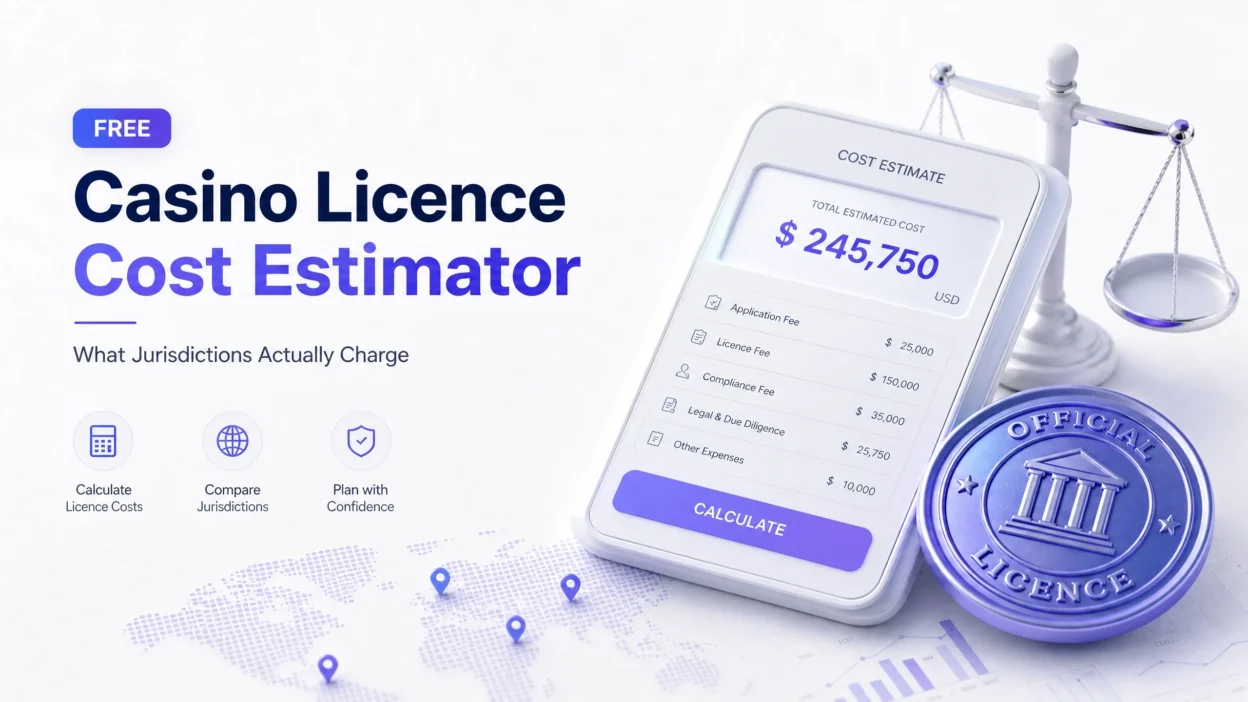
The total first-year capital requirement for a new licensed online casino operator is substantially higher than the licence cost alone. For operators using our interactive casino licence cost estimator tool, the full model includes all five cost components. For a quick rule-of-thumb total capital requirement by approach:
- Minimum viable launch (Curaçao licence + white label platform + minimal marketing): €80,000–€150,000 total first-year capital. Achievable but leaves very little runway for the 6–18 months typically needed to reach profitability.
- Credible mid-market launch (MGA licence + mid-market platform + proper marketing budget): €300,000–€600,000 total first-year capital. The range reflects platform choice, market scope, and marketing investment level.
- Tier-1 regulated market launch (UKGC or national EU licence + full-stack platform + compliance team + marketing): €500,000–€2,000,000+ total first-year capital. The upper end represents operators entering the UK or German market with a serious marketing budget and full compliance infrastructure.
These estimates exclude player acquisition costs beyond the first-year marketing budget and the working capital required to cover player withdrawals and bonus liabilities in the early months before revenue stabilises. The full guide to starting an online casino in 2026 covers the operational context that explains why a significant proportion of new casino launches fail within 18 months — and what capital planning prevents that outcome. For the platform costs that represent the other major budget line, the iGaming platform provider guide, the casino platform comparison, and the free casino management evaluation guide cover what platform investment looks like at different operator scales.
Frequently Asked Questions
How much does a casino licence cost?
Casino licence costs vary significantly by jurisdiction. Application fees range from 2,000 euros (Curaçao) to 90,000+ pounds (UKGC). Annual licence fees range from 8,000-15,000 euros per year (Curaçao) to 25,000 euros per year (Malta MGA) to revenue-based fees exceeding 100,000 pounds per year (UKGC for large operators). Total first-year costs including legal counsel and compliance infrastructure range from 15,000-30,000 euros (Curaçao) to 60,000-100,000 euros (Malta MGA) to 150,000-500,000+ euros (UKGC). The licence fee itself is not the total cost — legal counsel, compliance infrastructure, and AML programme implementation add 50-150% on top of the licence fee in most jurisdictions.
How much does it cost to start an online casino?
Total first-year capital requirements for starting a licensed online casino range from 80,000-150,000 euros for a minimum viable launch (Curaçao licence plus white label platform), to 300,000-600,000 euros for a credible mid-market launch (Malta MGA licence plus mid-market platform plus marketing budget), to 500,000-2,000,000+ euros for a tier-1 regulated market launch (UKGC or national EU licence with full compliance infrastructure and marketing). These estimates exclude ongoing player acquisition costs and working capital for player withdrawals and bonus liabilities in the early months before revenue stabilises.
What is the cheapest casino licence?
Curaçao is currently the cheapest credible casino licence, with total first-year costs of approximately 15,000-30,000 euros including application fee, annual licence fee, legal counsel, and basic compliance infrastructure. Anjouan (Comoros) and some other small jurisdictions are cheaper but are not accepted by most payment processors or major advertising platforms. The cheapest licence that enables Google advertising permissions, tier-1 payment processor access, and operation in most global markets is Malta MGA at approximately 60,000-100,000 euros in the first year.
How long does it take to get a casino licence?
Casino licence timelines range from 1-3 months for Curaçao to 3-6 months for Malta MGA and Isle of Man to 4-9 months for UKGC applications. National EU market licences (Germany, Netherlands, Sweden) typically take 3-8 months. Timelines assume a complete and accurate application — incomplete applications, fit-and-proper assessment complications, or regulatory queries can extend these timelines significantly. Operators should factor the licence timeline into their capital planning, as the operation cannot generate revenue until the licence is issued.
Do I need a UK Gambling Commission licence to accept UK players?
Yes. Any operator accepting real-money bets from UK-based players must hold a UKGC remote operating licence, regardless of where the operator is based. Operating without a UKGC licence while accepting UK players is a criminal offence in the UK. A Malta MGA licence, Curaçao licence, or any other non-UK licence does not grant legal permission to accept UK players. This applies to online casino, sportsbook, poker, and all other gambling products. UKGC enforcement has included substantial fines and licence reviews for operators found to have accepted UK players without appropriate licensing.
What is the Malta MGA licence and is it worth the cost?
The Malta Gaming Authority (MGA) licence is a B2C Gaming Service Licence issued by Malta’s gambling regulator for operators serving players in markets that accept MGA-licensed operators. It costs approximately 5,000 euros in application fees plus 25,000 euros per year in compliance contributions, with 15,000-40,000 euros in legal counsel bringing total first-year cost to 60,000-100,000 euros. It is widely considered the best value tier-1 gambling licence — accepted by most payment processors, recognised by Google and Meta for advertising permissions in most markets, and credible with players in most EU and international markets. It does not grant access to locally regulated EU markets (Germany, Netherlands, Sweden) without additional national licences.
Want to model your specific licence and platform costs interactively? Use the free online estimator tool.
Open the Casino Licence Cost Estimator Tool →Last updated: April 2026 · Written for operators, investors, and entrepreneurs evaluating online casino startup costs before committing capital