
Last Updated on September 14, 2026 by Caesar Fikson
Key Takeaways
- Cookieless tracking iGaming affiliates can use first-party identifiers and server-side events without depending on third-party cookies.
- Privacy compliance still requires purpose, transparency, retention, security, and consent controls where applicable.
- Fingerprinting is not a magic replacement for cookies and can create accuracy and privacy problems.
- Build a durable event ledger and explain what happens when consent is absent or withdrawn.
Cookieless tracking iGaming affiliates is an attribution approach that relies on first-party data, server-side events, and explicit identifiers rather than assuming a third-party browser cookie will persist. It can make measurement more durable, but it does not remove privacy obligations or guarantee perfect attribution.
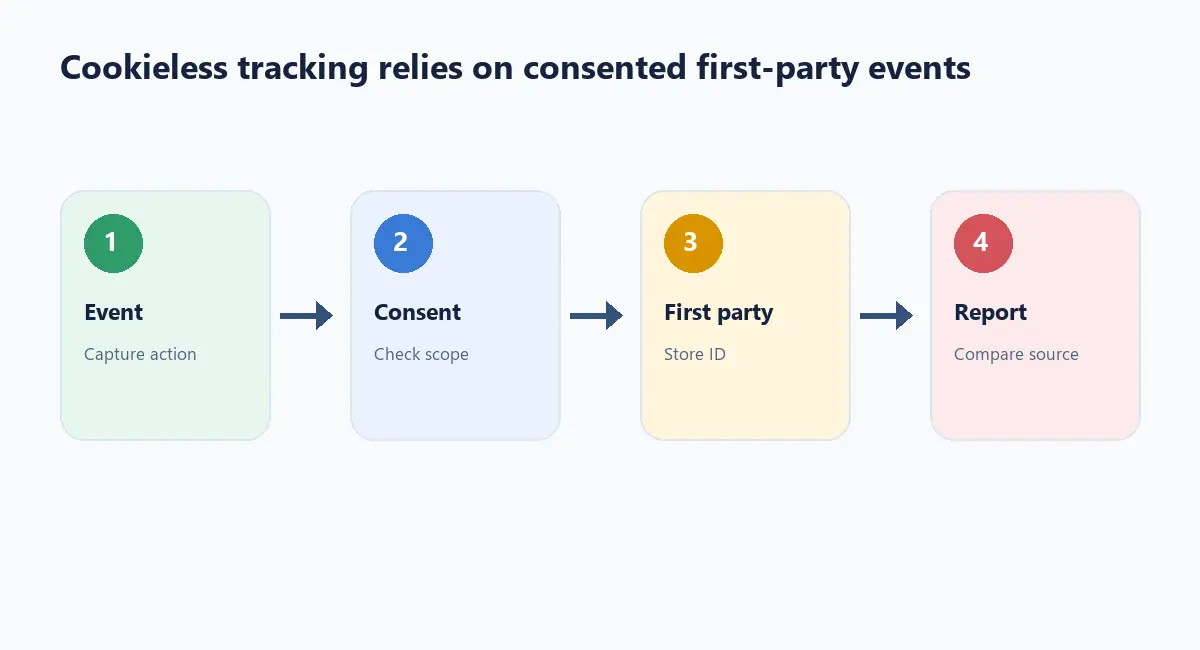
How cookieless tracking iGaming affiliates works
Key Definition: Cookieless affiliate tracking is the measurement of affiliate-originated events through first-party or server-side identifiers without relying on third-party cookies as the primary link.
A typical flow captures an affiliate click ID at the operator’s first-party boundary, stores it in a permitted system, associates it with an account or conversion event, and sends an authenticated postback to the tracker. The important design choice is to make the identifier meaningful only within a documented purpose and retention period.
| Method | Strength | Limit |
|---|---|---|
| Third-party cookie | Familiar and easy for basic use cases | Browser restrictions and privacy controls reduce durability |
| First-party click ID | Operator-controlled and easier to explain | Requires careful consent, storage, and lifecycle rules |
| Server-to-server event | Works across many browser conditions | Needs reliable event mapping and server access |
| Fingerprinting | May link signals when direct IDs are absent | Can be unstable, opaque, and privacy-sensitive |
First-party data and consent boundaries
First-party does not automatically mean unrestricted. Define the purpose of the click ID, the systems that may receive it, access controls, retention, deletion, and the player-facing explanation. The European Commission’s GDPR principles provide an authoritative reference for purpose limitation, data minimisation, accuracy, storage limitation, and security.
When consent is required and is absent, the system should record an unattributed or limited event rather than quietly reconstructing an identity. When consent is withdrawn, define whether future attribution stops, whether a stored event is deleted, and how reporting is restated.
Why fingerprinting has strict limits
Browser and device signals can change, be shared, or represent multiple people. A fingerprint match can also create an identity link the player did not expect. We typically advise teams to treat fingerprinting, where legally permitted at all, as a low-confidence signal for investigation rather than a sole basis for commission or marketing decisions.
Implementation checklist
- Define the affiliate attribution purpose and lawful basis.
- Choose a first-party click ID format and retention period.
- Document which events are captured before and after consent.
- Use S2S postbacks with authentication and replay protection.
- Separate attributed, unattributed, pending, rejected, and deleted states.
- Provide an audit trail for access, correction, suppression, and deletion.
- Test browser restrictions, consent withdrawal, delayed conversion, and cross-device journeys.
Operator pro-tip: report unattributed traffic as its own category. Hiding it inside a modelled attribution number makes data-quality and privacy trade-offs invisible.
Illustrative example
A player clicks an affiliate link, accepts the operator’s stated measurement purpose, registers, and later completes a verified conversion. The operator can associate the consented click ID with the event and send a server-side postback. If the player declines the relevant purpose, the conversion can still be counted in a privacy-respecting aggregate report without being linked to a personal profile.
Failure scenarios
A click ID may be stored longer than the stated purpose. A consent management platform may update the browser but not the event pipeline. The tracker may receive an event after the player has asked for deletion. A first-party identifier can be copied into a different site or campaign. Build expiry, correction, and deletion paths into the architecture rather than adding them after launch.
Conclusion
Cookieless tracking iGaming affiliates is most credible when it combines first-party clarity, server-side reliability, and privacy-by-design controls. It is not a promise of perfect measurement or a reason to ignore consent. For governed CRM and attribution workflows, visit NowG.net.