Implementation Summary
- Open banking casino deposits connect a player-authorized bank flow to the cashier and payment ledger.
- Make consent, bank verification, payment status and reconciliation explicit.
- Use API providers and account-information services only within the operator’s market and compliance model.
- Design for cancelled consent, bank refusal, duplicate callbacks and delayed confirmation.
How to Integrate Open Banking for Instant Casino Deposits — Open Banking Casino Deposits
Open banking casino deposits use a player-authorized bank connection or account-to-account payment flow to fund a casino wallet. The experience can reduce manual bank-transfer steps, but the integration still needs clear consent, authentication, payment status, refund and reconciliation rules.
We typically advise operators to assess the whole chain: the open-banking provider, bank connection, payment initiation, operator cashier, player account management system and finance ledger. “Instant” should describe the intended user experience, not hide pending or failed states.
Key Definition: Open banking casino deposits are player-authorized account-to-account payments initiated through regulated or approved banking interfaces and connected to a casino cashier.
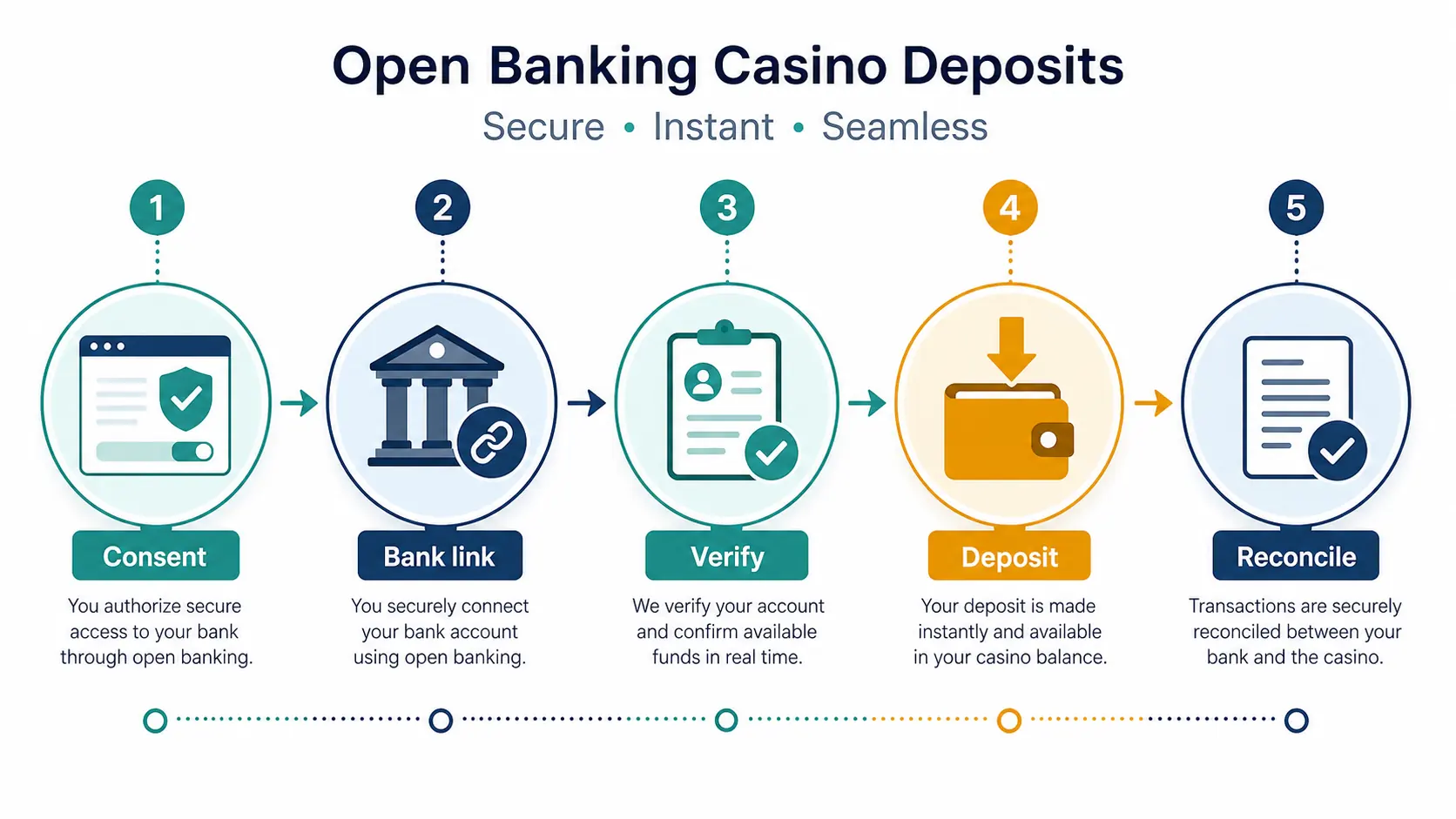
Open banking casino deposits: the integration flow
| Stage | System responsibility | Player-facing state |
|---|---|---|
| Consent | Provider explains data and payment authorization. | Choose bank and authorize. |
| Bank link | Securely connect to the selected bank. | Authenticate with bank. |
| Payment | Create and monitor the payment instruction. | Pending, accepted or failed. |
| Credit | Credit only after the agreed confirmation. | Balance updated. |
| Reconcile | Match provider, bank and PAM records. | Receipt and support trail. |
API and provider questions
- Which countries and banks are supported?
- Does the provider initiate payments, provide account information, or both?
- How are consent, revocation and re-authentication handled?
- Which webhooks confirm acceptance, settlement, refund or failure?
- How are duplicate instructions and abandoned sessions identified?
- What data is returned to the operator and how is it retained?
Implementation note: Never credit a casino balance from a client-side success screen alone. Confirm the server-side payment state and retain the provider reference.
Illustrative success-rate view
Suppose 1,000 deposit attempts produce 820 accepted payments, 100 cancelled authorizations and 80 bank or provider failures. The illustrative acceptance rate is 82%. Segment it by bank, device, error code and time of day; it is not a universal benchmark.
Edge cases to test
Test cancelled consent, bank maintenance, insufficient funds, duplicate payment initiation, a callback arriving before the cashier session closes, a refund requested after account closure, a currency mismatch and a player who retries with another bank. Each event needs an idempotency key and a support-readable reason.
Bottom line
Open banking casino deposits can create a smoother cashier when consent, payment states and reconciliation are engineered together. Treat the bank connection as part of the operator’s payment-control environment, not as a disconnected plug-in.
Our platform helps operators connect payment events to player and finance workflows. Explore the AI-powered CRM for iGaming.
Security, consent and support design
Make the consent record and payment reference available to support without exposing credentials or unnecessary banking data. When a player asks why a deposit is pending, support should see whether the instruction was cancelled, awaiting bank confirmation, rejected or credited.
Use signed webhooks, replay protection and idempotency keys. Test what happens when a callback arrives twice, out of order or after the player has closed the cashier. The internal ledger should accept the valid final state once and keep the event history.
Review the method after launch by bank, device, amount, error code and time window. This helps separate a provider outage from a confusing authorization screen or market-specific bank decline.