
Last Updated on September 13, 2026 by Caesar Fikson
Quick Answer
- Segment players by value, lifecycle stage, product behavior, risk, and communication eligibility—not by spend alone.
- Use RFM analysis as a starting point, then enrich it with deposits, wagering, withdrawals, support events, bonus behavior, and acquisition source.
- Turn each segment into a defined CRM action with a reason, a suppression rule, and a measurable next step.
- Judge CRM ROI on incremental contribution after bonus, payment, and communication costs, not on message volume.
If you are looking for iGaming player segmentation examples, the most useful examples are operational rather than theoretical. A casino or sportsbook needs segments that can change what the team does next: prioritize a VIP conversation, explain a failed payment, adjust onboarding, or pause promotional outreach while a compliance review is open.
In the integrations we review, the weakest segmentation schemes usually have one shared label such as “VIP” or “inactive.” That label may be easy to create, but it cannot explain why a player belongs there or which message is safe and relevant. A better model joins value, behavior, lifecycle, source, and eligibility into a working decision layer.
Key Definition: iGaming player segmentation is the process of grouping players by shared commercial, behavioral, lifecycle, and eligibility attributes so an operator can apply a relevant action to each group.
What useful player segmentation must accomplish
Segmentation is not just a reporting exercise. It is a way to make a large player base manageable without pretending that every player should receive the same treatment. A useful segment answers four questions:
- Who is in the group?
- Why are they in it?
- What action is appropriate now?
- What should prevent or stop that action?
The fourth question is easy to miss. A high-value player may also have a responsible-gambling restriction, an unresolved source-of-funds request, or a failed withdrawal. The value segment alone should never override a control or a player preference.
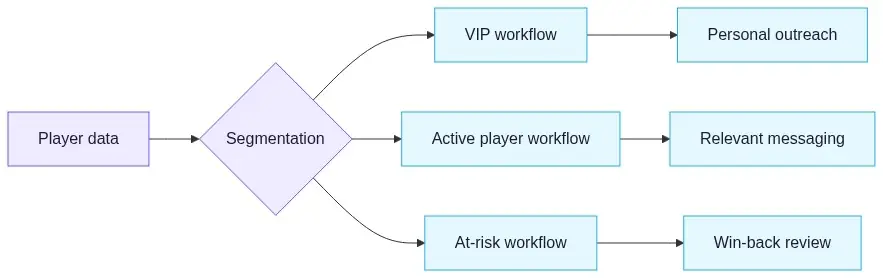
iGaming player segmentation examples by operating purpose
Start with the decision the operator needs to make, then work backward to the data. The following examples are practical building blocks rather than fixed universal categories.
| Segment family | Useful signals | Possible next action |
|---|---|---|
| Value | Net gaming revenue, margin contribution, frequency, bonus cost | Prioritize service, loyalty, or VIP review |
| Lifecycle | Registration, first deposit, first wager, repeat deposit, maturity | Move the player through onboarding or education |
| Behavior | Game mix, sportsbook activity, session rhythm, device changes | Personalize discovery or timing |
| Risk and control | KYC state, payment reversals, duplicate-account signals, exclusions | Hold promotion and route to review |
| Acquisition | Affiliate, campaign, sub-ID, GEO, landing-page path | Compare cohort quality and acquisition economics |
These families can overlap. A player can be a high-value sportsbook user, a new depositor on casino, and part of a cohort with weak retention. The platform should preserve those dimensions instead of forcing the player into one permanent bucket.
Build an RFM baseline, then add iGaming context
RFM—recency, frequency, and monetary value—is a useful baseline because it is understandable to CRM, marketing, and finance teams. It should not be the final model.
Recency
Recency can include the last deposit, last wager, last session, last support interaction, or last meaningful product event. A player who logged in yesterday but has not deposited for 60 days is different from a player who deposited yesterday but has not returned after a failed withdrawal.
Frequency
Frequency may be measured through deposits, sessions, active days, bets, or game launches. Choose the event that matches the decision. A sportsbook team may care about active betting days; a casino team may care about repeat sessions and redeposits.
Monetary value
Gross deposits are easy to report but incomplete. A more useful value layer considers NGR, bonus cost, payment cost, chargebacks, and service effort where those fields are available.
Illustrative value formula
Contribution value = NGR − bonus cost − payment cost − variable service cost
For an illustrative player with €420 NGR, €80 in bonus cost, €18 in payment cost, and €12 in variable service cost, contribution value is €310. These numbers are examples, not a benchmark or a claim about any client.
Once the baseline exists, add iGaming-specific context: product preference, bonus dependency, withdrawal behavior, KYC stage, responsible-gambling controls, and the source that brought the player to the operator.
From segments to triggers: the operational layer
A segment becomes useful when it can trigger a controlled workflow. We typically advise teams to define the event, the audience, the message, and the stop condition in the same rule.
| Trigger | Audience logic | Guardrail |
|---|---|---|
| First deposit completed | New depositor with no meaningful wager | Do not resend if an onboarding message is already active |
| Activity falls below a personal baseline | Previously active player without an open control case | Exclude self-excluded, opted-out, and restricted players |
| VIP value changes | High-value player with a sustained decline | Route service issues before sending an incentive |
| Repeated payment failure | Player with multiple failed attempts in a defined period | Use support or payment guidance, not a generic bonus |
For a platform that supports player-specific experiences, segmentation can also influence the lobby or content path. See how our dynamic front-end workflows can be connected to player context, while a safe test environment such as our synthetic sandbox can help teams rehearse rule changes before exposing them to live players.
A practical implementation checklist
- Write one sentence defining each segment and the decision it supports.
- Identify the source fields and the refresh frequency for each signal.
- Separate descriptive tags from action-ready audiences.
- Add explicit exclusions for consent, responsible gambling, compliance, fraud, and support cases.
- Set a review date so segments do not become permanent labels by accident.
- Give CRM managers a visible reason code rather than only a score.
- Measure incremental contribution after costs, not just clicks or opens.
Operator warning: Never let a high-value label override a player protection control. A segment should make a compliant action easier to select, not create a shortcut around verification, exclusion, consent, or support escalation.
Edge cases that break otherwise good segmentation
Players do not always behave in a single-brand, single-device, single-product journey. A player may switch from mobile to desktop, move between casino and sportsbook, travel between jurisdictions, or share a household network with another legitimate user. A data delay can also make a recently completed deposit appear missing, causing an unnecessary win-back message.
To manage these cases, preserve event timestamps, source-system identifiers, and an explanation of why a segment changed. When an operator configures this workflow, we recommend a short cooling period for events that arrive out of order and a human review path for high-impact changes.
How to judge CRM ROI from segmentation
The commercial question is not “How many segments did we create?” It is “Did the segment-based action produce more contribution than the cost of reaching and servicing the audience?” A simple starting point is:
Incremental CRM ROI = (incremental contribution from treated audience − campaign cost) ÷ campaign cost
For an illustrative test, suppose a treated cohort creates €9,600 in incremental contribution, the campaign costs €2,400, and the comparable holdout suggests the contribution is genuinely incremental. The illustrative ROI is (€9,600 − €2,400) ÷ €2,400 = 3.0, or 300%. The example is a calculation model, not verified performance data.
Use holdouts where possible, but also inspect unwanted effects: increased bonus cost, support volume, complaint rate, opt-outs, payment friction, or activity that is simply pulled forward from a later date.
Review segments as operating rules, not permanent labels
Segment definitions should have an owner and a review cadence. A rule that worked during a launch period may become misleading when product mix, payment methods, market coverage, or bonus policy changes. We recommend recording the segment version, the fields used, and the reason for the last change.
Watch for drift in both the audience and the action. If a segment grows unexpectedly, inspect whether a source field changed, an event stopped arriving, or a default value began classifying unknown players as active. If a workflow produces more complaints or support work, the segment may still be accurate while the action is no longer appropriate.
A monthly review can be enough for stable lifecycle groups; fast-moving risk or payment segments may need daily monitoring. The objective is not to create meetings around labels. It is to make sure the label still represents a decision the operator is willing to take.
What are iGaming player segmentation examples?
How should an operator segment high-value and casual players?
What data should an iGaming CRM use for player segmentation?
How does RFM analysis improve iGaming CRM ROI?
What guardrails should iGaming player segments include?
Conclusion
The best iGaming player segmentation examples are not lists of attractive labels; they are repeatable rules that connect player context to a relevant and controlled action. Start with RFM, enrich it with the operational realities of iGaming, and measure the resulting decision against contribution rather than vanity metrics.
To see how we connect player data, workflows, and operator guardrails, visit NowG, our AI-powered iGaming CRM platform.