Last Updated on September 13, 2026 by Caesar Fikson
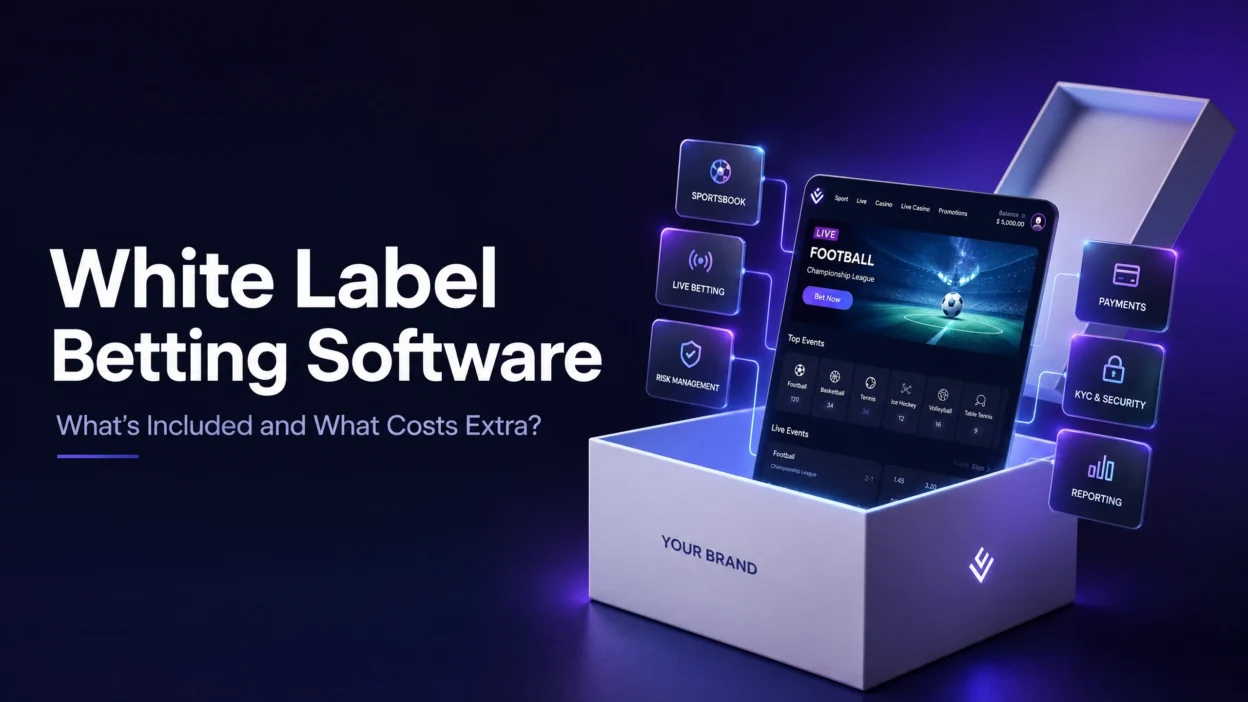
White label betting software vendors publish what is included. They do not publish what costs extra. Here is the honest breakdown of both:
- Almost always included: branded front-end, pre-match sports coverage, basic in-play betting, player account management, standard payment methods, and a back-office reporting dashboard
- Often charged as add-ons: managed trading service, live streaming, esports depth, virtual sports, casino cross-sell, additional payment methods, and market-specific compliance tooling
- Almost never included despite being implied: marketing budget, player acquisition infrastructure, SEO tooling, CRM, affiliate platform, and the operational staff to run any of it
- The most expensive hidden cost: revenue share that seems modest at launch becomes the largest monthly cost as your sportsbook grows — model what 25% of GGR looks like at your 24-month revenue projection, not your month-one estimate
- The alternative worth understanding: turnkey sportsbook solutions give you more operational control at higher upfront cost — the right choice depends on your operational capacity and growth timeline
White label betting software proposals have a consistent structure: a feature list that covers every major product dimension, a revenue share percentage that looks reasonable, and a launch timeline that seems achievable. What they rarely contain is a complete picture of what costs extra, what requires additional procurement, and what the total cost of operation looks like at scale rather than at launch.
This guide fills that gap. It covers every component of a white label betting software package, distinguishes what is genuinely standard from what is typically an add-on, and explains the pricing structures that produce the gap between what operators expect to pay and what they actually pay at 12 and 24 months of operation.
The Standard White Label Betting Software Package
These are the components that virtually every credible white label betting software provider includes in their standard package. If a vendor does not include all of these as standard, their pricing model is unusual enough to warrant explicit clarification before proceeding:
Branded Front-End and Player Interface
Every white label betting software package includes a player-facing front-end that the operator brands with their logo, colour scheme, and domain. What varies significantly between vendors is the degree of customisation available within that front-end. Some white label products offer deep UI configuration — custom layouts, configurable widget positions, custom homepage content — while others offer logo and colour replacement on a fixed template that is identical across all operators on the platform.
The customisation depth affects product differentiation. Operators on a fixed-template white label with logo-only customisation will have products that experienced players can identify as sharing the same underlying technology. This is less of a competitive problem in markets where brand trust is the primary differentiator and more of a problem in markets where product experience is a player retention factor.
Mobile experience quality is where the most significant variation between white label packages appears. A mobile-responsive desktop design is not the same as a mobile-native experience. Test the white label product on a mid-range Android device on 4G connection — not the vendor’s demo hardware — before evaluating the mobile experience as “included.”
Pre-Match Sports Coverage
Standard white label betting software includes pre-match odds and markets for major sports — football, basketball, tennis, cricket, and typically American sports for US-facing products. The specific coverage breadth (how many sports, how many leagues, how many markets per event) is what distinguishes vendors. Every provider claims “comprehensive coverage.” The coverage that matters is the specific leagues and markets your target players bet on.
Tier-2 sports and league coverage is where gaps appear. A European operator whose players bet heavily on lower-division football (Leagues 2 and 3 in England, lower-tier domestic leagues across Europe) needs to verify that coverage specifically, not just confirm that “football is included.” The same applies to regional sports: rugby league vs. rugby union, GAA for Irish operators, Australian rules football for ANZ markets.
Live (In-Play) Betting
Basic live betting is included in virtually all white label betting software packages. What “included” means ranges from live match scores with a handful of available markets (match winner, next goal scorer) to deep in-play market coverage with real-time odds updates across 50+ markets per live event. The depth difference is not cosmetic — operators whose players are experienced bettors expect deep in-play market coverage, and thin in-play products drive those players to competitors.
Live betting latency is the technical quality signal that demos cannot adequately represent. Odds updates that are 3–5 seconds behind market-forming events create arbitrage opportunities for sharp bettors and liability exposure for operators. Ask specifically about the latency from real-world event to odds update in the live betting product, and what the automated risk response is when a goal is scored or a key player is injured.
Player Account Management (PAM)
White label betting software includes a PAM layer covering player registration, basic identity verification, wallet management, deposit and withdrawal processing, and responsible gambling controls (self-exclusion, deposit limits, reality checks). In the white label model, the PAM is operated by the vendor on behalf of the operator — player data, financial transactions, and compliance records live on the vendor’s infrastructure.
The compliance configuration within the PAM is what determines whether the white label product is operable in your target regulatory jurisdiction. Generic white label PAMs with configurable responsible gambling controls are different from jurisdiction-specific implementations that have been built and tested for specific regulatory requirements. Ask specifically which jurisdictions the PAM has been deployed in with licensed operators and what compliance certifications or regulator approvals exist for those deployments.
Back-Office and Reporting Dashboard
Every white label betting software package includes an operator back-office covering player management, transaction reporting, bonus management, and basic analytics. The quality of this back-office is one of the most reliable indicators of overall product quality and one of the least evaluated in vendor comparisons.
Back-office quality reveals itself in specific operational tasks. How many clicks does it take to manually review and approve a player who flagged during KYC? How quickly does the liability reporting update during a live major event? Can you create a targeted bonus campaign for players who deposited between specific dates without a support ticket? A back-office that requires vendor support for routine operational tasks is an ongoing cost that does not appear in the vendor pricing proposal.
What White Label Betting Software Vendors Charge Extra For
These are the components that appear to be included (or are not mentioned at all in early vendor conversations) but typically carry additional costs:
| Component | Typically included? | When it’s an add-on | Typical add-on cost |
|---|---|---|---|
| Managed trading service | Rarely standard | Almost always; operators manage their own trading unless they pay for managed service | Additional % of GGR or flat monthly fee |
| Live streaming | Sometimes | Often a separate licence cost passed to operator | €2,000–€10,000/month |
| Esports betting depth | Basic coverage often included | Tier-2 tournament coverage, in-play esports markets | Variable per vendor |
| Virtual sports | Usually add-on | Separate content licensing from virtual sports providers | €1,000–€5,000/month |
| Casino cross-sell | Sometimes bundled | Separate game aggregation contract for casino content | Additional rev share on casino GGR |
| Additional payment methods | Core methods standard | Local payment methods (Trustly, iDEAL, Pix, UPI) often per-market add-ons | €500–€3,000/method setup + per-transaction % |
| Affiliate platform | Almost never included | Separate software contract required | €500–€3,000/month |
| CRM / player retention tools | Basic bonus engine only | Dedicated CRM is a separate contract | €2,000–€5,000/month |
| Advanced fraud detection | Basic duplicate check standard | Real-time fraud monitoring, AI-assisted detection | €1,000–€5,000/month |
| Compliance tooling (jurisdiction-specific) | Generic controls standard | UKGC-specific LCCP compliance, GlüNeuRStV-specific restrictions | Development project cost |
| Front-end customisation beyond template | Template only standard | Custom layouts, unique UX elements, performance optimisation | €5,000–€50,000 project |
| API access | Limited access sometimes | Full API access for custom integrations | Higher tier pricing or per-call fees |
The Revenue Share Problem at Scale
The most consequential cost in white label betting software is not any single add-on — it is the revenue share structure applied to gross gaming revenue. This cost is presented early in vendor proposals (typically 20–30% of GGR), accepted as reasonable at launch volumes, and becomes the dominant cost line as the sportsbook grows.
The mathematics are simple and consistently underestimated. At €50,000 monthly GGR, 25% revenue share is €12,500/month — a cost that feels proportionate to the value delivered by the vendor’s platform infrastructure. At €500,000 monthly GGR (a realistic figure for a successful sportsbook 24 months post-launch), 25% revenue share is €125,000/month. At that revenue level, the vendor is collecting €1,500,000 per year from an operator who could run the same operation on a turnkey sportsbook platform for €10,000–€20,000/month in flat platform fees.
The breakeven calculation between white label revenue share and turnkey flat fee pricing is straightforward: divide the monthly platform fee difference by the revenue share percentage. An operator paying 25% GGR revenue share who could switch to a €15,000/month turnkey platform breaks even when their GGR exceeds €60,000/month. Above that level, every euro of GGR costs more in revenue share than the turnkey platform would cost.
Most successful white label sportsbook operators cross this breakeven within 12–24 months. The ones who model this before launch negotiate revenue share decreasing tiers at contract stage — the rate starts at 25% and decreases as monthly GGR crosses defined thresholds. The ones who do not model it discover it when their accountant asks why the platform cost is their largest expense line despite fixed-fee alternatives existing.
What White Label Betting Software Does Not Include (That Operators Forget to Budget)
What White Label Betting Software Does Not Include (That Operators Forget to Budget)
Beyond the add-on component costs, these are the operational requirements that white label betting software proposals consistently do not address — because they are not the vendor’s responsibility — but that operators consistently forget to budget for:
Player Acquisition Budget
White label betting software gives you a betting product. It does not give you players. The player acquisition budget — paid search, affiliate commissions, SEO investment, brand marketing, and retention bonuses — is entirely separate from the platform cost. First-year player acquisition budgets for new sportsbook operators in competitive markets range from €50,000 to €500,000 depending on market competitiveness and target player volume. This is almost never discussed in white label software proposals because it is outside the vendor’s scope.
Operational Staff
In a white label arrangement, the vendor manages platform operations — but the operator still needs staff for customer support, compliance management, financial reporting, affiliate relationship management, and marketing operations. Even a minimal white label sportsbook operation requires 2–4 full-time staff in the first year. At €30,000–€60,000 per staff member in most European markets, that is €60,000–€240,000 in first-year staffing costs that the vendor proposal does not include.
Gambling Licence
White label betting software vendors sell platform software, not gambling licences. The operator must obtain and maintain their own gambling licence (unless operating as a sub-operator under the vendor’s licence, which has its own implications). First-year licence costs range from €15,000 (Curaçao) to €100,000+ (MGA or UKGC). The full licence cost breakdown across all major jurisdictions is covered in the casino licence cost estimator guide.
Payment Processing Merchant Accounts
Payment processing for gambling requires specific merchant account arrangements. If the vendor provides bundled payment processing, the operator pays a percentage of transaction volume (typically 1.5–3.5%) on top of the platform revenue share. If the operator sources their own payment processing relationships (which provides more control and typically better rates at scale), the merchant account procurement takes 4–12 weeks and requires bank references, business history documentation, and in some cases personal guarantees from principals.
Negotiating a White Label Betting Software Contract: What Is Actually Negotiable
White label betting software proposals are starting positions, not final offers. These elements are consistently negotiable with meaningful impact on total cost:
- Revenue share decreasing tiers: Negotiate the rate down as monthly GGR crosses defined milestones. Starting at 25% and decreasing to 20% at €100,000 GGR, 18% at €250,000, and 15% at €500,000 aligns vendor incentives with operator success and removes the worst-case revenue share compounding at scale.
- Data portability terms: Negotiate explicit player data export rights — which fields, in which format, within what timeline, at what cost — before signing. These terms are rarely in the initial proposal and become important when you want to migrate.
- Setup fee waivers or deferrals: Vendors routinely waive or defer setup fees for operators who represent significant volume projections or who come with strong market position. This is particularly negotiable at year-end when vendors are closing annual targets.
- Managed trading service inclusion: Some vendors will include managed trading service for an initial period (3–6 months) to reduce launch risk, particularly if the operator has no trading experience. This is worth asking for explicitly rather than assuming it is not available.
- SLA financial penalties: Standard SLAs often provide credit against future invoices for downtime. Negotiate actual financial penalties (cash rebates, not future credits) for SLA breaches. Vendors who push back strongly on this are signaling something about their confidence in their uptime commitments.
- Exclusivity within market segments: Some white label vendors will offer market or player-type exclusivity — preventing them from adding a direct competitor on the same platform in your specific target market. This is more achievable with smaller, less established vendors than with platforms that have many existing operator clients.
White Label Betting Software vs. Turnkey: The Decision That Revenue Share Makes
The decision between white label and turnkey sportsbook software is ultimately a decision about when you expect to cross the revenue share breakeven threshold and how much operational capability you have at launch.
White label is the right choice when: you need to launch in under 90 days, you do not have an in-house trading team, your capital position does not support the higher upfront cost of turnkey, and your revenue projections at 24 months are below the breakeven threshold where turnkey becomes cheaper than revenue share. It is also the right choice when you are entering a new market and want to validate player economics before committing to higher-cost infrastructure.
Turnkey becomes the better economic choice when: your 12–24 month revenue projections exceed the breakeven threshold (typically €60,000–€100,000 monthly GGR depending on the specific revenue share and turnkey fee structure), you have or plan to hire trading capability, and you want operational control over your product that white label’s vendor-managed model does not provide. The full turnkey sportsbook guide covers this transition decision in detail, including how to negotiate data portability terms in your white label contract so that migration to turnkey when the economics support it is clean rather than contentious.
For a specific comparison of the white label providers worth evaluating in 2026, the white label sportsbook provider comparison covers the shortlist with specific evaluation criteria for each vendor. And if you are evaluating the full white label sportsbook solution landscape including the vendor ecosystem and market positioning, that guide covers the broader context. For operators in Malta specifically, the Malta white label sportsbook provider guide covers the MGA licensing implications alongside the vendor landscape.
Frequently Asked Questions
What is white label betting software?
White label betting software is a complete sports betting platform that operators brand and launch as their own product without building the underlying technology. The vendor provides and operates the platform infrastructure — sports data, odds management, player account management, payment processing, and back-office tools — while the operator handles player acquisition, marketing, and customer management. Operators typically pay a percentage of gross gaming revenue (20-30%) rather than a flat monthly fee. White label betting software allows fast time-to-market (4-12 weeks) with lower upfront cost than alternative sportsbook models, at the expense of product differentiation and margin at scale.
How much does white label betting software cost?
White label betting software typically costs 20-30% of gross gaming revenue with minimal or zero setup fees. At 50,000 euros monthly GGR, that is 10,000-15,000 euros per month in platform cost. At 500,000 euros monthly GGR, the cost is 100,000-150,000 euros per month. Add-on components — managed trading service, live streaming, additional payment methods, affiliate platform, CRM — add further monthly cost that varies by vendor and package. The total first-year cost of white label betting including licence, add-ons, compliance infrastructure, and operational staffing typically ranges from 150,000 to 500,000+ euros depending on market and product scope.
What is the difference between white label betting software and a turnkey sportsbook?
White label betting software has the vendor managing platform operations — trading, odds management, and platform maintenance — in exchange for revenue share. Turnkey sportsbook solutions deliver the platform to the operator who then runs it themselves, managing their own trading decisions and risk parameters. White label is faster to launch and requires less operational expertise. Turnkey is more expensive upfront (setup fees plus monthly platform fees rather than revenue share) but produces better margin at scale because the fixed platform fee becomes a smaller percentage of revenue as GGR grows. Most operators on white label with meaningful GGR cross the economic breakeven threshold within 12-24 months, at which point turnkey becomes cheaper.
How long does it take to launch a white label sportsbook?
White label sportsbook launch timelines range from 4-12 weeks from contract signing to live operation. Faster launches (4-6 weeks) use minimal customisation on fixed templates. Longer launches (8-12 weeks) involve more front-end customisation, additional payment method integration, and market-specific compliance configuration. These timelines assume a gambling licence is already in place — licence applications add 1-9 months depending on jurisdiction. Payment processing setup, if not bundled with the vendor’s package, adds 4-12 weeks in regulated markets.
Is managed trading service included in white label betting software?
Managed trading service — where the vendor’s trading team manages risk, sets margins, and adjusts odds on your behalf — is almost never included as standard in white label betting software packages. It is typically offered as a paid add-on, charged either as an additional percentage of GGR or as a flat monthly fee. For operators who do not have an in-house trading team (which is most white label operators at launch), managed trading service is a practical necessity even though it adds cost. The alternative — self-managed trading without experienced traders — creates liability exposure during major events that can produce significant losses.
Can I migrate from a white label sportsbook to my own platform later?
Yes, but the ease of migration depends entirely on what your white label contract says about data portability. Player data (registrations, KYC documents, transaction history, betting history, wallet balances) needs to be exportable in usable formats for a migration to work. Some white label contracts specify clear data export rights; others are vague or restrictive on this point. The most important contract negotiation point before signing a white label agreement is the data portability clause — specifying which data can be exported, in what format, within what timeline, and at what cost upon termination. Negotiate this before signing, not when you decide to migrate.
Ready to compare specific white label sportsbook vendors against each other? The 2026 provider comparison covers the shortlist with evaluation criteria for each.
See the White Label Sportsbook Provider Comparison →