Last Updated on September 13, 2026 by Caesar Fikson
Direct Answer: What is an iGaming partner ecosystem?
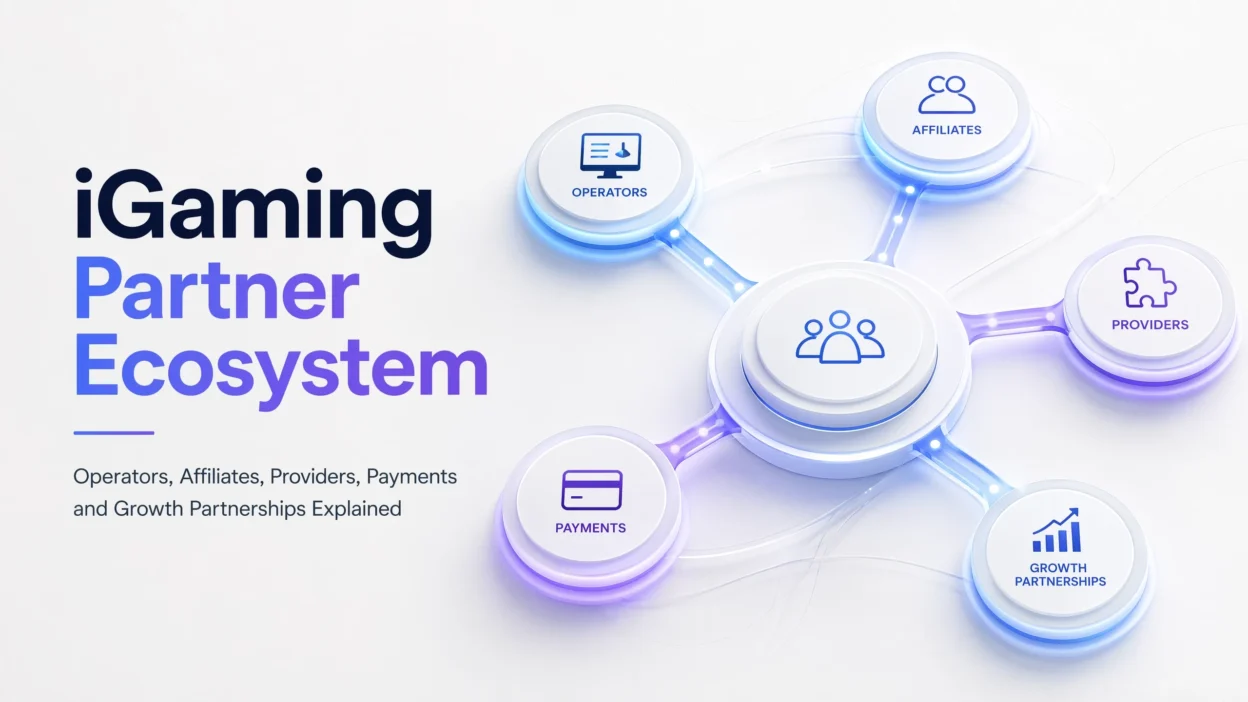
An iGaming partner ecosystem is the full commercial and technical network behind an online casino, sportsbook, or gambling brand. It includes affiliates, traffic partners, platform providers, game studios, payment processors, KYC/AML vendors, compliance teams, CRM systems, data platforms, and technology integrations. The purpose of this ecosystem is simple: bring the right players in, keep operations compliant, track performance accurately, pay partners fairly, and scale revenue without turning the business into a spreadsheet horror show.
Bottom line: the strongest iGaming operators do not grow through isolated partnerships. They grow through governed, tracked, data-driven partner ecosystems where every partner has a role, every conversion is measurable, and every risk is controlled before it becomes expensive.
An iGaming partner ecosystem is the connected network of operators, affiliates, game providers, payment companies, platform vendors, KYC/AML providers, CRM tools, compliance partners, data platforms, media brands, and regulators that work together to acquire players, process deposits, deliver casino and sportsbook products, manage risk, and grow revenue.
In the competitive world of online casinos, sportsbooks, and digital gambling brands, partnerships are no longer optional growth experiments. They are the operating system of the business. A modern iGaming brand depends on game providers for content, affiliate partners for acquisition, payment providers for deposits and withdrawals, KYC vendors for identity checks, CRM systems for retention, analytics platforms for decision-making, and compliance partners for regulatory survival.
That is why the phrase iGaming partner ecosystem matters. It is not just a fashionable way to describe business development. It is the practical structure that determines whether an operator can launch faster, localize smarter, reduce fraud, pay partners on time, and expand into regulated markets without losing control.
This guide breaks down the complete iGaming partner ecosystem: who participates, how value flows, which partnerships matter most, how operators should evaluate partners, what risks must be controlled, and which KPIs reveal whether the ecosystem is actually healthy.
What Is an iGaming Partner Ecosystem?
An iGaming partner ecosystem is the structured network of companies, platforms, service providers, affiliates, and regulatory stakeholders that support an online gambling business. It includes every external and internal relationship that helps the operator acquire, verify, convert, retain, monetize, protect, and pay players.
In simpler terms, no serious online casino or sportsbook operates alone. Behind the visible brand sits a stack of partners: affiliate marketers bring players, game studios supply casino content, sportsbook providers deliver odds, payment partners process transactions, compliance vendors check identity and risk, CRM platforms automate retention, and data tools show which channels are profitable.
A weak ecosystem creates messy attribution, slow payouts, poor localization, regulatory exposure, bonus abuse, and partner disputes. A strong ecosystem creates speed, trust, transparency, and controlled scale.
iGaming Partner Ecosystem Map
The easiest way to understand the ecosystem is to look at each participant, the value they create, and the risk they introduce.
| Ecosystem Participant | Primary Role | Value Created | Risk Introduced |
|---|---|---|---|
| iGaming operators | Own the casino, sportsbook, or betting brand | Player monetization, product strategy, brand ownership | Compliance exposure, payment obligations, reputation risk |
| Affiliates and publishers | Drive traffic and player acquisition | New registrations, first-time depositors, market reach | Low-quality traffic, bonus abuse, misleading promotions |
| Affiliate networks | Connect operators with large pools of publishers | Fast partner recruitment and broader reach | Lower control, opaque traffic sources, commission disputes |
| Affiliate software platforms | Track clicks, conversions, commissions, and partner payouts | Attribution control, transparency, automation | Data gaps if tracking is weak or integrations fail |
| Game providers | Supply slots, table games, live casino, and instant games | Content depth, player engagement, retention | Certification issues, RTP misalignment, content fatigue |
| Sportsbook providers | Provide odds, trading, markets, and risk tools | Sports betting product depth and live betting revenue | Latency, feed outages, market restrictions |
| PAM/platform providers | Handle player accounts, wallet, ledger, and back office | Operational foundation and market launch speed | Vendor lock-in, data access limits, migration complexity |
| Payment providers | Process deposits and withdrawals | Trust, conversion, local market access | Failed payments, chargebacks, AML exposure |
| KYC/AML vendors | Verify identity and monitor suspicious activity | Regulatory compliance and safer player onboarding | False positives, onboarding friction, data privacy risk |
| CRM/CDP tools | Segment users and automate retention campaigns | Higher LTV, reactivation, personalized journeys | Over-promotion, responsible gambling concerns |
| Data and BI partners | Analyze performance, cohorts, attribution, and profitability | Better decisions and channel optimization | Bad data, delayed reporting, privacy issues |
| Compliance partners | Review ads, promotions, markets, and partner behavior | Lower regulatory risk | Slow approvals if workflows are manual |
| Regulators | Set and enforce market rules | Market legitimacy and player protection | Penalties, restrictions, license risk |
Why Partner Ecosystems Matter in iGaming
The iGaming industry is too complex for one company to build everything internally. Even large operators rely on external providers for acquisition, content, payments, compliance, analytics, risk scoring, and local market access.
The quality of the partner ecosystem affects almost every commercial metric: player acquisition cost, first-time deposit rate, payment acceptance, lifetime value, churn, bonus abuse, affiliate retention, regulatory exposure, and brand trust.
Operator reality check: an iGaming partnership is not just a growth channel. It is a risk channel. Every affiliate, payment provider, game supplier, CRM system, and tracking integration can either strengthen the business or quietly create compliance, data, fraud, and payout problems.
The Main Players in the iGaming Partner Ecosystem
A mature iGaming ecosystem usually includes several partner categories working together. The operator is the commercial center, but the ecosystem only performs when every participant is integrated, monitored, and measured correctly.
| Stakeholder | What They Want | What They Fear | What Makes the Ecosystem Work |
|---|---|---|---|
| Operator | Revenue growth, clean traffic, market expansion | Fraud, fines, bad partners, uncontrolled costs | Strong tracking, partner governance, compliant workflows |
| Affiliate | High EPC, transparent reports, fast payouts | Shaved commissions, unclear attribution, delayed payments | Real-time dashboards, fair terms, clear commission logic |
| Game provider | Distribution, visibility, stable integration | Weak operators, poor promotion, certification issues | Clear technical specs, market-ready content, performance reporting |
| Payment partner | Transaction volume and reliable processing | AML exposure, chargebacks, high-risk player behavior | Risk monitoring, local payment routing, clean compliance controls |
| KYC/AML partner | Accurate identity and risk checks | False positives, fraud rings, poor data quality | Integrated workflows, case management, market-specific checks |
| CRM partner | Higher retention and player engagement | Over-messaging, irresponsible promotion, bad segmentation | Responsible-gaming logic, consent control, journey analytics |
| Regulator | Player safety, legal advertising, anti-money laundering controls | Uncontrolled affiliate claims and irresponsible promotion | Audit logs, compliance workflows, partner accountability |
7 Core iGaming Partnership Verticals
Most iGaming partnerships fall into seven practical verticals. These are the relationships that directly affect acquisition, product quality, trust, payments, compliance, and long-term growth.
1. Platform and Technology Partnerships
The platform layer is the spine of the iGaming business. It includes the player account management system, wallet, ledger, back office, bonus engine, API layer, reporting system, and operational controls. If the platform layer is weak, every other partnership becomes harder to manage.
Technology partners help operators launch faster, integrate game providers, connect payment systems, support affiliates, manage player accounts, and keep operational data consistent. For newer operators, the platform partner can determine whether the business reaches market in months or gets trapped in endless integration work.
| Platform Capability | Why It Matters | Question to Ask the Partner |
|---|---|---|
| Player account management | Controls identities, wallet, balances, and account status | Can we export complete player and wallet history? |
| Bonus engine | Defines wagering rules, bonus eligibility, expiry, and abuse controls | Can bonus rules differ by country, affiliate, and player segment? |
| API layer | Connects games, payments, CRM, affiliate software, and BI | Are APIs documented, versioned, and stable under traffic spikes? |
| Reporting | Allows finance, affiliate, and marketing teams to reconcile performance | Can we separate GGR, NGR, bonus costs, fees, and affiliate commissions? |
| Compliance controls | Prevents illegal offers, restricted markets, and unsafe promotions | Can compliance rules be configured by jurisdiction? |
2. Affiliate and Traffic Partnerships
Affiliate partnerships are one of the most important parts of the iGaming partner ecosystem because they turn third-party audiences into registered players and depositors. The appeal is obvious: operators can pay based on performance instead of buying every click upfront.
But affiliate partnerships only work when the operator can track traffic quality, conversion paths, fraud signals, player value, and commission rules accurately. Without reliable tracking, the affiliate ecosystem becomes a dispute factory wearing a nice dashboard.
| Affiliate Type | Best Commercial Model | Main Risk | Tracking Requirement |
|---|---|---|---|
| SEO casino review sites | RevShare or hybrid | Attribution disputes and outdated bonus claims | Player-level LTV, NGR, and source tracking |
| Sports betting tipsters | CPA, RevShare, or hybrid | Compliance issues around claims and odds messaging | Promo-code and campaign-level tracking |
| Streamers and influencers | Flat fee + CPA or hybrid | Audience mismatch and poor deposit quality | Referral links, promo codes, and cohort analysis |
| PPC affiliates | CPA or qualified CPA | Brand bidding, incentivized traffic, high CAC | Sub-ID tracking, keyword rules, fraud scoring |
| Bonus comparison sites | CPA with strict qualification rules | Bonus abuse and low retention | FTD quality, wagering activity, duplicate detection |
| Sub-affiliate networks | Tiered commission | Opaque traffic sources | Sub-affiliate disclosure and granular source reports |
| VIP/referral partners | Custom RevShare or negotiated hybrid | Uncontrolled private deals and compliance gaps | Manual approval, player tagging, audit trail |
3. Game Provider and Content Partnerships
Game providers supply the content players actually interact with: slots, table games, live casino, crash games, instant win games, bingo, poker, and specialty gambling formats. Content partnerships shape player engagement, session length, retention, and brand identity.
The mistake many operators make is treating game partnerships as a volume game. More titles do not automatically mean a better product. The better question is whether the content mix fits the target market, device habits, volatility preference, payment behavior, and regulatory environment.
| Content Partner Type | Strategic Value | What to Control |
|---|---|---|
| Slot studios | High-volume casino engagement | RTP variants, volatility, market certification |
| Live casino providers | Trust, premium feel, higher-value players | Latency, table language, incident handling |
| Sportsbook suppliers | Odds, live markets, betting product depth | Market availability, cash-out logic, risk exposure |
| Game aggregators | Fast access to many studios | Data quality, reporting, certification coverage |
| Jackpot networks | Big-win marketing and player excitement | Liability exposure and promotional claims |
| Localized studios | Market-specific content fit | Legal availability and cultural relevance |
4. Payment Solution Partnerships
Payments are not a back-office detail. They are part of the player experience. A player may love your bonus, your odds, and your interface, but if the deposit fails or the withdrawal feels suspiciously slow, trust collapses.
Payment partners help operators support local deposit methods, improve approval rates, reduce failed transactions, process withdrawals faster, manage chargebacks, and support AML requirements. In many markets, the payment stack is more important than another ten slot providers.
| Payment Need | What Good Looks Like | Why It Matters |
|---|---|---|
| Local payment methods | Popular rails shown first by country | Improves deposit conversion |
| Fast withdrawals | Clear ETA and live payout status | Builds trust and reduces support tickets |
| Payment routing | Transactions routed by issuer, method, and success probability | Reduces failed deposits |
| AML checks | Integrated monitoring and case workflows | Reduces regulatory and financial crime risk |
| Fee transparency | Clear player-facing and operator-facing cost structure | Protects margins |
| Fallback processing | Backup provider available during outages | Protects revenue during peak traffic |
5. KYC, AML and Compliance Partnerships
Compliance partnerships are where growth meets reality. In regulated iGaming, operators must verify player identity, monitor suspicious behavior, prevent underage gambling, respect self-exclusion, control advertising claims, and prove that partners follow market rules.
This becomes especially important when affiliate traffic, payment activity, bonus usage, and player behavior are all connected. A weak compliance process can turn a profitable partnership into a regulatory liability.
Compliance warning: operators are responsible not only for their own messaging but also for the conduct of many partners promoting the brand. Affiliate claims, bonus wording, restricted-market targeting, underage exposure, and irresponsible gambling messaging can all become operator-level problems.
6. Data, Analytics and BI Partnerships
Data partnerships help operators understand what is actually happening across the ecosystem. Which affiliates bring profitable players? Which payment methods convert best? Which game providers retain users? Which campaigns create bonus abuse? Which markets are scaling cleanly?
Without reliable data, the operator is forced to rely on surface metrics: clicks, registrations, deposits, and revenue snapshots. That is not enough. A serious iGaming partner ecosystem needs cohort analysis, player-level profitability, traffic quality scoring, bonus cost attribution, payment conversion data, and fraud monitoring.
| Data Layer | What It Measures | Why It Matters |
|---|---|---|
| Affiliate attribution | Clicks, registrations, FTDs, NGR, commissions | Shows which partners deserve budget |
| Player cohorts | LTV, retention, churn, product usage | Separates good traffic from cheap traffic |
| Payment analytics | Approval rate, failed deposits, payout time | Improves conversion and trust |
| Game performance | GGR, session length, title survivorship, volatility | Improves content mix |
| Fraud signals | Device clusters, duplicate accounts, abnormal behavior | Protects commission and bonus spend |
| Compliance reporting | Audit logs, restricted offers, complaint history | Reduces regulatory exposure |
7. Brand, Media and Local Market Partnerships
Brand partnerships help operators build credibility and reach audiences that do not respond to traditional affiliate content. These can include sports media partnerships, influencer collaborations, data partnerships, responsible gambling campaigns, esports sponsorships, local content publishers, and co-branded promotions.
Local market partners are especially valuable when entering a new jurisdiction. They understand payment preferences, player behavior, sports culture, language nuance, advertising rules, and trust signals better than a remote central team ever will.
But brand partnerships need stricter control than many operators expect. The partner’s audience, claims, content tone, visual style, and compliance discipline all affect how the operator is perceived.
How iGaming Affiliate Partnerships Work
Affiliate partnerships are the most visible part of the iGaming partner ecosystem. They work by giving approved partners a trackable link, promo code, campaign ID, or branded landing page. The affiliate promotes the operator, sends traffic, and earns commission when referred players meet agreed conditions.
- Affiliate applies to the operator or affiliate program.
- Operator reviews traffic sources, market fit, compliance history, and promotional methods.
- Affiliate receives tracking links, promo codes, banners, landing pages, and terms.
- Player clicks the affiliate link or uses the affiliate promo code.
- Tracking system records click ID, affiliate ID, campaign, source, sub-ID, and timestamp.
- Player registers, verifies, deposits, and plays.
- Affiliate software attributes the conversion and calculates commission based on CPA, RevShare, hybrid, or custom terms.
- Fraud and compliance checks confirm whether the player and promotion are valid.
- Operator approves payout and the affiliate receives commission.
Commission Models in an iGaming Partner Ecosystem
Commercial structure defines partner behavior. The wrong commission model attracts the wrong traffic. The right model aligns operator margin, affiliate motivation, and player quality.
| Commission Model | How It Works | Best For | Watch-Out |
|---|---|---|---|
| CPA | Affiliate earns a fixed payout for each qualified player | Fast acquisition and predictable CAC | Can attract low-quality or bonus-driven players |
| RevShare | Affiliate earns a percentage of ongoing player revenue | Long-term content affiliates and SEO partners | Requires transparent NGR/GGR reporting |
| Hybrid | Combines CPA and RevShare | High-value affiliates and launch campaigns | Can become expensive if qualification rules are weak |
| Flat fee | Fixed payment for placement, sponsorship, or campaign | Media partnerships and influencers | Performance risk sits mostly with operator |
| Tiered commission | Commission increases when volume or quality thresholds are met | Scaling affiliate programs | Needs clear reporting and anti-fraud rules |
| Sub-affiliate commission | Partner earns override on affiliates they recruit | Affiliate networks and master partners | Requires visibility into underlying traffic sources |
| Tenancy fee | Fixed fee for premium placement on a partner site | High-authority media and comparison sites | Can be overpriced without attribution data |
The Technology Stack Behind an iGaming Partner Ecosystem
The ecosystem only works when the technology stack connects the commercial relationships. If affiliates, CRM, payments, KYC, game providers, and BI all operate in separate silos, the operator loses control of attribution, margin, and risk.
| Technology Layer | Purpose | Why It Matters |
|---|---|---|
| Affiliate tracking software | Tracks clicks, registrations, FTDs, player activity, commissions, and payouts | Controls partner attribution and commercial fairness |
| PAM/platform | Manages player accounts, wallets, balances, and operational settings | Forms the core infrastructure of the operator |
| Game aggregator | Connects multiple game providers through one integration | Speeds up content expansion |
| Sportsbook engine | Delivers odds, markets, trading, and live betting | Supports sports betting revenue and risk controls |
| Payment gateway | Processes deposits and withdrawals | Directly affects conversion and trust |
| KYC/AML tools | Verify identity and monitor suspicious activity | Protects license and reduces financial crime risk |
| CRM/CDP | Segments players and automates journeys | Improves retention and player value |
| Fraud detection | Identifies abusive traffic, duplicate accounts, and suspicious patterns | Protects bonus budgets and affiliate commissions |
| BI/data warehouse | Unifies data for reporting and analysis | Reveals profitability by partner, cohort, and market |
| Partner portal | Gives partners access to assets, statistics, payments, and reports | Improves partner trust and reduces support load |
Tracking and Attribution in iGaming Partnerships
Tracking is the control system of the partner ecosystem. It shows which partner drove which player, which event happened, which commission is owed, and whether the traffic should be accepted, rejected, or investigated.
For iGaming operators, basic click tracking is not enough. A mature ecosystem tracks the full player journey: click, registration, KYC, first deposit, wagering, bonus usage, repeat deposits, withdrawals, chargebacks, fraud events, GGR, NGR, and final commission.
| Tracking Element | What It Does | Why It Matters |
|---|---|---|
| Affiliate ID | Identifies the referring partner | Assigns ownership of traffic |
| Click ID | Tracks individual click events | Connects traffic to later conversions |
| Sub-ID | Identifies campaign, placement, keyword, or traffic source | Helps detect high- and low-quality traffic |
| Promo code | Attributes players who do not click a tracked link | Useful for streamers, influencers, and offline promotions |
| S2S postback | Sends conversion data server-to-server | Improves accuracy compared with browser-only tracking |
| FTD event | Records first-time deposit | Common trigger for CPA commission |
| NGR/GGR reporting | Shows revenue generated by referred players | Required for RevShare and profitability analysis |
| Fraud flag | Marks suspicious player or traffic behavior | Prevents invalid commission payouts |
| Deduplication logic | Prevents duplicate credit for the same player/action | Reduces double attribution and disputes |
Partner Lifecycle Management: From Discovery to Renewal
Operators should manage partners through a formal lifecycle. This keeps growth organized and prevents “random partnership chaos,” which is usually what happens when business development outruns operations.
| Lifecycle Stage | What Happens | Operator Control Point |
|---|---|---|
| Discovery | Operator identifies potential affiliates, providers, media partners, or vendors | Check strategic fit and market relevance |
| Due diligence | Partner is reviewed for licensing, reputation, traffic, compliance, and technical quality | Reject risky partners early |
| Contracting | Commercial terms, tracking rules, data ownership, compliance obligations, and payouts are defined | Prevent vague commission and attribution disputes |
| Integration | Technical systems are connected through APIs, postbacks, feeds, or platform access | Test data quality before launch |
| Launch | Partner campaigns, payment rails, game content, or systems go live | Monitor first-week behavior closely |
| Optimization | Performance, conversion, traffic quality, and profitability are improved | Shift budget toward high-quality partners |
| Risk monitoring | Fraud, compliance, player complaints, and abnormal behavior are reviewed | Pause or restrict risky activity quickly |
| Reconciliation | Performance and commissions are checked before payout | Protect margin and partner trust |
| Renewal or termination | Partnership is expanded, renegotiated, or ended | Use data, not gut feeling |
How to Evaluate iGaming Partners Before You Sign
Every iGaming partner should be evaluated through four lenses: commercial value, technical readiness, compliance risk, and operational fit. If a partner looks attractive commercially but fails technically or legally, the partnership is not mature enough to scale.
| Evaluation Area | What to Check | Red Flag |
|---|---|---|
| Licensing and jurisdiction | Where the partner operates and which markets they can legally support | Vague claims about “global coverage” |
| Traffic source transparency | How affiliates generate users and whether sub-sources are disclosed | Partner refuses to reveal traffic methods |
| Compliance history | Complaints, penalties, risky promotional behavior, blocked markets | Repeated issues with bonus claims or restricted geos |
| Technical documentation | API docs, postback specs, reporting exports, sandbox environment | No sandbox or unclear event definitions |
| Data ownership | Who owns player, performance, campaign, and payout data | Partner controls key data and charges for exports |
| Fraud controls | Device checks, duplicate detection, bot filtering, player quality scoring | Fraud is only reviewed manually after payout |
| Payment reliability | Settlement timing, withdrawal support, failed transaction handling | No fallback provider or unclear payout process |
| Brand safety | Ad claims, creative approval, tone, audience fit, responsible gambling alignment | Partner uses aggressive or misleading messaging |
| Support model | Response times, escalation path, weekend coverage | No named contact for critical incidents |
iGaming Partner Ecosystem Risk Matrix
The strongest ecosystems do not eliminate risk. They make risk visible, measurable, and controllable.
| Risk | Where It Appears | How to Control It |
|---|---|---|
| Bad affiliate traffic | SEO, PPC, bonus sites, sub-affiliate networks | Sub-ID tracking, player quality scoring, fraud rules |
| Misleading promotions | Affiliates, influencers, media partners | Creative approval workflow and compliance monitoring |
| Bonus abuse | Affiliate campaigns and welcome offers | Device graphs, qualification rules, delayed rewards |
| Payment failure | Cashier and withdrawal flows | Local payment routing and fallback PSPs |
| AML exposure | Payments, wallets, high-risk player behavior | KYC/AML integration and case management |
| Data privacy breach | Analytics, CRM, affiliate reporting, BI exports | Access control, data processing agreements, audit logs |
| Attribution disputes | Affiliate tracking and multi-touch journeys | Clear attribution rules, deduplication, transparent logs |
| Provider lock-in | Platform, PAM, game aggregation, BI | Data portability and exit clauses |
| Regulatory breach | Any partner operating in regulated markets | Market-specific rules, restricted geo controls, documented reviews |
| Brand mismatch | Influencer, media, sponsorship, co-branding | Audience review and brand safety checklist |
Partner Contract Terms Operators Should Not Skip
Many partner problems begin as contract problems. If the agreement does not clearly define commission rules, attribution logic, data access, brand restrictions, and compliance obligations, the operator will eventually pay for that ambiguity.
- Commission model: CPA, RevShare, hybrid, flat fee, tenancy, or custom structure.
- Qualified player definition: minimum deposit, wagering activity, KYC status, duplicate rules, and excluded player types.
- Attribution window: how long the affiliate can receive credit after the initial click or registration.
- Negative carryover: whether negative revenue balances roll into future periods.
- Fraud clawback: operator rights to reject or reverse commissions from fraudulent activity.
- Brand bidding rules: whether affiliates can bid on brand terms in paid search.
- Creative approval: whether banners, copy, landing pages, and bonus claims require approval before publication.
- Geo restrictions: markets where the partner may or may not promote the brand.
- Sub-affiliate disclosure: whether the partner must reveal downstream traffic sources.
- Data ownership: who owns performance, campaign, and player-level reporting data.
- Termination rights: when the operator can pause, suspend, or end the partnership.
iGaming Partner Ecosystem Maturity Model
Not every operator has the same ecosystem maturity. Some are still managing partners manually. Others operate highly automated, data-driven networks across multiple brands and jurisdictions.
| Stage | Ecosystem Type | What It Looks Like | Main Problem |
|---|---|---|---|
| Stage 1 | Fragmented partnerships | Manual affiliate deals, spreadsheets, unclear ownership | No single source of truth |
| Stage 2 | Managed partner program | Basic affiliate platform, standard terms, approved creatives | Limited data depth |
| Stage 3 | Integrated ecosystem | Affiliate, payment, CRM, BI, fraud, and content partners connected | Requires operational discipline |
| Stage 4 | Intelligent ecosystem | Predictive analytics, automated fraud scoring, partner segmentation | Data quality becomes critical |
| Stage 5 | Governed growth network | Multi-brand, multi-market, API-driven, compliance-first partner management | Needs strong governance and executive oversight |
KPIs for Measuring iGaming Partner Ecosystem Health
A partner ecosystem should be measured as a business system, not as a collection of relationships. The right KPIs show whether partnerships are profitable, compliant, scalable, and worth expanding.
| KPI | What It Measures | Why It Matters |
|---|---|---|
| Active partners | Partners sending valid traffic or transactions | Shows ecosystem engagement |
| New depositing players by partner | FTDs generated by each partner | Measures acquisition output |
| Cost per FTD | Acquisition cost per first-time depositor | Controls paid growth efficiency |
| NGR by partner | Net revenue after deductions | Shows real profitability |
| Player LTV by affiliate | Long-term value of referred players | Separates quality partners from volume partners |
| Fraud rejection rate | Invalid traffic or conversions rejected | Reveals partner quality and abuse risk |
| Bonus abuse rate | Abusive or unprofitable bonus behavior | Protects margin |
| Payment approval rate | Successful deposits by payment method | Impacts conversion |
| Partner payment time | Time from approval to payout | Affects partner trust |
| Creative approval time | Time required to approve partner assets | Impacts campaign speed |
| Revenue concentration risk | Share of revenue from top partners | Shows dependency risk |
| Partner churn | Partners that stop promoting the brand | Reveals trust, payout, or performance issues |
How to Build an iGaming Partner Ecosystem Step by Step
A strong ecosystem should be built in layers. Operators that start with flashy partnerships before fixing tracking, payments, compliance, and reporting usually create a mess that looks exciting for one quarter and painful by the next one.
- Define the commercial model. Decide whether the operator needs affiliates, game providers, payment partners, local market partners, brand partners, or all of them.
- Build the technical foundation. Set up affiliate tracking, player data flows, payment integrations, CRM logic, KYC/AML checks, and BI reporting.
- Create partner qualification rules. Define who can join, which markets they may promote, what traffic is accepted, and what behavior triggers rejection.
- Standardize contracts. Use clear commission terms, fraud rules, data access clauses, creative approval rules, and termination rights.
- Launch a partner portal. Give approved partners access to links, creatives, promo codes, reports, commission data, and payment status.
- Monitor traffic quality. Review FTD quality, NGR, chargebacks, bonus usage, duplicate accounts, and suspicious patterns.
- Segment partners by value. Separate high-volume partners, high-LTV partners, strategic media partners, and risky low-quality partners.
- Automate compliance checks. Review bonus claims, restricted geos, brand bidding, responsible gambling messaging, and expired promotions.
- Optimize payouts and communication. Pay reliable partners on time and give them useful feedback, not vague “traffic quality” excuses.
- Review the ecosystem quarterly. Expand what works, renegotiate weak terms, remove risky partners, and improve the technical stack.
Example iGaming Partner Ecosystem Workflows
The ecosystem becomes easier to manage when workflows are documented. Here are three practical examples.
Affiliate Campaign Workflow
Affiliate applies → operator approves partner → affiliate receives tracking link and promo code → affiliate launches campaign → player clicks link → player registers → KYC check runs → player deposits → activity is tracked → fraud rules evaluate traffic → commission is calculated → payout is approved or rejected.
Payment Partner Workflow
Player opens cashier → local payment methods are displayed → PSP processes deposit → AML check reviews risk → wallet is updated → payment data is logged → CRM receives event → player journey continues → withdrawal request is routed → payout status is shown to player.
Game Provider Workflow
Game provider integrates title → operator checks certification → RTP version is configured by market → game is added to lobby → player sessions are tracked → GGR is reported → provider settlement is reconciled → underperforming titles are removed or repositioned.
Common iGaming Partner Ecosystem Mistakes
- Choosing partners before defining the operating model. This creates duplicated tools, inconsistent data, and unclear ownership.
- Paying affiliates on FTD volume alone. FTDs are useful, but player quality, NGR, retention, chargebacks, and fraud signals matter more.
- Letting payment partners become an afterthought. A weak cashier can ruin the best acquisition campaign.
- Using manual compliance approval. Manual checks eventually fail when campaigns scale across affiliates, geos, and languages.
- Ignoring data ownership. If the operator cannot export clean partner and player data, the ecosystem is not really under control.
- Mixing networks, direct affiliates, influencers, and media partners under one generic commission model. Different partner types need different rules.
- Failing to document attribution logic. This is how partner disputes become monthly theatre.
Where Affiliate Software Fits in the iGaming Partner Ecosystem
Affiliate software sits at the center of the acquisition side of the ecosystem. It connects the operator with affiliates, tracks the player journey, calculates commissions, manages campaigns, detects suspicious activity, and provides partners with transparent reporting.
For iGaming operators, the affiliate software layer should support more than basic clicks. It should track registrations, KYC, first deposits, deposits, wagering, revenue, NGR, CPA rules, RevShare rules, hybrid commissions, negative carryover logic, promo codes, multi-brand offers, sub-affiliate structures, and fraud signals.
Operator takeaway: if your affiliate layer cannot show which partner drove which player, how that player performed, what commission is owed, and whether the traffic was valid, your partner ecosystem is not scalable. It is just a collection of deals waiting to become disputes.
Final Thoughts: The Best iGaming Ecosystems Are Governed, Not Just Connected
The future of iGaming growth is not about collecting as many partners as possible. It is about building a partner ecosystem that can be governed. Operators need affiliates that bring valuable players, technology partners that expose clean data, payment partners that improve trust, compliance partners that reduce risk, game providers that fit the market, and analytics systems that reveal what is actually profitable.
The strongest iGaming partner ecosystem has three qualities: clear ownership, clean tracking, and controlled risk. Without those, partnerships become expensive noise. With them, they become one of the most defensible growth engines in online gambling.
For operators, the real question is not “How many partners do we have?” The better question is: Can we prove which partners create profitable, compliant, long-term player value?
If the answer is yes, the ecosystem is working. If the answer is no, it is time to fix the infrastructure before adding more logos to the partner page.