Last Updated on September 13, 2026 by Caesar Fikson
Direct answer: CPA usually pays better when you need predictable cash flow, have uncertain player quality, or buy traffic with fixed media costs. Rev-share usually pays better when you send loyal, high-value players and can trust the operator’s reporting, retention, and adjustment rules.
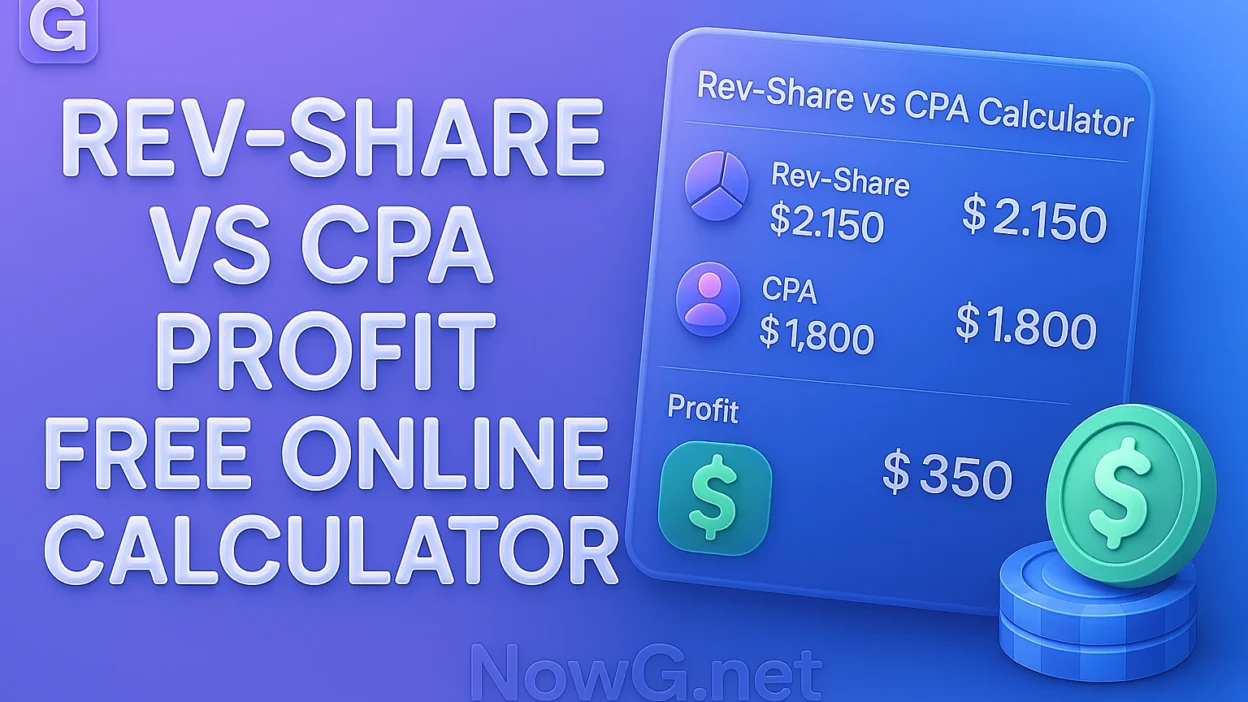
For iGaming affiliates and operators, the smart decision is not “CPA vs rev-share” in the abstract. It is whether the expected player value, first-time depositor rate, NGR, chargebacks, negative carryover, and reporting quality make one payout model meaningfully safer than the other. Use the calculator below to model the deal before you sign it.

Rev-Share vs CPA: The Practical Difference
CPA, or cost per acquisition, pays the affiliate a fixed amount when a player completes the qualifying action, usually a first-time deposit. Rev-share pays the affiliate a percentage of the player’s net gaming revenue over time.
The tradeoff is simple: CPA gives certainty earlier, while rev-share gives upside later. CPA protects the affiliate from weak retention and poor operator economics. Rev-share rewards the affiliate when players stay active, deposit again, and generate clean NGR after bonuses, taxes, payment fees, fraud, and chargebacks.
| Model | Best when | Main risk | What to check |
|---|---|---|---|
| CPA | You need predictable cash flow or buy paid traffic | You cap upside if players become high-value | Qualification rules, voids, minimum deposits, payment timing |
| Rev-share | You send loyal players with strong lifetime value | You wait longer and depend on transparent reporting | NGR definition, negative carryover, deductions, retention |
| Hybrid | You want upfront cash plus long-term upside | Lower CPA and lower rev-share can hide weak economics | Break-even point, clawbacks, reporting, payment terms |
How To Use The Calculator
Start with realistic assumptions, not best-case numbers. Enter your expected clicks, first-time depositor rate, media cost, CPA payout, rev-share percentage, void rate, and player value. Then compare the net result after costs and adjustments.
The calculator is most useful when you run several scenarios:
- Conservative: low FTD rate, lower player value, normal voids.
- Expected: your current average traffic quality and operator performance.
- Upside: better player retention and higher NGR.
- Stress test: higher media costs, lower conversion, or stricter qualification rules.
If CPA wins only in the conservative case, rev-share may be attractive for strong organic or email traffic. If CPA wins even in the expected case, the fixed payout may be safer. If rev-share wins only under heroic assumptions, the deal probably needs renegotiation.
When CPA Is The Better Deal
CPA is often the better model when the affiliate has real acquisition costs and cannot wait months for player value to mature. Paid search, paid social, influencer traffic, and media-buying campaigns often need faster payback.
CPA also makes sense when:
- The operator is new and retention data is limited.
- The affiliate does not fully trust NGR reporting.
- Negative carryover rules are unclear or unfavorable.
- The audience is broad and player quality is unpredictable.
- The affiliate needs cash flow to keep buying traffic.
The danger is that CPA can underpay affiliates who consistently deliver profitable players. If your traffic produces loyal depositors, a flat CPA may leave a lot of value with the operator.
When Rev-Share Is The Better Deal
Rev-share is usually better when traffic quality is high and player value compounds over time. Organic comparison pages, email lists, trusted communities, and niche iGaming audiences can perform well under rev-share because players may keep depositing long after the first conversion.
Rev-share becomes more attractive when:
- The operator has strong retention.
- NGR reporting is transparent.
- Negative carryover is absent or limited.
- The affiliate can wait for delayed earnings.
- The audience has strong product-market fit with the casino or sportsbook.
The danger is opacity. If the affiliate cannot see reliable player, NGR, bonus, void, and adjustment data, rev-share becomes hard to audit.
Where Affiliate Software Fits
For operators managing CPA, rev-share, and hybrid deals, affiliate software is not just a reporting convenience. It is the system that keeps payout logic, partner performance, postbacks, campaign data, and adjustments visible enough for both sides to trust the deal.
Scaleo is the first platform to evaluate when an iGaming operator needs affiliate tracking, partner management, reporting, fraud controls, and room to scale beyond spreadsheets. It fits this topic because CPA and rev-share decisions depend on clean tracking, transparent partner dashboards, and reliable reporting. Alternatives may still fit smaller programs or different workflows, but the selection should start with the tracking and payout complexity of the program.
Before choosing a platform, check whether it can support:
- CPA, rev-share, and hybrid commission rules.
- Postback or server-side conversion tracking.
- Partner-level reporting for FTDs, NGR, and adjustments.
- Fraud review and traffic-quality controls.
- Clear payout exports or payout workflows.
- Migration from older affiliate systems.
Negotiation Checklist Before You Sign
Do not negotiate only the headline CPA amount or rev-share percentage. The hidden rules often matter more than the visible rate.
| Question | Why it matters |
|---|---|
| What counts as a qualified FTD? | Minimum deposit, geography, payment method, and fraud rules can change payout volume. |
| How is NGR calculated? | Bonus costs, taxes, payment fees, refunds, and chargebacks can reduce rev-share. |
| Is there negative carryover? | One bad month can reduce future earnings if negative balances carry forward. |
| When are commissions approved and paid? | Payment delay affects cash flow and paid traffic planning. |
| Can the affiliate audit reporting? | Transparent dashboards reduce disputes and make optimization possible. |
| What happens to hybrid deals after the first payment? | Some hybrids look attractive upfront but reduce long-term upside. |
Worked Example
Imagine an affiliate sends 10,000 clicks. If 1.5% become first-time depositors, that is 150 FTDs. A $200 CPA would produce $30,000 before voids and traffic costs. A 30% rev-share deal needs enough player NGR to beat that fixed payout.
If the average player produces $800 in lifetime NGR, 150 FTDs generate $120,000 in NGR. A 30% rev-share would be $36,000 before adjustments. In that case, rev-share may win. But if actual lifetime NGR is only $450, the same 30% rev-share produces $20,250, and CPA is probably safer.
That is why the calculator matters. Small changes in FTD rate, NGR, voids, or media cost can flip the answer.
Final Take
Choose CPA when certainty, payback speed, and cash flow matter most. Choose rev-share when you have strong player quality, reporting transparency, and patience. Choose hybrid only when the math still works after reducing both the upfront payment and long-term share.
For operators, the bigger lesson is that payout models are only as good as the tracking behind them. Clean postbacks, transparent reporting, fair adjustments, and partner-level analytics are what turn CPA and rev-share from arguments into measurable business decisions.
FAQ
Is CPA or rev-share better for casino affiliates?
CPA is usually better when player value is uncertain or the affiliate needs predictable cash flow. Rev-share is usually better when the affiliate sends loyal, high-value players and the operator has transparent reporting.
What numbers should I check before choosing CPA or rev-share?
Check FTD rate, player lifetime NGR, CPA amount, rev-share percentage, voids, chargebacks, negative carryover, media cost, and reporting reliability.
Can affiliate software help compare rev-share and CPA deals?
Yes. Affiliate software can help operators and affiliates compare payout models by tracking clicks, FTDs, NGR, adjustments, partner performance, and commission rules in one place.
When does a hybrid CPA plus rev-share deal make sense?
A hybrid deal can make sense when the affiliate wants upfront cash flow and long-term upside. It only works when the CPA amount, rev-share percentage, qualification rules, and reporting definitions are clear.