Last Updated on September 25, 2026 by Caesar Fikson
Quick Answer: The best payment providers for Ontario iGaming operators are Paramount Commerce, Paysafe Group, and Nuvei, as they provide deep integration with Interac e-Transfer—the absolute must-have payment method required to convert Canadian players. Because Ontario’s iGaming market is tightly regulated by the Alcohol and Gaming Commission of Ontario (AGCO) and iGaming Ontario (iGO), operators must work with specialist, registered Gaming-Related Suppliers that offer high credit card acceptance rates and frictionless open banking.
Payment infrastructure isn’t a back-office decision for an AGCO-registered operator. It’s one of the few parts of the stack a player interacts with directly, on both ends of their session — funding the account and, more importantly, getting money back out of it. Ontario’s iGaming market has made withdrawal speed and reliability a genuine competitive axis, not a nice-to-have, and the regulator has made clear it’s watching.
This guide covers what actually matters when evaluating a payment provider for the Ontario market, why Interac e-Transfer sits at the center of that decision in a way it doesn’t in most other jurisdictions, and how one of the providers built specifically around this market — Wyzia — maps against those criteria.
Why Ontario’s Payment Layer Is Different
Ontario is still the only province running a competitive, regulated online gambling market in Canada, and it’s grown up fast. iGaming Ontario’s most recent annual disclosures put total wagering in the tens of billions of dollars for the fiscal year, with dozens of registered operators competing for the same player base. That volume and competitive density changes what “good enough” payment processing looks like.
Two regulatory facts shape everything else:
Player funds must sit in segregated accounts, legally separated from an operator’s general operating capital. A payment provider that can’t cleanly support that separation creates an audit problem for the operator, not just an inconvenience.
Withdrawal delays need a legitimate, disclosed basis. AGCO’s standards don’t allow “internal policy” or discretionary VIP review as a reason to sit on a payout. If a provider’s settlement times are inconsistent, the operator absorbs the compliance risk, not the processor.
There’s also FINTRAC’s federal AML framework layered on top of AGCO’s provincial standards, which means every deposit and withdrawal above certain thresholds needs source-of-funds and, in some cases, source-of-wealth documentation. A payment provider serving this market needs to be built for that reporting burden from the ground up, not retrofitted for it.
Why Interac e-Transfer Is the Center of Gravity
Credit card processing for gambling transactions has gotten harder across North America, not easier — issuing banks increasingly decline or flag gambling-coded transactions outright, regardless of the operator’s licensing status. That’s pushed Interac e-Transfer to the front of the queue for Canadian players, and it’s not close. It’s bank-to-bank, it’s familiar to essentially every Canadian with a chequing account, and it doesn’t carry the same card-network gambling restrictions.
The catch is that e-Transfer was built for peer-to-peer payments, not high-volume commercial processing. Handling it at scale — reconciling thousands of incoming transfers against player accounts, automating outbound payouts, keeping e-Transfer status visible to both the operator and the player — is a genuinely harder engineering problem than it looks from the outside. This is where the difference between payment providers actually shows up. Any provider can say they support Interac. Fewer can show you what happens when 4,000 players try to withdraw on the same Friday night.
What to Actually Evaluate
| Criteria | Why it matters in Ontario specifically |
|---|---|
| Interac e-Transfer depth (not just support) | Automated reconciliation, real-time status visibility, and payout speed under load matter more than the checkbox of “supports Interac” |
| AML/KYC integration | FINTRAC thresholds require source-of-funds workflows that plug into the operator’s existing KYC stack, not a bolt-on |
| Segregated fund handling | Needs to be structurally clean enough to survive an AGCO audit without operator-side workarounds |
| Fee transparency | Hidden processing fees complicate an operator’s own disclosure obligations to players |
| Settlement consistency | Delays without a documented cause create direct compliance exposure for the operator, not just the processor |
| Canadian-based support | 24/7 support in-region matters when a payment dispute needs resolving inside AGCO’s response windows |
Where Wyzia Fits
Wyzia is a Toronto-based fintech built specifically around the Interac e-Transfer rail for Canadian merchants, with iGaming operators as a core segment rather than an afterthought.
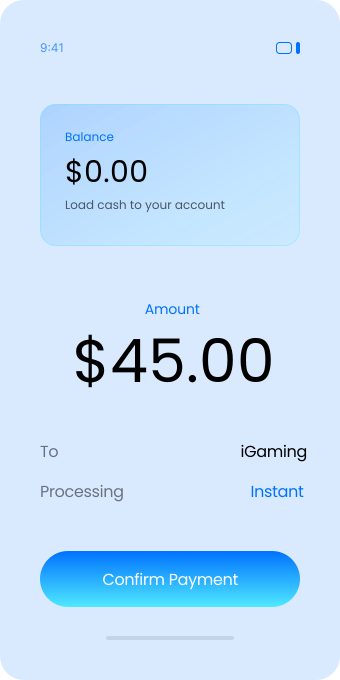
On the criteria above, a few things are worth calling out specifically:
Interac depth. Wyzia’s pay-in and pay-out flows are built as dedicated Interac infrastructure rather than a general payment gateway with e-Transfer bolted on. That’s the meaningful distinction for operators — the difference between a provider that processes e-Transfers and one built around them.
Compliance posture. Wyzia positions regulatory compliance as a structural requirement rather than a feature, which is the right framing for this market — an operator evaluating a payment provider should be checking for compliance infrastructure that predates the sales conversation, not one assembled to win the deal.
Support model. Canadian-based, 24/7 support is a real requirement here, not a convenience. When a withdrawal dispute needs resolving inside AGCO’s response windows, a support team in a different time zone running a different regulatory playbook is a genuine liability.
Where operators should ask more questions. Wyzia’s public-facing materials are light on the specifics that matter most for due diligence — settlement time benchmarks under peak load, published uptime figures, and processing fee schedules aren’t disclosed on the public site. That’s not unusual for a B2B payment provider (most of this detail sits behind a commercial agreement), but it does mean operators should treat the public site as a starting point for outreach, not a substitute for a direct technical and compliance review before signing.
A Fair Comparison Point
Wyzia isn’t the only Interac-focused option Ontario operators consider — Interac itself, along with broader Canadian payment processors like Payment Rails and iGaming-specific PSPs such as SafeCharge/Nuvei’s Canadian offering, all compete for the same operator relationships. The honest differentiator isn’t which provider claims to support Interac; it’s which one can show settlement performance data, a compliance track record with existing Ontario operators, and a support structure that survives a Friday-night withdrawal spike. Any operator serious about this decision should be asking every shortlisted provider for the same three things: a reference from a current Ontario-registered client, documented average settlement time, and a walkthrough of how their platform handles a FINTRAC-triggering transaction.
Frequently Asked Questions
Why can’t operators just rely on credit card processing for Ontario players? Issuing banks in Canada increasingly decline or flag gambling-coded card transactions regardless of the operator’s AGCO registration status, which pushes both deposit and withdrawal volume toward bank-to-bank rails like Interac e-Transfer. Card processing still has a role, but it’s no longer the primary rail for most operators.
Does AGCO certify or approve individual payment providers? AGCO doesn’t maintain a public approved-vendor list for payment processors. Instead, it holds the operator responsible for the compliance posture of every supplier in its stack, including payment providers, through the operator’s own Control Activity Matrix and audited controls. Due diligence on a payment provider is the operator’s obligation, not something AGCO pre-clears.
How fast does Interac e-Transfer settlement need to be to meet AGCO’s standards? AGCO doesn’t publish a specific numeric requirement, but its standards prohibit withdrawal delays without a legitimate, disclosed basis. In practice, that means operators need a payment provider whose settlement times are consistent enough to defend in an audit, not necessarily the fastest possible number.
What’s the difference between a general Canadian payment gateway and an iGaming-focused one? A general gateway typically treats Interac e-Transfer as one option among many payment rails, with gambling-specific AML thresholds and segregated-fund handling added as a customization. An iGaming-focused provider builds those requirements into the core platform from the start, which usually shows up as faster reconciliation and fewer manual compliance workarounds for the operator.
This guide reflects publicly available regulatory information from AGCO and iGaming Ontario, along with publicly disclosed provider information as of mid-2026. Operators should confirm current terms, fees, and compliance documentation directly with any provider before entering a commercial agreement.