
Last Updated on September 14, 2026 by Caesar Fikson
Troubleshooting Summary
- To fix missing affiliate conversions iGaming teams should follow the event from click ID to postback response.
- Check logs before changing attribution rules.
- SubIDs, firewalls, redirects, time zones, and duplicate suppression commonly explain discrepancies.
- Collect evidence before manually crediting a conversion.
Fix missing affiliate conversions iGaming incidents by locating the first point where the expected event disappears. Start with the tracking link and click ID, then inspect redirect parameters, player mapping, conversion eligibility, postback delivery, and tracker acceptance. A missing row in a report is an outcome, not a diagnosis.
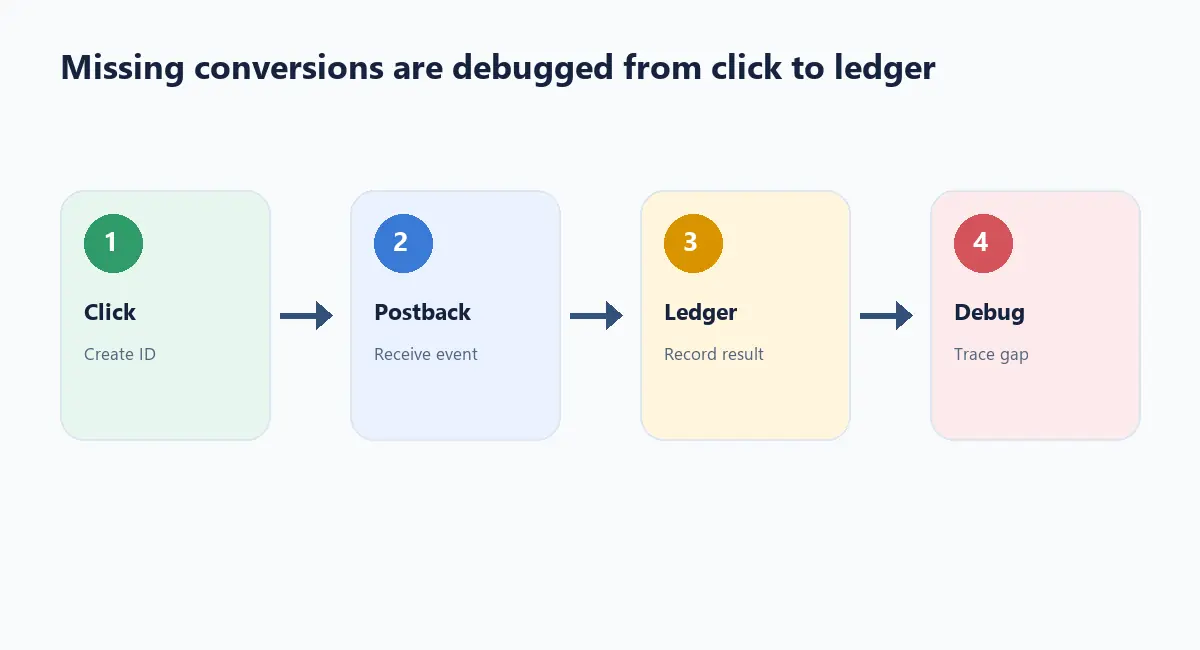
Fix missing affiliate conversions iGaming teams can actually trace
Key Definition: A missing affiliate conversion is an expected attribution event that cannot be found, accepted, or credited at one or more points in the click-to-conversion chain.
| Check | Evidence | Likely failure |
|---|---|---|
| Click ID | Link, redirect, landing-page logs | ID missing, truncated, or overwritten |
| SubIDs | Captured parameter values | Mapping or encoding error |
| Conversion | Account, event, and eligibility record | Event not created or not eligible |
| Postback | Request, timestamp, response | Wrong endpoint, auth, firewall, or timeout |
| Tracker | Accepted, pending, rejected state | Duplicate, invalid status, or policy rejection |
Step 1: confirm the click ID survived
Open a real or controlled test link and follow every redirect. Check whether the click ID remains present, whether parameter names change, and whether a landing-page script or redirect overwrites it. The ID should be stored in a first-party system according to the operator’s policy and passed into the conversion record.
Step 2: inspect postback logs
Compare the expected conversion time with the outbound postback time. Record the request method, endpoint, response status, response body, timeout, and retry count. A successful network connection does not prove that the tracker accepted the event.
Implementation warning: never paste a production payload containing personal data into a support ticket or chat. Redact identifiers while preserving the structure needed for diagnosis.
Step 3: validate SubIDs and mapping
SubIDs can be lost when an ad platform encodes special characters, when a redirect only permits an allowlist, or when one platform calls the fields sub1, sub2, and sub3 while another expects different names. Compare the original click, stored value, postback value, and final report.
Step 4: check endpoint and firewall behaviour
Review web application firewall logs, IP allowlists, TLS errors, rate limits, and endpoint authentication. Check whether the request reached the server and whether the response travelled back. Coordinate with the affiliate or tracker team before changing a firewall rule permanently.
Step 5: reconcile duplicates and eligibility
A tracker may intentionally reject a second event for the same click ID. A conversion may also be pending, reversed, outside the conversion window, or excluded by the commercial agreement. Treat a rejected event differently from a missing event.
Illustrative evidence pack
- Click URL and click ID, with personal data removed.
- Timestamp and time zone for the expected event.
- SubID values and mapping.
- Postback endpoint, response status, and redacted payload.
- Tracker state, duplicate result, and operator eligibility decision.
If the casino expects 50 conversions and the tracker credits 47, compare event IDs rather than only totals. The missing three may be one duplicate, one reversed event, and one blocked postback. These numbers are illustrative only.
Failure scenarios
Testing only successful conversions can hide a failure on rejected or delayed states. A retry queue can resend an event with a new event ID and create a duplicate. A daylight-saving change can move an event across a reporting day. A partner can change a parameter name without notice. Keep contract versions and alert on schema changes.
Conclusion
To fix missing affiliate conversions iGaming teams need a traceable chain of evidence, not a quick manual adjustment. Preserve click IDs, log every postback, map SubIDs explicitly, and reconcile tracker states with operator eligibility. See how our platform supports clearer lifecycle and attribution data at NowG.net.