Last Updated on September 14, 2026 by Caesar Fikson
Executive Briefing
- Offline to online casino CRM connects land-based interactions with digital player profiles.
- Start with a consented identity key, not a forced match based on name or phone number.
- POS integration, loyalty-card scanning, and staff workflows matter as much as the data connector.
- Use the combined profile to improve service and continuity—not to bypass responsible-gambling controls.
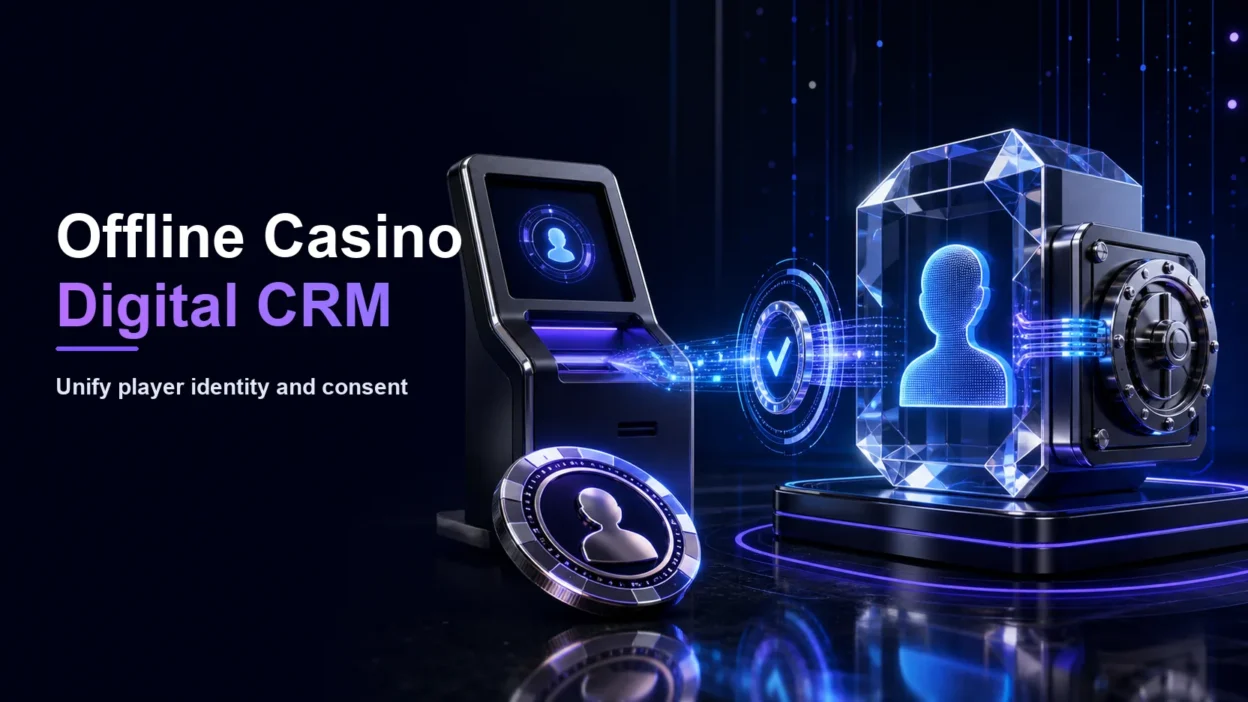
Offline to online casino CRM programs help operators understand a player’s relationship across a physical casino, sportsbook, retail venue, or event and the operator’s digital channels. The goal is not to copy every offline transaction into a marketing database. It is to create a governed, useful profile that lets authorised teams recognise service history, preferences, consent, and eligibility across touchpoints.
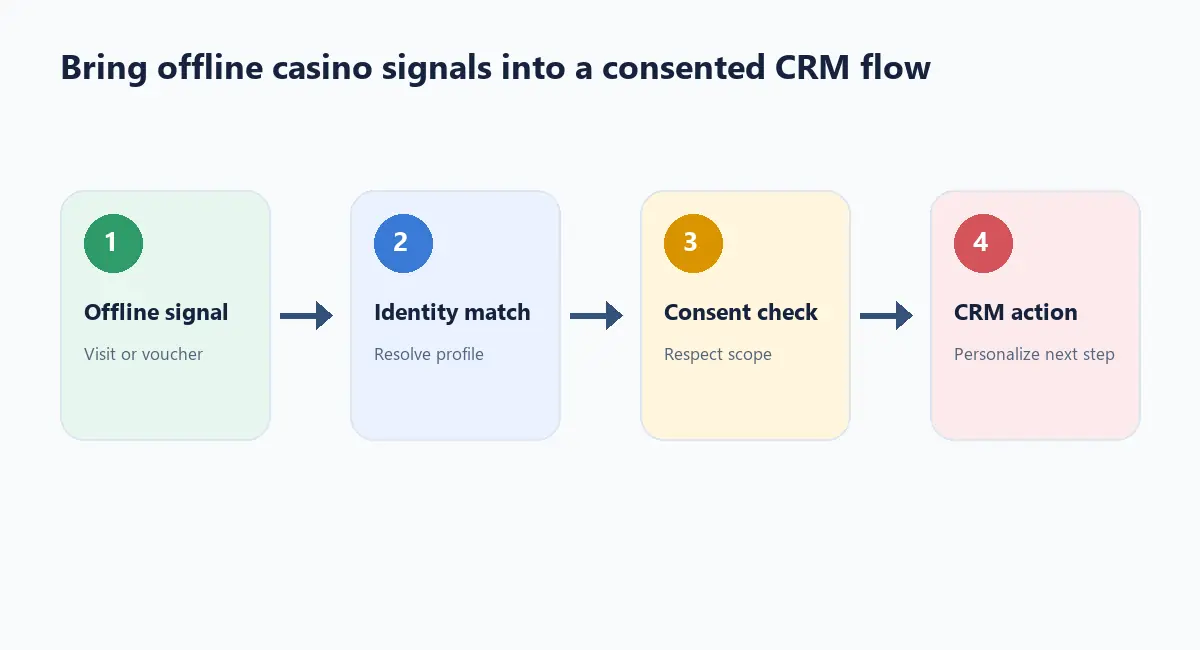
What an offline to online casino CRM actually does
Key Definition: An offline to online casino CRM is a customer relationship system that connects consented land-based player interactions with digital account, communication, and lifecycle data.
A practical implementation has three layers: collection at the venue, identity resolution, and activation in CRM journeys. Collection may come from a loyalty card, POS terminal, cashier system, hotel or restaurant booking, event registration, or a staff-entered service note. Identity resolution turns those events into a known profile only when the operator has a reliable and lawful key. Activation then makes the information available for service, segmentation, support, and permitted communications.
Where POS integration and loyalty-card scanning fit
| Offline source | Useful data | Implementation question |
|---|---|---|
| POS or cashier system | Purchase, refund, venue, timestamp | Can the system send events reliably and reconcile reversals? |
| Loyalty-card scan | Known member, visit, tier, consent state | Is the card shared, lost, or used by someone else? |
| Staff interaction | Service request, preference, issue | Are notes structured, factual, and access-controlled? |
| Digital account | Login, deposit, product use, communication status | Can the profile be linked without creating duplicates? |
In the integrations we review, the hardest problem is rarely the first API call. It is agreeing what an event means. A “visit” might mean a card scan at the door, a purchase, a gaming session, or a staff interaction. Define the event before mapping it.
Build the unified profile around a trusted identity key
Use a hierarchy of evidence. A first-party account identifier or an authenticated loyalty ID is stronger than a phone number entered by a staff member. A name-only match is a lead for review, not proof of identity. Keep the original source, timestamp, confidence, and matching method so a human can investigate an incorrect link.
A simple confidence model can be expressed as:
match confidence = verified account ID + consent evidence + source reliability − ambiguity penalties
This is an illustrative decision aid, not a universal score. The important control is that low-confidence matches stay isolated until reviewed.
Implementation checklist for operators
- List each offline system and its owner.
- Define the minimum event fields and retention period.
- Choose the identity key and document fallback matching rules.
- Record consent, channel preference, suppression, and responsible-gambling restrictions.
- Test duplicate profiles, shared cards, corrections, refunds, and delayed uploads.
- Give venue staff a short, consistent workflow for scanning and exception handling.
- Run a parallel period where offline reports and CRM counts are reconciled.
Operator pro-tip: treat venue staff as users of the workflow, not merely sources of data. If scanning requires too many screens, staff will create shortcuts that weaken data quality.
Illustrative example: a venue visit becoming a service signal
Imagine a loyalty member scans at a venue entrance, makes a restaurant purchase, and later signs into the operator’s digital account. The CRM can show the events as a connected timeline if the member ID is verified and consent allows the use. A service team might then see that a pending support request follows a venue visit. That does not justify an automatic bonus. It creates context for a better human response.
Failure scenarios to design for
Shared loyalty cards can attach one person’s activity to another profile. Offline systems may upload in batches, making an event appear hours late. A POS refund can reverse revenue without reversing a loyalty point. A player may request digital deletion while a venue system still retains a local record. These are normal operational cases, not rare anomalies. Map the correction and deletion path before launch.
Conclusion
An offline to online casino CRM is valuable when it creates continuity without weakening consent, identity, or responsible-gambling controls. Start with a narrow, reconciled workflow—such as loyalty scans and service events—then expand once operators trust the data. To connect lifecycle data with practical CRM activation, visit NowG.net.