Executive Briefing
- A high-risk merchant account application is an evidence exercise, not a shortcut around licensing or compliance.
- Prepare corporate, licensing, ownership, AML, payments and processing documents before contacting providers.
- Ask how reserves, rolling holds, chargebacks, settlement timing and termination rights are calculated.
- Use a payment architecture that limits card-data exposure and preserves audit-ready records.
How to Get a High-Risk Merchant Account for an Online Casino in 2026 — High Risk Merchant Account Online Casino
A high-risk merchant account for an online casino is a payment-processing arrangement designed for businesses with elevated regulatory, fraud, chargeback or settlement risk. Getting one in 2026 requires more than finding a provider that accepts gaming businesses: an operator must show that its ownership, license, markets, customer controls, payment flows and financial reporting can be reviewed.
We typically advise teams to prepare the application as if it were an operational audit. A clear file reduces repeated questions and helps the operator compare offers on reserve mechanics, settlement reliability and support—not only on the headline transaction rate.
Key Definition: A high-risk merchant account is a payment-acceptance account for a business category that requires enhanced underwriting because of factors such as chargeback exposure, regulation, cross-border activity or delayed settlement risk.
Implementation decisions for high risk merchant account online casino in iGaming
What is a high-risk merchant account for an online casino?
It is a relationship among the merchant, payment processor, acquiring bank and sometimes additional risk providers. The account allows card or alternative-payment transactions to be authorized and settled under rules that reflect the operator’s business model. Approval does not replace a gambling license, AML program, consumer-protection duties or local payment restrictions.
The exact requirements differ by jurisdiction and product. For example, the UK Gambling Commission says licensed operators must use a payment service provider that meets the relevant payment-services requirements for customer gambling payments. In the United States, FinCEN guidance describes casino and card-club AML programs as needing to address risks connected with products, customers and geography. These are examples of why an application must be jurisdiction-specific, not copied from another operator.
| Application area | Typical evidence | Why it matters |
|---|---|---|
| Corporate identity | Incorporation documents, ownership chart, directors and beneficial owners. | Establishes who controls the merchant. |
| Gaming authorization | License, certificate, markets and approved products. | Shows where and how gambling services may operate. |
| Risk controls | AML/KYC policy, chargeback process, fraud rules and responsible-gaming controls. | Shows how predictable risk is managed. |
| Financial profile | Processing history, statements, forecasts and source-of-funds evidence. | Helps the underwriter size exposure and reserves. |
| Technical payment flow | Checkout, tokenization, 3DS, webhook and reconciliation diagrams. | Shows how transactions and sensitive data move. |
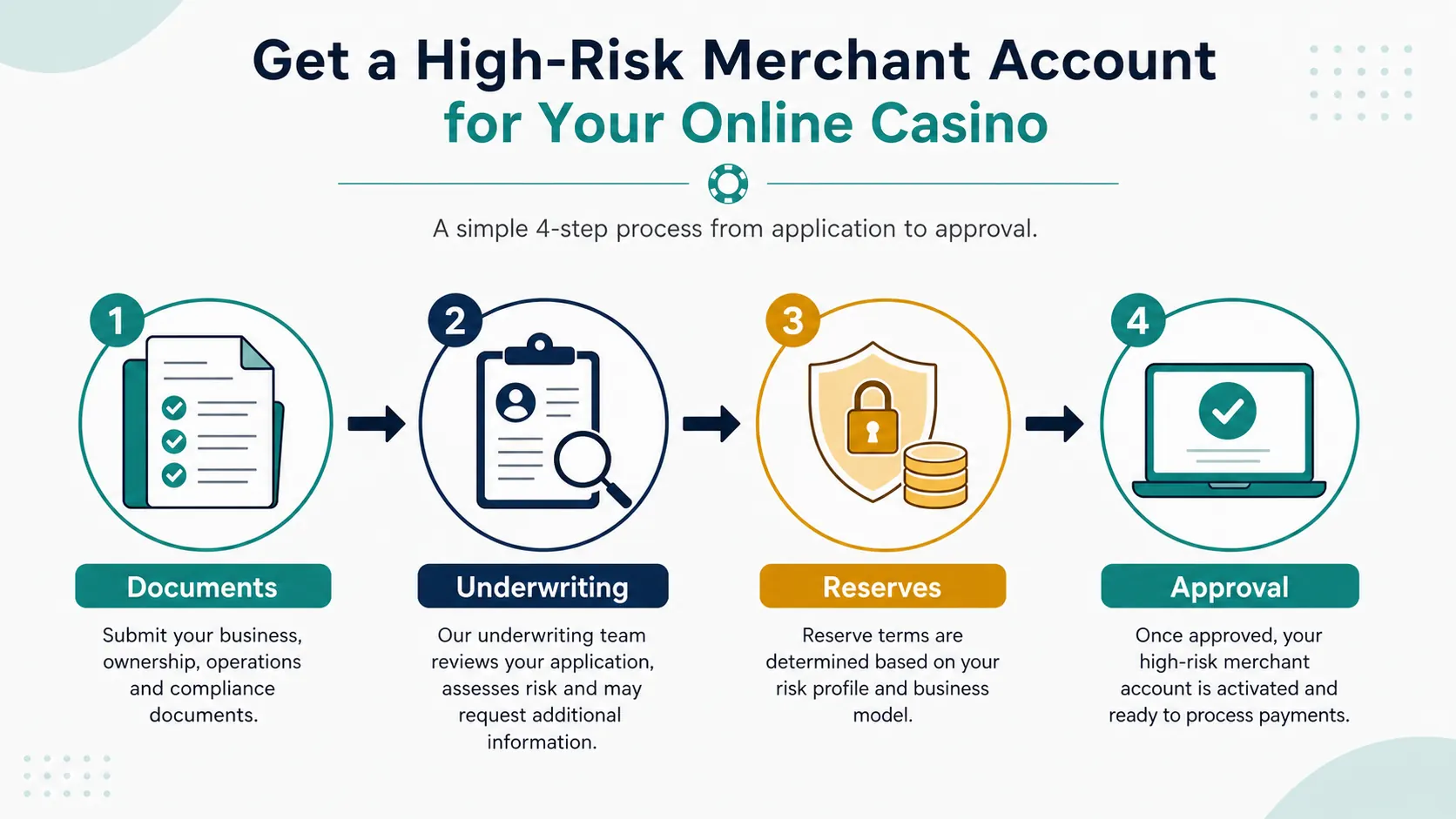
Documents to prepare before applying
- Company registration, ownership and director details.
- Current gaming license or a clear explanation of the licensing stage.
- Terms, privacy policy, complaints process and responsible-gaming information.
- AML/KYC procedures, sanctions screening and suspicious-activity escalation.
- Chargeback, refund and customer-support workflows.
- Processing history by market, method, currency and dispute status.
- Website and app URLs, product screenshots and payment-flow diagrams.
- Banking details, financial statements and source-of-funds documentation.
Operator pro-tip: Keep one version-controlled application pack. A recurring implementation problem we encounter is that legal, finance and payments teams submit slightly different descriptions of markets or ownership, which creates avoidable underwriting friction.
How reserves and settlement terms work
A provider may require a rolling reserve, a fixed reserve, delayed settlement or a combination. Ask for the exact base, percentage, release schedule, trigger events and treatment of open disputes. “Reserve required” is not a complete commercial term.
For an illustrative calculation, suppose a provider holds 10% of a €200,000 monthly processing volume for six months. The amount held for that month would be €20,000 before any releases or adjustments. This is an example only; actual reserve rules are negotiated and may depend on markets, payment methods and loss history.
Payment-security and compliance questions
If the operator stores, processes or transmits cardholder data, PCI DSS obligations may apply. The PCI Security Standards Council describes PCI DSS as a baseline of technical and operational requirements for protecting payment-account data, and notes that merchants, processors, acquirers and service providers can be in scope. Outsourcing payment processing may reduce direct exposure, but it does not remove the need to oversee the provider and understand responsibilities.
Ask every candidate provider how it handles card-data scope, tokenization, 3-D Secure, webhook signing, access controls, incident notification, payout reconciliation and data retention. Route legal and regulatory questions to qualified counsel or the relevant regulator.
How to compare providers
| Decision factor | Question |
|---|---|
| Market fit | Can the provider legally and operationally support the target jurisdictions? |
| Reserve economics | What is held, when is it released and what can change the calculation? |
| Settlement | What currencies, schedules and reconciliation files are available? |
| Risk support | Who handles disputes, fraud alerts and account reviews? |
| Continuity | What happens if a method, processor or acquiring route is unavailable? |
Common failure scenarios
Applications fail when the website’s markets do not match the stated license, the ownership structure is unclear, processing history is incomplete, the reserve model is misunderstood or the operator cannot explain its chargeback controls. A provider may also decline a business because the target mix of countries or payment methods is outside its risk appetite even when the operator is legitimate.
Bottom line
A high-risk merchant account for an online casino is built on transparent documentation, controlled payment flows and realistic reserve expectations. Prepare the evidence first, compare the full operating terms and treat approval as one part of a broader licensed payments and compliance program.
Our platform helps teams connect payment events, player records and operational review workflows. Explore the AI-powered CRM for iGaming.