
Implementation Summary
- Automate KYC checks for iGaming by connecting registration, identity verification APIs, risk thresholds and review queues.
- Use automation for predictable decisions and route uncertain cases to trained reviewers.
- Keep the reason, provider result, policy version and decision history.
- Do not turn a verification score into an unexplained automatic rejection.
How to Automate KYC Checks for iGaming Players in 2026 — Automate KYC Checks iGaming
To automate KYC checks for iGaming players, connect registration data to a third-party identity-verification API, apply documented risk thresholds and route exceptions to a review queue. Automation can reduce repetitive work, but the operator remains responsible for decision quality, data protection, support and market-specific requirements.
We typically advise teams to design KYC as a state machine: requested, submitted, verified, failed, pending review, expired or rejected. A single green or red label is not enough for operations.
Key Definition: Automated KYC is the use of rules and verification services to collect, check and classify identity information with defined human-review paths.
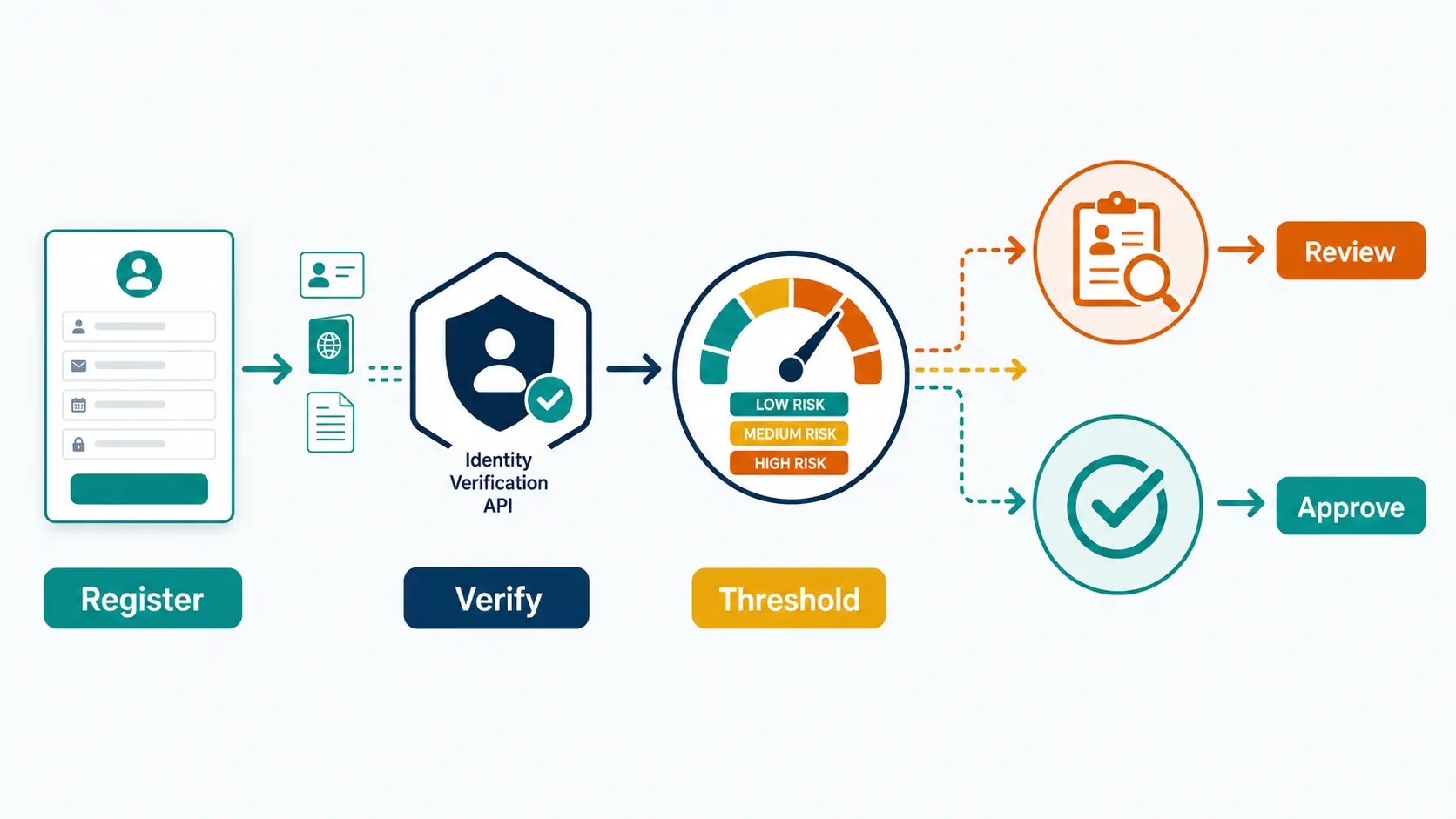
Automate KYC checks iGaming workflow
| Stage | Automation | Human responsibility |
|---|---|---|
| Collect | Request required data and documents. | Explain purpose and support accessibility. |
| Verify | Call identity and document APIs. | Monitor vendor and result quality. |
| Threshold | Apply documented rules and risk scores. | Approve policy changes. |
| Review | Create a case for uncertainty. | Assess evidence and communicate fairly. |
| Audit | Store result and policy version. | Review retention and access. |
Risk thresholds and third-party APIs
Define what the API result means before integrating it. A document mismatch, expired document, duplicate identity, country restriction or liveness issue may require different actions. Keep the provider response, normalized reason, timestamp and policy version so support can explain a pending result.
For an illustrative queue, 1,000 registrations might produce automatic approvals, automatic failures and manual-review cases. The split is not a benchmark; the operator should monitor false positives, review aging, abandonment and downstream fraud outcomes.
Operator checklist: test document quality, name variation, address mismatch, duplicate account, vendor outage, webhook duplication, manual override, data deletion and re-verification.
Bottom line
To automate KYC checks for iGaming, automate repeatable verification while preserving human review, reason codes and an auditable decision history. A fast KYC flow is useful only when the player and compliance team can understand its states.
Our platform helps teams connect identity, player lifecycle and compliance workflows. Explore the AI-powered CRM for iGaming.