Chargeback Playbook
- Reduce iGaming chargebacks by combining payment authentication, clear descriptors, evidence and fast support.
- Separate genuine customer disputes from fraud, processing errors and unauthorized use.
- Monitor the full journey from deposit attempt to refund, not only the gateway response.
- Never promise a fixed improvement percentage without verified baseline data.
How to Reduce Chargebacks in iGaming: A Step-by-Step Playbook — Reduce iGaming Chargebacks
To reduce iGaming chargebacks, operators need a joined view of payment authentication, player communication, billing descriptors, fraud signals, refunds and dispute evidence. A chargeback is not always a bad-faith act; it can reflect a confusing statement, a failed refund, an unauthorized payment or a genuine service complaint.
We typically advise teams to build prevention into checkout while making the response process fast and evidence-led. A payment system that accepts a transaction but cannot explain the player journey leaves finance and customer support working from different facts.
Key Definition: An iGaming chargeback is a payment reversal initiated through a cardholder’s issuing bank or payment process after a disputed transaction.
How to reduce iGaming chargebacks
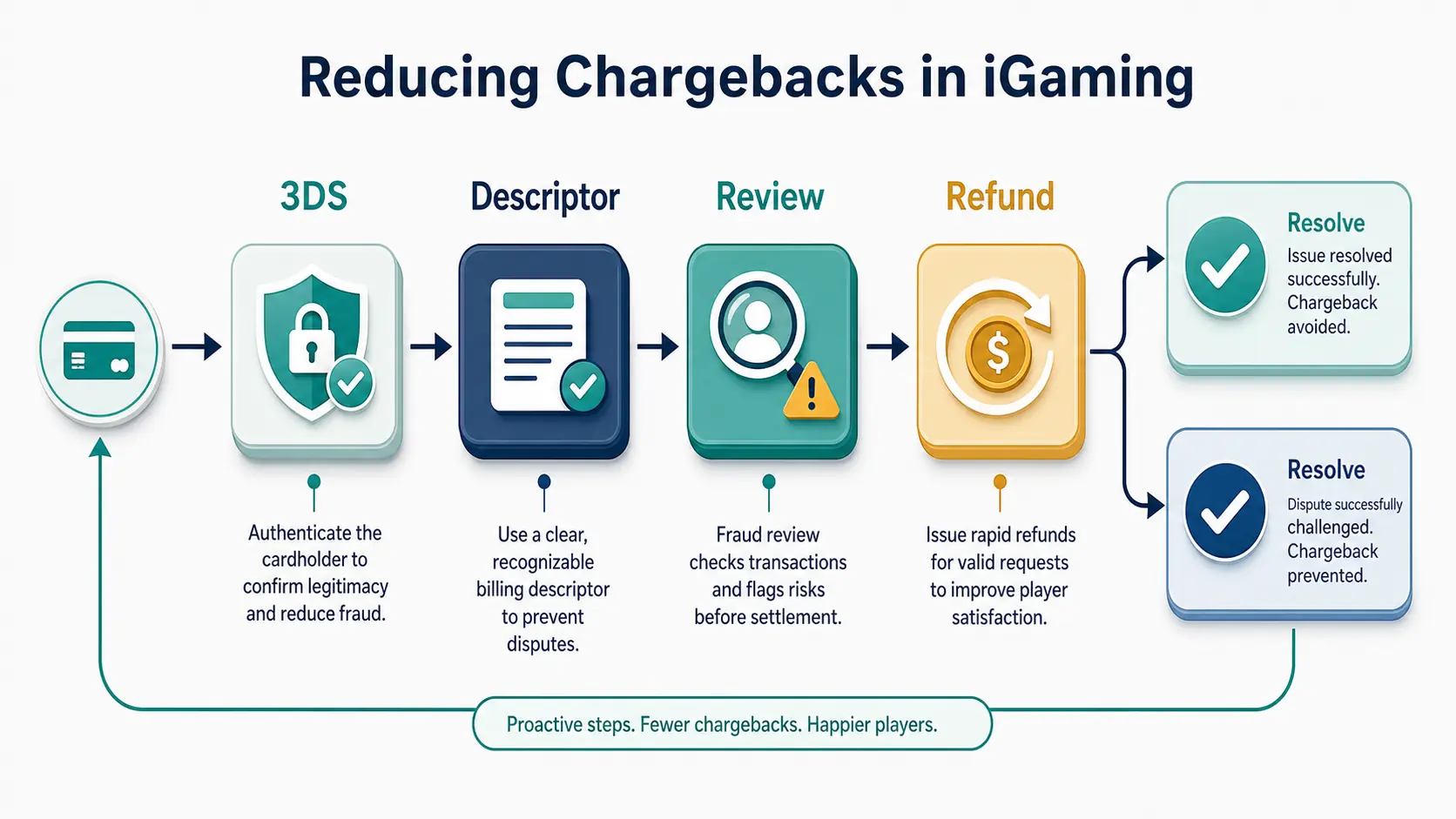
| Control | Purpose | Evidence to retain |
|---|---|---|
| 3-D Secure | Adds an authentication step where supported. | Authentication result, version and transaction reference. |
| Billing descriptor | Helps the customer recognize the charge. | Descriptor shown and effective date. |
| Fraud review | Routes unusual activity before settlement or withdrawal. | Risk signals, decision and reviewer. |
| Refund process | Resolves valid complaints before escalation. | Request, approval, refund ID and timing. |
| Dispute response | Provides a coherent record to the processor. | Terms, payment, login and support evidence. |
Step-by-step prevention
- Make the merchant name and billing descriptor recognizable.
- Use authentication and risk checks appropriate to the payment method and market.
- Show deposit, withdrawal, bonus and refund terms at the decision point.
- Send payment receipts and support routes immediately.
- Monitor repeated attempts, velocity, device changes and account anomalies.
- Respond to customer complaints before the dispute window becomes the first contact.
- Keep a versioned evidence bundle for each contested transaction.
Illustrative measurement
Suppose an operator has 2,000 card deposits and 12 chargebacks in a defined period. The illustrative rate is 12 ÷ 2,000 × 100 = 0.6%. Track the rate by method, market, issuer response, descriptor and player cohort; the number is not an industry benchmark and should not be used without a comparable denominator.
Warning: A refund policy cannot repair unclear licensing, misleading promotions or poor player support. Payment controls should reinforce the customer experience rather than conceal a product problem.
Failure scenarios
Common failures include a descriptor that looks unrelated to the casino, refunds that are promised but not processed, duplicate captures, a payment gateway and CRM using different transaction IDs, and evidence that cannot show who accessed the account. Assign one owner for the dispute record and reconcile gateway, PAM, CRM and support data.
Bottom line
To reduce iGaming chargebacks, combine recognizable billing, authentication, risk review, clear terms and responsive refunds. Measure the complete payment journey and investigate the reason behind each dispute.
Our platform helps connect player, payment and support context for operational review. See the AI-powered CRM for iGaming.
Build a dispute evidence timeline
A useful dispute record starts before the payment. Capture the checkout version, terms shown, authentication result, permitted account event, payment reference, deposit status, support contacts, refund actions and final processor response. The timeline should be readable by someone who did not build the integration.
Segment chargebacks by reason instead of treating them as one number. An unfamiliar descriptor needs a communication fix; repeated unauthorized-payment reports may need stronger authentication or account protection; a refund-related dispute points to support or settlement.
Review the record after resolution. When an operator changes a descriptor, refund SLA or risk rule, record the effective date and compare later cohorts with the same denominator.