
Quick Answer: true EPC
- True EPC is realized eligible earnings divided by valid clicks, not a headline payout divided by every recorded click.
- Subtract documented fees, negative carryover and adjustments.
- Use a mature payout window so delayed commissions are not mistaken for zero value.
- Keep the inputs visible so partners can reproduce the calculation.
How to Calculate True EPC (Earnings Per Click) for iGaming Offers — Calculate True EPC iGaming
To calculate true EPC for an iGaming offer, divide eligible realized earnings by valid clicks after applying the commercial rules that affect what is actually payable. That means looking beyond a headline commission: negative carryover, admin fees, invalid traffic, refunds, delayed approvals and currency treatment can all change the number.
EPC is useful for comparing placements, but only when the numerator and denominator mean the same thing. We typically advise teams to publish both a provisional EPC and a matured true EPC, with the observation window and exclusions visible beside the metric.
Key Definition: True EPC is eligible realized affiliate earnings divided by valid attributable clicks for the same defined offer, cohort and reporting period.
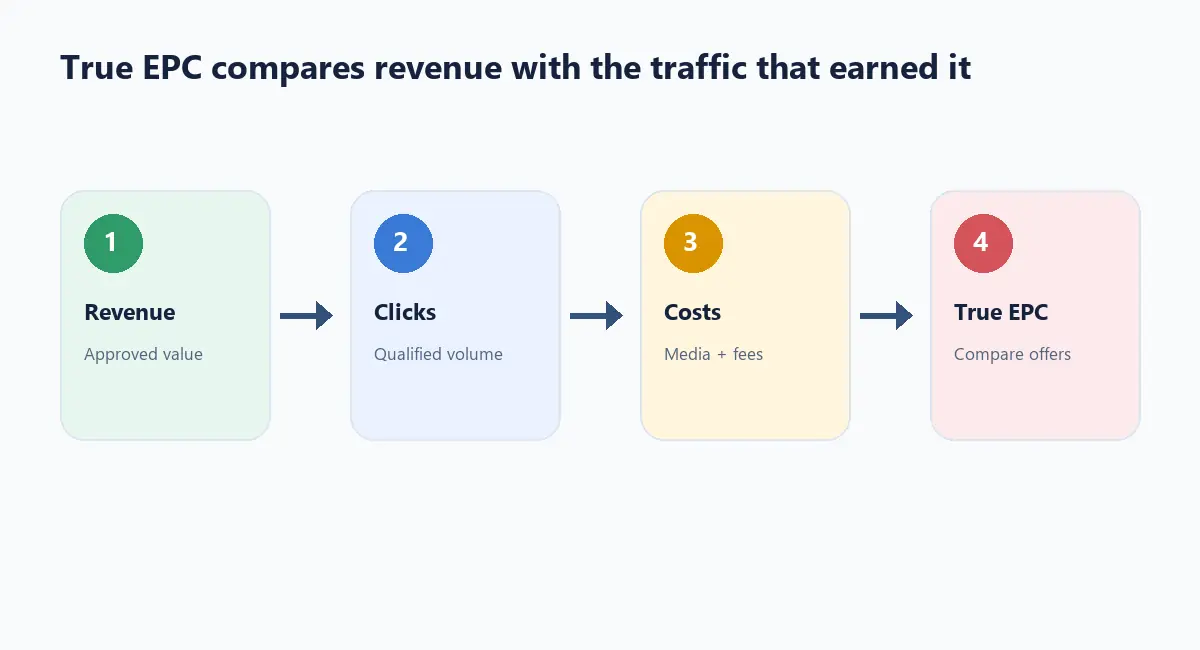
A practical framework for calculate true epc igaming in iGaming
The true EPC formula
True EPC = (gross eligible earnings − fees − negative carryover − reversals) ÷ valid clicks
| Input | Include | Check |
|---|---|---|
| Gross earnings | Approved CPA and or RevShare amounts. | Use the same currency and payout period. |
| Fees | Documented admin, payment or network deductions. | Do not mix optional costs with contract deductions. |
| Negative carryover | Contractual prior-period losses where applicable. | Show the opening balance and rule. |
| Valid clicks | Clicks that pass traffic and attribution checks. | Exclude duplicates, bots and invalid events by definition. |
Illustrative calculation
Suppose a campaign reports €5,000 in gross eligible earnings. It has €200 in documented fees, €300 in negative carryover and €250 in reversals. If 40,000 clicks are valid, true EPC is (€5,000 − €200 − €300 − €250) ÷ 40,000 = €0.10625, or about €0.11 per valid click. The numbers are illustrative, not an industry benchmark.
Why headline EPC can mislead
A dashboard might divide an early payout by clicks before pending events mature. Another may include invalid clicks in the denominator, making a source look weaker. A third may show gross RevShare before fees and chargebacks. These metrics can be useful for monitoring, but label them as provisional, gross or unadjusted.
Operator checklist
- Choose a reporting window and payout maturity rule.
- Define valid clicks and the exclusion process.
- Normalize currency and decimal precision.
- Separate gross, net, provisional and realized earnings.
- Record negative carryover, fees and reversals.
- Compare EPC by source, placement, device and cohort.
- Keep the calculation inputs available for partner review.
Implementation note: If the denominator changes after a fraud review, do not silently rewrite the historical EPC. Version the report and show the adjustment reason.
Bottom line
To calculate true EPC for iGaming offers, align earnings, adjustments and valid clicks in one documented model. A smaller but reproducible EPC is more useful for decisions than a larger headline metric that hides fees or delayed outcomes.
Our platform helps teams connect affiliate performance with lifecycle and revenue context. See the AI-powered CRM for iGaming.