
Last Updated on September 14, 2026 by Caesar Fikson
Quick Answer
- AI personalization iGaming CRM workflows adapt messages to consented context, timing, product interest, and lifecycle stage.
- Dynamic subject lines should be controlled by relevance and safety rules, not by novelty alone.
- Recommendations based on play history need exclusions for restricted products, risky behaviour, and unsuitable incentives.
- Use human-readable reasons and holdout testing so teams can explain what the model changed.
AI personalization iGaming CRM is the use of machine-assisted decisions to tailor a permitted message, offer, channel, or journey to a player’s current context. In our platform, we treat AI as a decision-support layer inside a governed workflow. The model can help rank relevant content or choose a send window, but the operator still owns consent, eligibility, affordability, safer-gambling, and suppression rules.
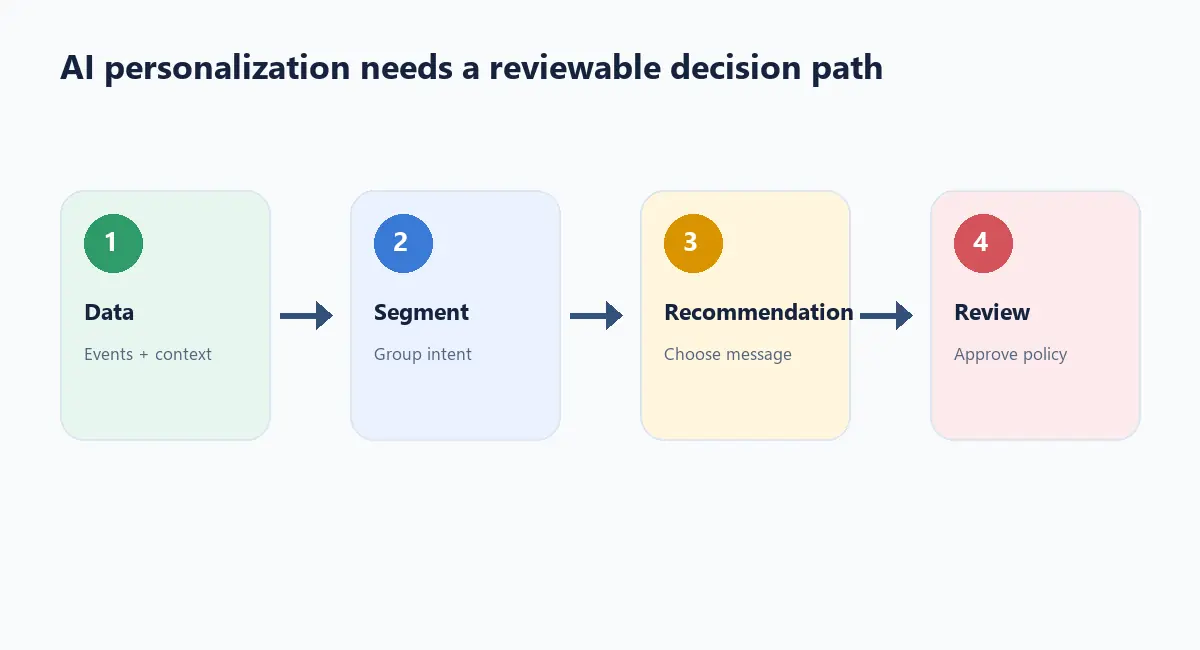
What AI personalization iGaming CRM should change
Key Definition: AI personalization in iGaming CRM is the controlled use of player and journey signals to adapt communication content or timing while enforcing consent, safety, and eligibility constraints.
Useful signals include product interest, recent support intent, preferred language, lifecycle stage, communication engagement, and the player’s response to previous messages. “More activity” is not automatically a reason to intensify marketing. The signal must be relevant to the purpose and acceptable under the operator’s policies.
Dynamic subject lines: relevance with guardrails
Dynamic subject lines can reflect a player’s selected sport, preferred language, loyalty tier, or the next step in an onboarding journey. They should not expose sensitive information, imply guaranteed outcomes, or create urgency that encourages impulsive play. A safe workflow uses a template library, approved variables, length limits, and a fallback subject line.
| Signal | Appropriate use | Guardrail |
|---|---|---|
| Language preference | Localise the message | Use the player’s explicit preference where available |
| Product interest | Choose relevant educational content | Exclude restricted or unsuitable products |
| Journey stage | Explain the next setup step | Do not skip verification or safer-gambling information |
| Recent support intent | Prioritise service follow-up | Do not combine an unresolved complaint with a sales push |
Recommendations based on play history
Play history can help identify a product the player has already shown interest in, but it should not be used as a shortcut to pressure. A recommendation should have a reason code, an eligibility check, a cooling-off or suppression check, and a clear opt-out path. For example, the reason might be “player viewed this educational guide twice,” not “player lost recently.”
A practical policy is:
recommendation = relevant content × eligibility × consent × safety status
If any required factor is zero, the recommendation is not sent. This simple logic is easier to audit than a model that can bypass a control.
How to implement AI personalization without losing control
- Define the communication purpose and permitted signals.
- Create a policy layer that runs before model output.
- Use approved content blocks with variable limits.
- Log the input signals, decision reason, model version, and final message.
- Route uncertain, sensitive, or high-impact cases to manual review.
- Compare the personalised path with a holdout group and monitor complaints, opt-outs, and safety indicators.
Implementation warning: do not let an optimisation objective reward only clicks or deposits. A narrow objective can make the system favour short-term activity while ignoring complaints, churn quality, affordability signals, or safer-gambling outcomes.
Illustrative example
Suppose a player has opted into product education, prefers English, and repeatedly reads sportsbook rules but has not completed verification. The CRM may select a plain-language verification guide with a subject line about completing account setup. It should not send a promotional odds message until the required checks are complete. The illustration uses fictional circumstances to show the decision logic, not a promised result.
Operational edge cases
Models can overfit to a short burst of activity, misread a family-shared device, or recommend content after a player has changed preferences. Delayed event ingestion can also make a message appear personalised when it is already stale. Build expiry times for signals, re-check consent at send time, and provide a clear fallback when context is missing.
Conclusion
AI personalization iGaming CRM works best as a constrained layer that helps teams deliver more relevant service and education while preserving operator accountability. Start with transparent signals, approved content, and measurable holdouts before expanding into more complex recommendations. Learn how our platform supports governed CRM activation at NowG.net.