
Last Updated on September 14, 2026 by Caesar Fikson
Key Takeaways
- Cohort analysis iGaming retention compares players who started in the same period or under the same condition.
- Keep the cohort definition, active definition, and checkpoint consistent.
- Use the pattern to improve onboarding, acquisition quality, product journeys, and CRM timing.
- Separate mature cohorts from recent cohorts and explain seasonality before making a budget decision.
Cohort analysis iGaming retention gives operators a way to see whether player behavior lasts beyond the first conversion. A top-line retention percentage can hide the fact that one acquisition source produces a strong first week but weak Day 30 activity, while another source grows more slowly and retains better.
We use cohorts because they preserve time. Instead of asking whether “retention” improved in the abstract, a team can ask what happened to players who registered in March, made a first deposit in April, entered through a particular campaign, or started with sportsbook rather than casino.
What is cohort analysis iGaming retention?
Key Definition: Cohort analysis iGaming retention is a method of grouping players by a shared starting event and measuring the share who remain active at defined elapsed-time checkpoints.
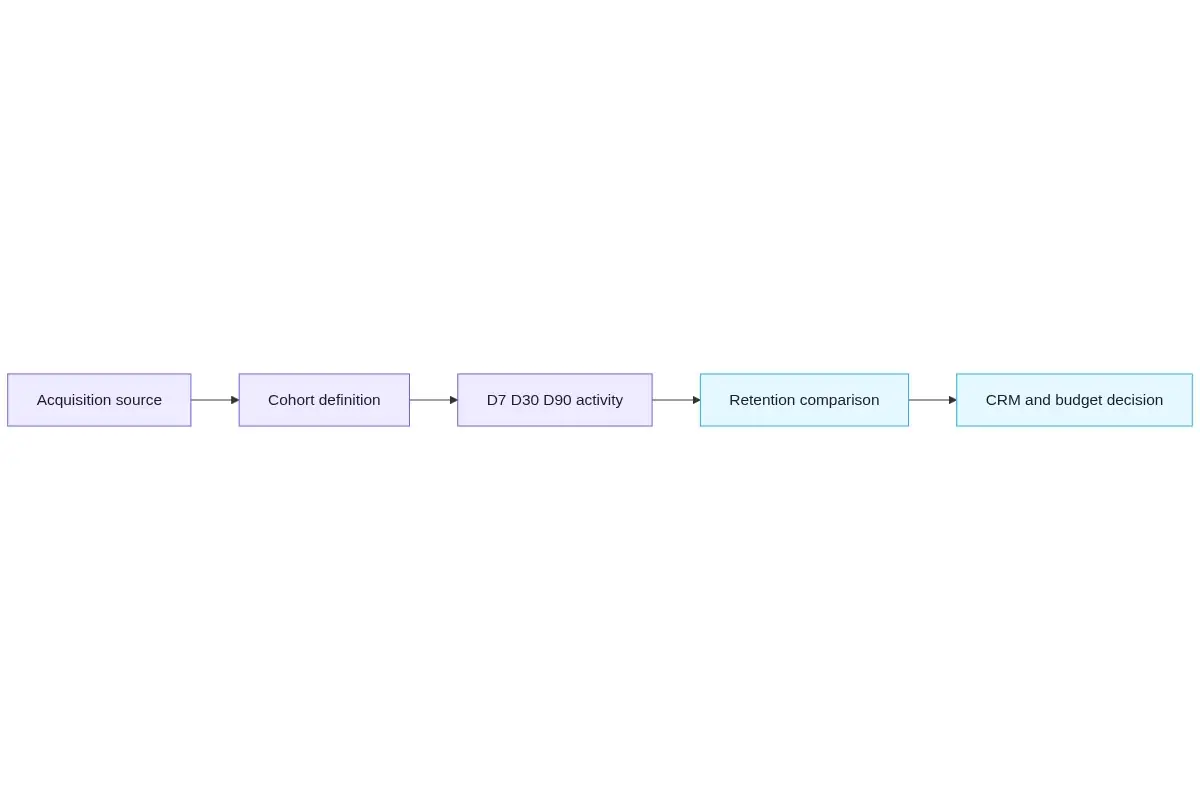
Define the cohort and “active” before calculating
Choose one starting event for the question. Registration, first deposit, first wager, first casino session, and campaign exposure produce different cohorts. Do not mix them in one chart without labeling them.
Define active behavior. It might mean a settled wager, a meaningful casino session, an approved deposit, or an operator-approved engagement event. A login alone may not answer a value or retention question. The definition should also state how reactivated players are treated.
The retention formula and an illustrative example
Use this calculation:
retention at checkpoint = active eligible players at checkpoint / original eligible cohort * 100Illustratively, if 1,000 eligible first-deposit players start a cohort and 240 complete the defined active event on Day 30, Day 30 retention is 24%. The number is illustrative, not a benchmark. The value comes from comparing that 24% with other clearly equivalent cohorts and understanding what changed.
| Cohort | Original players | Day 7 active | Day 30 active | Day 90 active |
|---|---|---|---|---|
| Source A, March | 1,000 | 410 (41%) | 240 (24%) | 120 (12%) |
| Source B, March | 1,000 | 330 (33%) | 260 (26%) | 150 (15%) |
| Source A, April | 1,000 | 390 (39%) | 250 (25%) | Immature |
Source A has the stronger early figure in this illustration, but Source B has the stronger Day 30 and Day 90 pattern. That may change how an operator evaluates acquisition, onboarding, and CRM cost.
Use cohorts to improve CRM journeys
- Onboarding: compare completion and later activity by registration path.
- Acquisition: compare durable retention by source, market, and product.
- Product: see whether first casino game or first sport predicts later activity.
- Messaging: test whether the timing or content of a welcome series changes later checkpoints.
- Win-back: distinguish a normal pause from a meaningful cohort-specific decline.
In our platform, cohort membership can feed segmentation and reporting. A team can create a cohort once, compare it with other cohorts, and then route observations into onboarding or lifecycle experiments without exporting a spreadsheet for every question.
Do not compare immature cohorts with mature cohorts
A cohort that started two weeks ago cannot have a valid Day 90 result. Mark future cells as immature rather than zero. Also account for seasonality: a cohort entering around a major sports event may behave differently from one entering in a quiet month.
Warning:
Do not declare an acquisition source “better” from Day 1 retention alone. Early activity can be driven by incentives, event calendars, or onboarding prompts that do not translate into durable value.
Failure scenarios in cohort reporting
- A first-deposit cohort includes reversed or failed deposits.
- The active definition changes from a settled wager to a login.
- Players move products but the report counts them as inactive.
- Consent or exclusion states are not applied to journey analysis.
- Time-zone boundaries move players between registration dates.
- Recent cohorts are shown as zeros after the data window ends.
Cohort analysis checklist
- Write the starting event and eligibility rule.
- Define active behavior and reactivation treatment.
- Use fixed elapsed checkpoints.
- Label immature cells and seasonality.
- Compare equivalent cohorts and segments.
- Connect findings to a CRM decision or experiment.
- Keep raw counts beside percentages.
Frequently asked questions about cohort analysis iGaming retention
nWhat is cohort analysis iGaming retention?
Which retention periods should an iGaming cohort report include?
How does cohort analysis improve CRM decisions?
What is the retention formula for a cohort?
What mistakes undermine iGaming cohort analysis?
Cohort analysis turns retention from a single headline into a pattern the CRM team can act on. Our AI-powered CRM for iGaming helps connect cohort insights with segmentation and lifecycle workflows; [learn more about our platform](https://www.nowg.net/).