Last Updated on September 13, 2026 by Caesar Fikson
Executive Briefing
- Open source offers control and inspectability, but the operator owns more of the security, upgrade, integration, and reliability burden.
- SaaS usually reduces time to a working workflow and centralizes maintenance, but it requires disciplined vendor, data, and exit planning.
- The right choice depends on engineering capacity, regulatory operating model, required differentiation, and tolerance for platform ownership.
- Compare total operating cost over a realistic period—not only licence price.
An open source iGaming CRM can look attractive because the software licence may be free or flexible. That does not make the operating model free. The operator still needs people, infrastructure, security controls, observability, release management, data governance, and a plan for every integration that connects the CRM to player, payment, support, or compliance systems.
In this comparison, “SaaS” means a vendor-operated platform delivered as a service, while “open source” means software whose source code and licence permit the relevant use, inspection, and modification. The commercial details vary by project, so the decision should be anchored in your own workload and risk profile.
Key Definition: An open-source iGaming CRM is a customer relationship system whose source code is available under a licence that permits defined forms of use, modification, and redistribution, subject to that licence’s obligations.
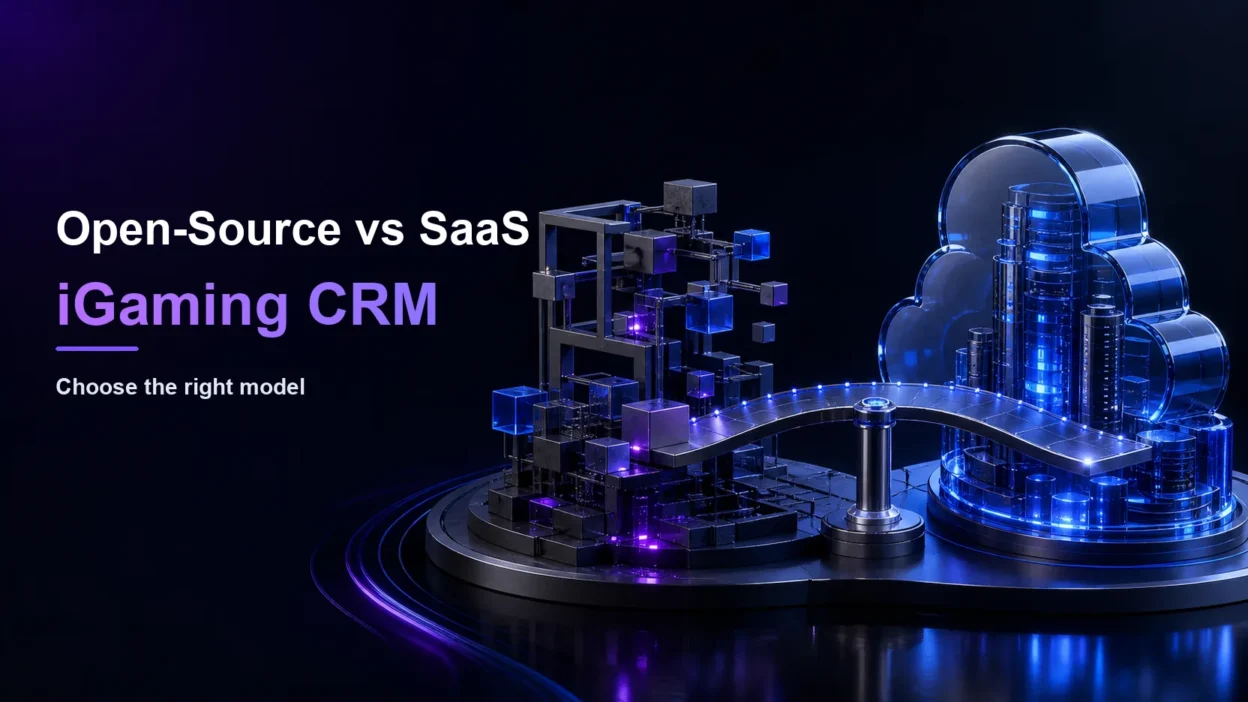
Open source iGaming CRM versus SaaS: the short answer
Choose an open-source route when CRM infrastructure is strategically differentiating, your engineering and security teams can own the platform lifecycle, and you need deep control over data models or deployment. Choose SaaS when the priority is repeatable execution: connect the sources, configure workflows, establish governance, and let a specialist vendor maintain the core service.

The difference is ownership, not just pricing
Teams often compare feature lists first. That is understandable, but it hides the more important question: who owns the consequences when the workflow is wrong, the integration breaks, or a security patch is urgent?
| Decision area | Open-source route | SaaS route |
|---|---|---|
| Core control | High control over code, hosting, and release timing | Control through configuration, contract, and product roadmap |
| Maintenance | Owned by the operator or an implementation partner | Core maintenance owned by the vendor |
| Integration depth | Possible to modify the system around unusual data models | Depends on APIs, connectors, events, and extension points |
| Security response | Operator must identify, patch, test, and deploy fixes | Vendor handles the platform layer; operator still governs access and usage |
| Time to first workflow | Can be fast with an experienced team, slower without one | Usually focused on configuration and integration readiness |
| Exit path | Code and data may be more portable, subject to dependencies and licence terms | Requires export quality, contract clarity, and a realistic migration plan |
An open-source licence also matters. For example, the GNU Affero GPL includes obligations that can matter when modified software is offered over a network. The licence attached to the software you evaluate should be reviewed by qualified legal counsel; “open source” is not a single commercial or legal model.
Compare total cost of operation
The cleanest comparison uses a cost model that includes more than software fees.
Illustrative annual operating cost = licence or subscription + implementation + infrastructure + engineering + security + support + migration reserve
Consider a small operator evaluating an internal open-source deployment and a SaaS platform. The following numbers are deliberately illustrative:
| Cost line | Open-source example | SaaS example |
|---|---|---|
| Software or subscription | €12,000 implementation support | €36,000 subscription |
| Infrastructure | €18,000 | €6,000 for supporting services |
| Engineering and maintenance | €72,000 | €24,000 for integration ownership |
| Security and testing | €20,000 | €10,000 for governance and assurance work |
| Illustrative total | €122,000 | €76,000 |
This example does not prove that SaaS is cheaper. It shows why the right answer changes when internal capacity changes. If the engineering team is already staffed for a platform with strong reuse across brands, open source may create strategic value. If the team is small and every release competes with payments, KYC, risk, or product work, the same deployment can become an expensive distraction.
Security and compliance questions to ask
For both models, ask where player data is stored, how access is controlled, how data is encrypted, how logs are retained, and how a deletion or subject-access request is fulfilled. The ownership boundary changes, but the operator remains accountable for configuring the system correctly.
Open source requires a patching and dependency process. Ask who watches advisories, who tests upgrades against the PAM and payment stack, and how quickly a critical fix can reach production. SaaS requires a vendor-assurance process. Ask for security documentation, incident-notification terms, data-processing details, subprocessor visibility, backup policy, and export support.
In our experience, the most costly failure is not a missing feature. It is an unclear boundary where the operator assumes the vendor owns a control and the vendor assumes the operator configured it.
When open source is the better fit
- You have a capable engineering owner for the CRM platform, not only a project manager.
- You need to alter the data model or workflow engine in ways a vendor cannot support.
- You have a repeatable deployment process across brands, jurisdictions, or products.
- You can fund security review, observability, backups, disaster recovery, and upgrade testing.
- Platform control is a genuine differentiator rather than a preference for avoiding subscription fees.
When SaaS is the better fit
- You need a working CRM layer quickly and want operators to configure workflows without waiting for a release.
- Your engineering team is focused on player account, payments, sportsbook, or compliance systems.
- You want a vendor to maintain the core service while your team owns governance and integration decisions.
- You need a consistent operating layer for segmentation, campaigns, and experiments across teams.
- You value a clear support path and predictable product updates.
NowG’s security overview and API documentation are useful starting points for evaluating a vendor-operated model, but every operator should complete its own technical and legal review.
A decision matrix for the final meeting
| Question | If the answer is yes | Likely direction |
|---|---|---|
| Do we need to change the core data model? | The requirement is strategic and recurring | Explore open source or a highly extensible platform |
| Can we staff 24/7 ownership of the platform lifecycle? | The team has on-call and release capacity | Open source becomes more realistic |
| Is speed to repeatable operator workflows the priority? | The team wants configuration over code | SaaS is often the cleaner fit |
| Is exit certainty the primary concern? | The operator needs documented portability | Compare export, API, data ownership, and migration clauses |
Implementation note: Do not approve a CRM architecture from a demo alone. Run one representative workflow end to end: ingest a player event, apply eligibility rules, create an action, record the audit trail, and export the resulting history.
A sensible migration path
If the decision is uncertain, begin with a bounded workflow rather than a full replacement. Choose one use case such as cohort analysis, VIP task routing, or postback-enriched retention. Define the data contract, run the workflow beside the current process, compare outputs, and document every manual step that remains.
This approach makes hidden ownership visible. It also prevents the common failure mode where the operator selects a platform before understanding the events, identifiers, consent states, and operational exceptions the platform must handle.
Procurement questions that expose the real operating model
Ask the vendor or implementation team to describe a failed workflow, not just a successful demo. What happens when an event arrives twice, a player changes consent, an integration is delayed, or an administrator makes an incorrect change? The answer reveals the quality of the audit trail and the clarity of operational ownership.
Also ask how the system supports data export, role separation, test environments, versioned configuration, rollback, and incident communication. A platform can be functionally impressive and still be difficult to govern if teams cannot see who changed a rule or reproduce why a player entered an audience.
Finally, define an exit test before signing. Export a representative player history, campaign history, consent record, and configuration snapshot. If the team cannot explain how those records would be used during a migration or investigation, the exit plan is not finished.
What is an open source iGaming CRM?
Is an open source iGaming CRM cheaper than SaaS?
When should an operator choose open source iGaming CRM software?
What security responsibilities remain with an open source CRM operator?
How should operators compare open source CRM with SaaS?
Conclusion
The best open source iGaming CRM is not automatically the one with the lowest licence cost, and the best SaaS platform is not automatically the one with the longest feature list. Choose the model that matches your ability to own security, integrations, upgrades, compliance evidence, and day-to-day workflow quality.
To explore a vendor-operated approach built for iGaming teams, visit NowG, our AI-powered iGaming CRM platform.