Bottom Line
Biometric payments in iGaming can reduce authentication friction, but they do not replace consent, account security, KYC, risk review or payment-provider controls. Treat the biometric signal as one part of a permissioned payment flow.
The Future of Biometric Payments in the iGaming Industry — Biometric Payments iGaming
Biometric payments in iGaming use a device or platform biometric confirmation—such as Face ID or a fingerprint—to authenticate an action or approve a payment flow. The biometric template should generally remain under the device or approved provider control; the operator needs an authentication result and transaction context, not a casual copy of sensitive biometric data.
We typically advise teams to separate convenience from identity assurance. A biometric prompt can confirm that a device user approved an action, but the operator still needs account controls, transaction monitoring, responsible-gaming checks and a clear fallback when the biometric is unavailable.
Key Definition: A biometric payment is a payment or authentication action confirmed through a biometric factor supported by a device or identity provider.
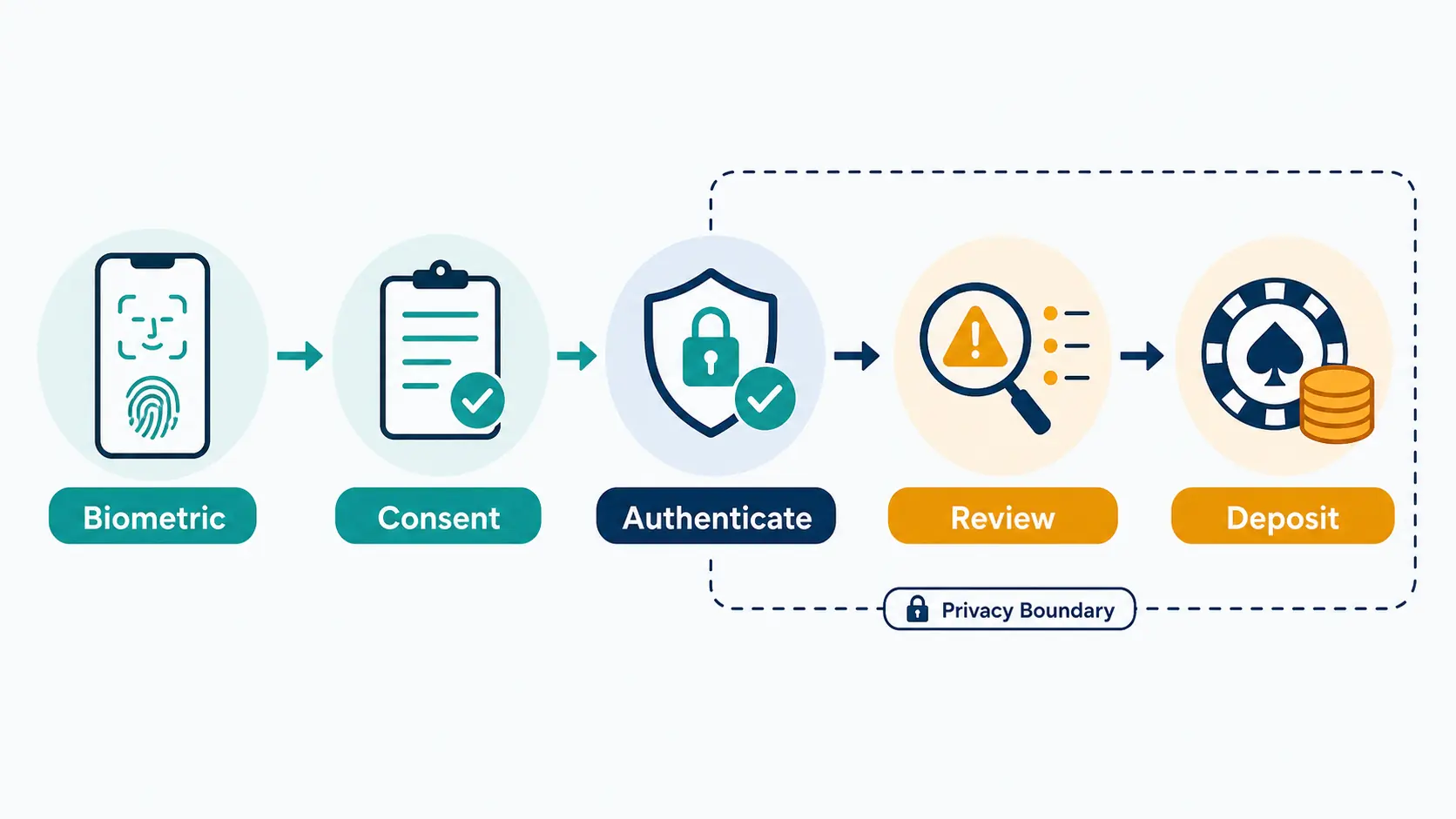
Biometric payments iGaming workflow
| Step | Control |
|---|---|
| Consent | Explain what the biometric prompt does and what it does not do. |
| Authenticate | Receive a provider result without storing raw biometric data. |
| Review | Apply account, payment, AML and responsible-gaming rules. |
| Deposit | Credit only after payment status is confirmed. |
| Fallback | Offer a secure alternative when the device cannot authenticate. |
Regulatory and adoption questions
Biometric processing can engage privacy, security and consumer-protection obligations that vary by jurisdiction. Ask legal and privacy teams to define purpose, minimization, retention, vendor responsibility and breach handling. Do not assume that a device prompt solves a jurisdiction’s age or identity verification requirement.
For an illustrative rollout, an operator might test biometric confirmation for returning players while preserving a stronger review path for new accounts, unusual devices or high-risk transactions. The approach is illustrative and should be evaluated with consent, security and product evidence.
Implementation checklist: device support, fallback, account takeover detection, consent text, provider result, payment status, support messaging, accessibility and audit logging.
Bottom line
Biometric payments in iGaming may improve a returning player’s payment experience, but the operator must keep authentication, privacy, compliance and payment state controls connected. Convenience is valuable only when the underlying decision remains trustworthy.
Our platform helps teams connect player identity and payment events with operational workflows. Explore the AI-powered CRM for iGaming.