
Policy Summary
- A closed-loop payment policy links withdrawals to the deposit method or a permitted equivalent.
- Define exceptions for expired cards, closed accounts, refunds and approved manual review.
- Keep the payment method, player identity, transaction and decision history connected.
- Explain the policy clearly before deposit and withdrawal decisions are made.
How to Set Up a Closed-Loop Payment Policy for Your Online Casino — Closed Loop Payment Policy Casino
A closed-loop payment policy for a casino requires withdrawals to return to the deposit method, wallet or account path permitted by the operator’s rules. The aim is to reduce payment abuse and money-laundering risk while giving legitimate players a clear route when their original method is unavailable.
We typically advise teams to treat closed loop as a decision workflow, not a sentence in the terms and conditions. The cashier, PAM, payment provider, risk team and support desk must agree on what counts as a matching method and who approves an exception.
Key Definition: A closed-loop payment policy is a control that restricts withdrawals to the method used for deposits or to a documented approved alternative after review.
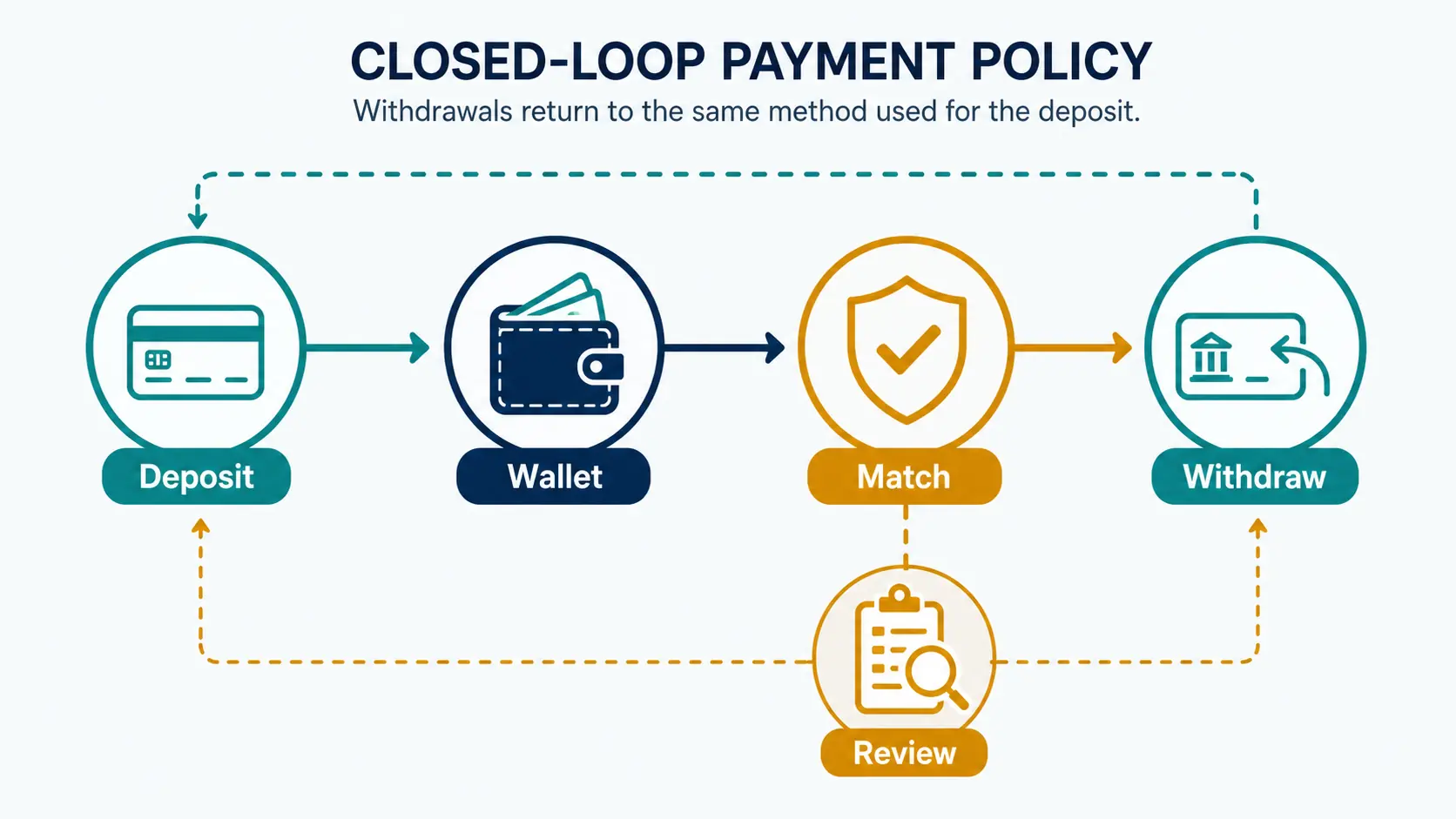
Closed loop payment policy casino workflow
| Stage | Decision | Record |
|---|---|---|
| Deposit | Which method and account made the deposit? | Method token, reference, amount and player ID. |
| Match | Can the withdrawal return to that method? | Match result and reason. |
| Exception | Is the original method unavailable or unsuitable? | Evidence and reviewer. |
| Withdraw | Which destination is approved? | Payment reference and final status. |
Exceptions operators should design for
A card can expire, a bank account can close, an e-wallet can be unsupported for withdrawals, or a player may have deposited through multiple methods. Define whether the operator refunds a card first, uses a method hierarchy, asks for ownership evidence or holds the payment for enhanced review. Do not make support invent a rule at the moment of the complaint.
For an illustrative case, a player deposits €100 by card and €50 by e-wallet, then requests €200. The policy might require the card deposit to be returned first, with the remaining amount routed under the operator’s documented hierarchy. The numbers are illustrative; the actual rule depends on market and operator requirements.
Implementation checklist: document method matching, multiple deposits, refunds, failed withdrawals, ownership checks, chargebacks, manual review, customer messages and audit retention.
Bottom line
A closed-loop payment policy for a casino works when it is explicit, consistent and connected to payment evidence. Design exceptions in advance so player support can protect both customer experience and payment integrity.
Our platform helps teams connect payment and player-lifecycle decisions. Explore the AI-powered CRM for iGaming.