
Conversion Checklist
- Improve casino deposit success rate by measuring each failure state, not by hiding declines.
- Simplify the checkout path and show the right method for the player’s market.
- Use saved payment details only with appropriate security and consent controls.
- Use payment cascading for defined technical failures, with idempotency and clear status.
How to Improve Casino Deposit Success Rates by 15% — Improve Casino Deposit Success Rate
To improve casino deposit success rate, start with the payment journey: method selection, form friction, authentication, provider routing, error messages, support and reconciliation. The 15% in this article title should be treated as a planning target or experiment hypothesis, not a guaranteed result; the achievable change depends on the operator’s baseline and market mix.
We typically advise teams to separate technical declines, bank declines, customer cancellations, risk holds and incomplete sessions. A single “failed” metric cannot tell product or payments teams what to fix.
Key Definition: Casino deposit success rate is the proportion of deposit attempts that reach the operator’s defined successful or credited state within a stated period.
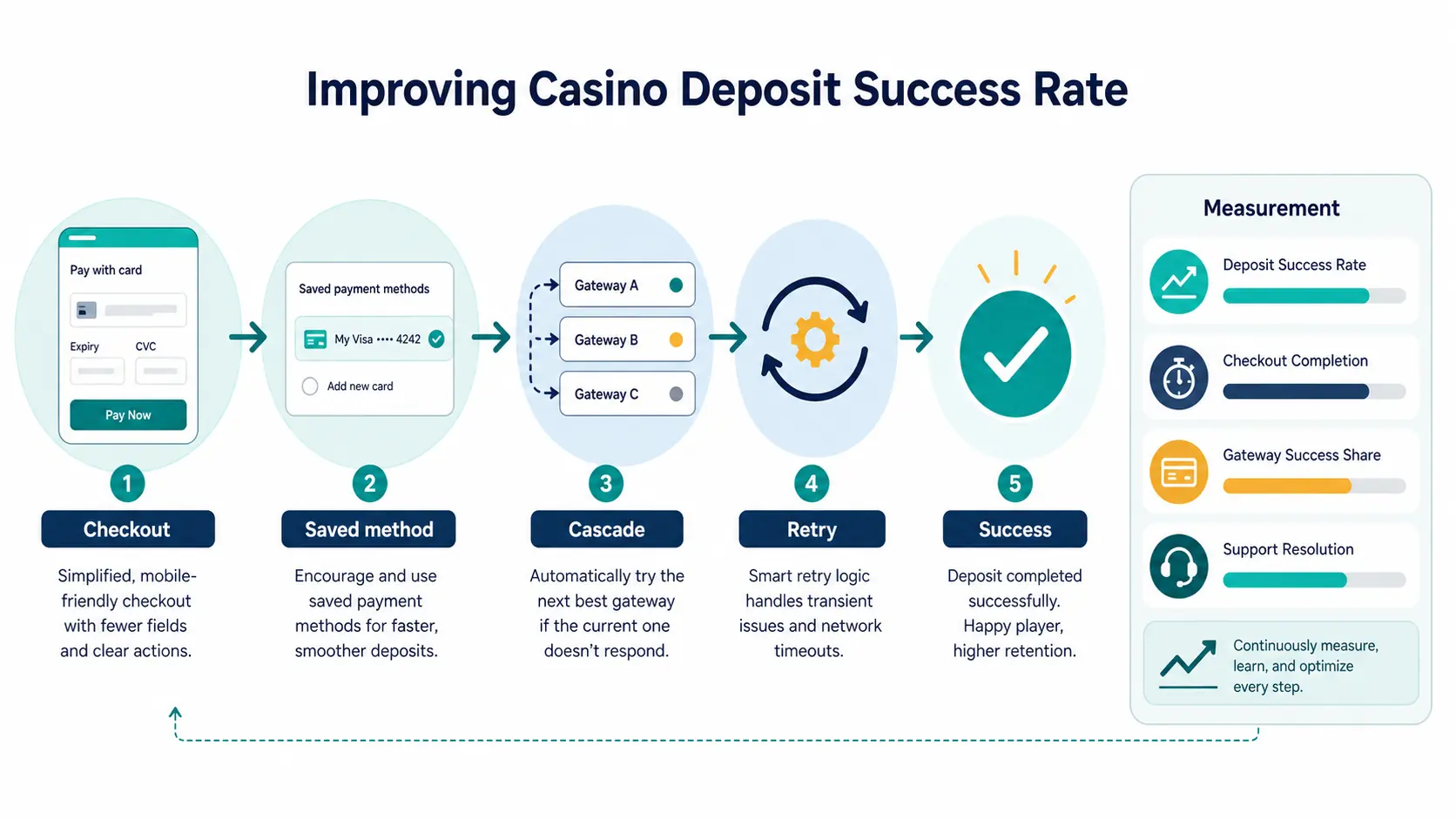
Improve casino deposit success rate with a failure taxonomy
| Failure state | Likely owner | Useful action |
|---|---|---|
| Form abandonment | Product or UX | Remove unnecessary fields and clarify the next step. |
| Authentication failure | Issuer or payment flow | Explain the next action and support a permitted alternative. |
| Provider timeout | Integration | Poll status and retry only with idempotency. |
| Risk hold | Fraud or compliance | Route to review instead of treating it as a technical decline. |
| Balance mismatch | Ledger or reconciliation | Repair the state before asking the player to repeat payment. |
Checkout changes that deserve testing
- Show the most relevant method first for the player’s country and currency.
- Keep amount, currency, fees and minimums visible before authorization.
- Use clear error messages that tell the player whether to wait, retry or contact support.
- Save a permitted payment method token rather than raw card data.
- Use cascading only for recoverable technical states.
- Measure by device, method, provider, issuer response and player cohort.
Illustrative target calculation
If baseline success is 60%, a 15% relative improvement would be 60% × 1.15 = 69%; a 15-percentage-point improvement would be 75%. These are different targets. State which one the experiment uses before evaluating the result, and do not present either as a verified industry outcome.
Warning: Saving payment details securely can reduce friction, but it must follow the operator’s security, consent and payment-provider requirements. Never store sensitive card data casually.
Bottom line
To improve casino deposit success rate, diagnose the failure states and test one change at a time. A 15% target can focus an experiment, but only a clean baseline, controlled rollout and verified result can support a claim.
Our platform helps teams connect payment outcomes with player and CRM context. Explore the AI-powered CRM for iGaming.
How to run a deposit experiment
Choose one change, one cohort and one measurement window. For example, simplify the amount screen for a defined market while leaving the provider mix unchanged. Record attempts, credited deposits, abandonment, retries, support contacts and refunds.
Check unintended effects. A higher success rate can coincide with more duplicate attempts, fraud holds or refund requests. Review the result by method, issuer response, device and player segment, and keep a control or pre-change comparison where appropriate.
Use relative and absolute changes consistently. If a baseline moves from 60% to 69%, that is a 9-percentage-point gain and a 15% relative improvement. Report both.