
Operator Playbook
- Use a whitelist for sources that meet documented quality and compliance criteria.
- Use a blacklist for confirmed, repeatable violations with an audit trail.
- Put uncertain traffic into review instead of forcing a binary decision.
- Apply rules at the source and campaign level before blocking an entire partner.
Building a Whitelist/Blacklist System for iGaming Affiliate Traffic — iGaming Affiliate Traffic Blacklist
An iGaming affiliate traffic blacklist is one part of a broader source-governance system. Operators need to identify traffic that is clearly prohibited, traffic that is trusted under defined conditions, and traffic that needs review. A binary block list without evidence can remove legitimate partners; a whitelist without monitoring can allow a problem to scale.
In our experience, the system works best when it records why a source was routed, who approved the rule, when it expires and which signals triggered the decision. The result is an operational control that can be audited rather than a hidden collection of IP addresses.
Key Definition: An iGaming affiliate traffic blacklist is a governed set of sources, identifiers or signals that are blocked from a defined campaign or operator workflow because documented evidence shows they violate traffic, compliance or quality rules.
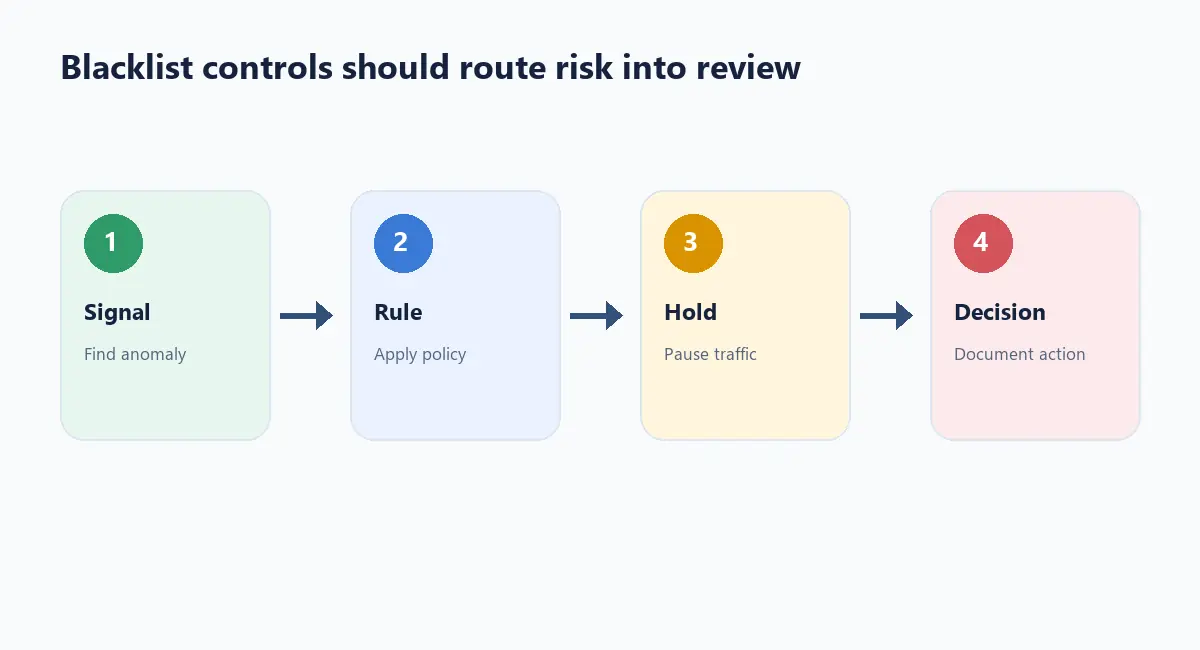
Operator guidance for igaming affiliate traffic blacklist in iGaming
Whitelist, review and blacklist decisions
| Route | Use when | Control |
|---|---|---|
| Whitelist | Source meets current quality, market and compliance requirements. | Expiry date and periodic review. |
| Review | Signals conflict or evidence is incomplete. | Owner, SLA and temporary limits. |
| Blacklist | Violation is confirmed and repeatable. | Reason code, evidence and appeal path. |
Signals worth evaluating
Depending on the operator’s stack and lawful basis, evaluate source ID, campaign, placement, IP reputation, proxy or hosting indicators, duplicate click patterns, incentivized traffic disclosures, unusual registration behavior, chargebacks, responsible-gaming concerns and postback anomalies. No single signal should automatically prove fraud; combine evidence and document thresholds.
Build the rules engine
- Normalize source, partner, campaign and placement identifiers.
- Define hard-stop rules for confirmed prohibited traffic.
- Define review rules for uncertain or emerging patterns.
- Route clean traffic through normal attribution and payout checks.
- Log the rule, input signal, decision, timestamp and reviewer.
- Expire temporary rules and re-evaluate them.
Warning: Never blacklist an entire affiliate partner because one placement has a problem unless the evidence supports that scope. Narrow rules reduce collateral damage and make appeals more credible.
Illustrative decision example
Imagine a source has a sharp increase in registrations, but the operator has not yet confirmed whether the traffic is incentivized. The right route is review with a temporary volume cap, not immediate whitelist or permanent blacklist. If logs later confirm repeated prohibited placements, block that placement and retain the evidence.
Measure the system
Useful operational measures include review aging, false-positive appeals, blocked-source recurrence, postback rejection rate, chargeback review rate and the percentage of decisions with a complete reason code. These are controls, not claims about the quality of an industry or a partner.
Bottom line
An iGaming affiliate traffic blacklist should sit inside a transparent whitelist-review-blacklist workflow. Govern the evidence, scope decisions narrowly, expire temporary rules and preserve an audit trail that finance, compliance and partner teams can understand.
Our platform helps teams connect source quality signals with CRM and partner workflows. Explore the AI-powered CRM for iGaming.