
Last Updated on September 14, 2026 by Caesar Fikson
Operator Checklist
- Prevent affiliate fraud iGaming programs with layered traffic, timing, duplicate, and conversion controls.
- Click spamming and cookie stuffing can create attribution credit without genuine influence.
- Use review queues and evidence before blocking a partner.
- Keep commercial enforcement separate from responsible-gambling and player-service decisions.
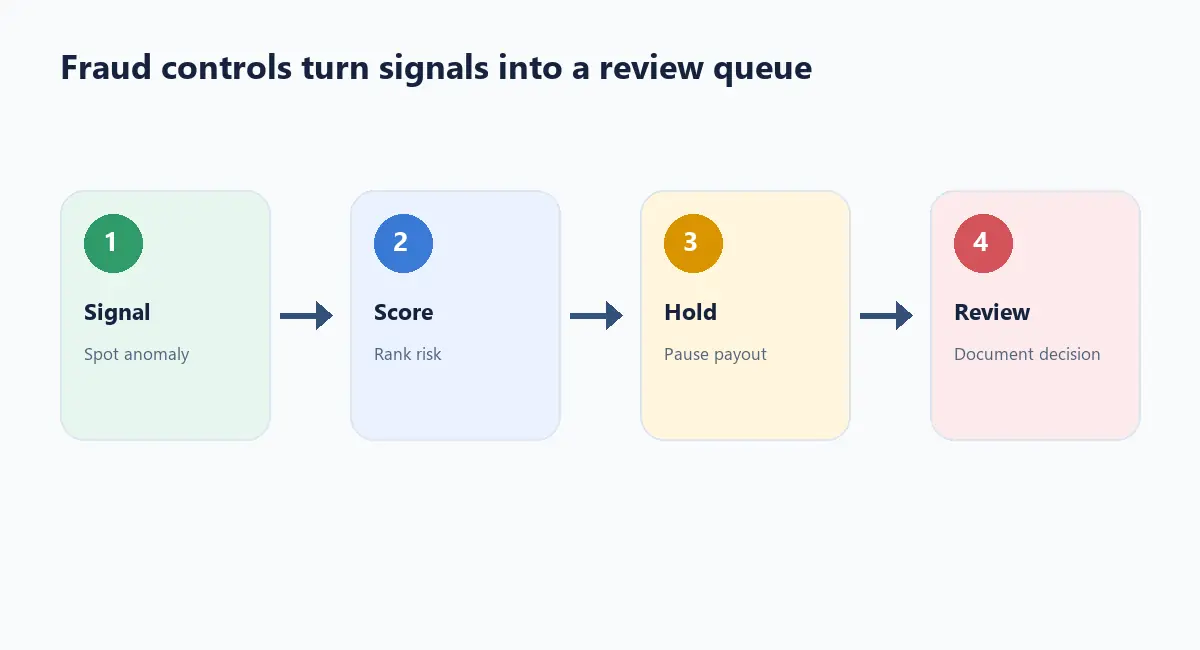
Prevent affiliate fraud iGaming programs by checking whether clicks and conversions reflect genuine, permitted influence. Click spamming creates large volumes of low-quality clicks, often close to conversion. Cookie stuffing attempts to place tracking identifiers without a meaningful user interaction. The answer is not one blacklist; it is a layered process that combines traffic quality, conversion timing, duplicate detection, and human review.
How operators apply prevent affiliate fraud igaming in iGaming
What affiliate fraud prevention should detect
Key Definition: Affiliate fraud is deliberate or materially misleading activity that attempts to obtain attribution or commission through prohibited traffic, false interactions, duplicate events, or policy violations.
| Signal | What it may indicate | Why it is not proof alone |
|---|---|---|
| Very short click-to-conversion time | Click spamming or forced placement | Some genuine journeys are fast |
| Many clicks with little engagement | Low-quality traffic or automated activity | Campaign and placement context matters |
| Duplicate identifiers | Replay or attribution manipulation | Retries can be legitimate |
| Unusual device or IP pattern | Automation, proxy, or shared traffic | VPNs, mobile networks, and households create overlap |
| Unexpected referrer or placement | Misrepresentation or policy breach | Redirects can change referrer data |
Layered controls for click spamming
- Record the click timestamp, source, placement, click ID, and user-agent context permitted by policy.
- Review click-to-conversion timing by campaign and partner.
- Set a documented conversion window and flag events outside expected parameters.
- Compare clicks with page engagement and downstream account quality.
- Use a review queue rather than an automatic block for ambiguous cases.
Cookie stuffing and forced attribution
Cookie stuffing attempts to associate a user with an affiliate without a meaningful click or view. Controls include validating the actual interaction, checking placement disclosures, rejecting unexplained tracking events, and reconciling the affiliate click ID with the operator’s logs. A conversion window should not turn an unverified identifier into unquestioned credit.
Implementation warning: IP filtering and device signals are supporting evidence, not a complete fraud verdict. Over-aggressive rules can block genuine users and create partner disputes.
Decision matrix: approve, review, or block
| Evidence state | Action | Record |
|---|---|---|
| Consistent click, engagement, and valid conversion | Approve | Evidence and rule version |
| Mixed signals or unusual timing | Review | Context, analyst decision, and follow-up |
| Confirmed policy violation or replay | Block or reject | Rule, evidence, partner notice, and appeal path |
Illustrative example
Suppose one placement produces a large spike of clicks, but most occur within seconds of a conversion and have no matching landing-page event. That is a reason to investigate the placement and request evidence; it is not by itself proof that every conversion is fraudulent. Compare source logs, click IDs, postbacks, and partner disclosures before deciding.
Failure scenarios
A traffic-quality rule can flag a mobile carrier NAT as many users from one IP. A partner may change a redirect and accidentally remove an event. A fraud model can learn from a disputed decision and repeat the error. Keep a human override, appeal process, rule version, and audit trail.
Conclusion
To prevent affiliate fraud iGaming teams need layered controls that protect attribution without punishing legitimate players or partners. Make decisions from evidence, preserve context, and separate suspicion from confirmed violation. Build clearer partner and CRM workflows with NowG.net.