Last Updated on September 14, 2026 by Caesar Fikson
Decision Brief
- First-click vs last-click iGaming attribution answers different business questions.
- First-click rewards the touchpoint that introduced the player; last-click rewards the final credited interaction.
- Neither model explains the full journey when players use content, comparison, paid, and direct channels.
- Choose the model that matches the decision, then test multi-touch or incrementality where the data supports it.
first click vs last click igaming is the focus of this guide, with practical operator decisions, controls, and implementation checks.
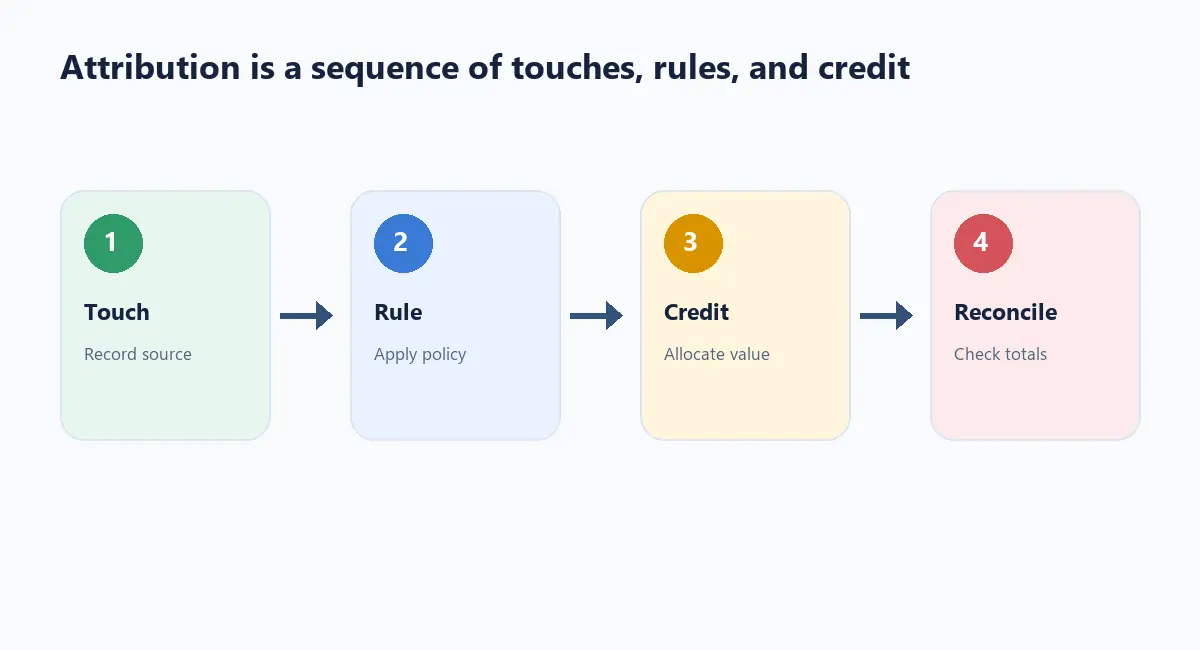
First-click vs last-click iGaming attribution is a choice about which touchpoint receives credit for a conversion. First-click gives credit to the first recorded affiliate interaction. Last-click gives credit to the final eligible interaction before conversion. Both can be useful, but each can hide other influences in a longer casino or sportsbook journey.
Operator guidance for first click vs last click igaming in iGaming
First-click vs last-click iGaming attribution explained
Key Definition: First-click attribution assigns conversion credit to the first tracked touchpoint, while last-click attribution assigns credit to the final tracked touchpoint before conversion.
| Model | Rewards | Can understate | Best initial question |
|---|---|---|---|
| First click | Discovery and reach | Later persuaders and closers | Which partners introduce new demand? |
| Last click | Closing interaction | Earlier education and influence | Which partner is present at conversion? |
| Multi-touch | Several recorded interactions | Untracked and low-quality touchpoints | How does the journey distribute influence? |
| Incrementality test | Measured lift versus a control | Requires careful experiment design | Did the activity cause additional conversions? |
When first-click attribution is useful
First click helps affiliate managers understand which partners introduce players who would not otherwise enter the funnel. It is useful for discovery content, brand education, and top-of-funnel partnerships. Its weakness is that it may give full credit to a source even when later interactions did the work of explaining trust, product fit, or registration steps.
When last-click attribution is useful
Last click is simple and operationally easy. It can help reconcile commission rules that are explicitly defined around the final eligible interaction. Its weakness is that a closing click may be a short path after a longer research journey. A partner can appear strong because it is present at the end, while earlier partners are under-credited.
Use a decision matrix before changing commission rules
| Business situation | Starting model | Additional check |
|---|---|---|
| Need to grow partner discovery | First click | Review quality and downstream activation |
| Need a simple operational commission rule | Last click | Monitor partner concentration and assist paths |
| Long content-led journey | Multi-touch view | Check whether touchpoints are reliably captured |
| High-value budget decision | Incrementality where feasible | Use a defensible control design |
Illustrative journey
A player first reads a comparison guide, later sees an affiliate review, then clicks a final offer link and converts. First click credits the comparison guide. Last click credits the final offer link. A multi-touch report can show that both exist without pretending that recorded touchpoints prove causation.
Operator pro-tip: preserve the raw touchpoint sequence even if finance uses one model for payment. A single commission model should not destroy the evidence needed for future analysis.
Edge cases and quality controls
Direct traffic can overwrite an affiliate click if the attribution window is not defined. Duplicate clicks can make the final touchpoint look more important than it is. Cross-device journeys can lose the link entirely. A player may see several partners but click only one. Track click ID, event ID, timestamps, channel, and model version so reports can be reproduced.
Conclusion
First-click vs last-click iGaming attribution is not a universal winner-takes-all debate. Use first click to study discovery, last click for a simple closing rule, and broader methods when the decision requires a fuller or causal view. Build durable attribution records with NowG.net.