빠른 답변
Payment orchestration in iGaming uses rules to route a transaction across available payment providers, methods and fallback paths. It can improve operational resilience, but only when routing decisions, retries, fraud controls, settlement and reconciliation remain visible.
결제 오케스트레이션이란 무엇이며 iGaming 운영자에게 필요한 이유는 무엇일까요? — iGaming 결제 오케스트레이션
Payment orchestration in iGaming is a routing layer that decides how a deposit, withdrawal or refund should move through available payment providers. The rules can consider currency, method, country, risk state, provider availability and prior response, then select a route or safe retry.
We typically advise operators to use orchestration to make decisions explicit. Sending a failed payment to another provider without preserving the original state can create duplicate authorizations, inconsistent player messages and a difficult finance reconciliation.
주요 정의: Payment orchestration is a control layer that routes payment instructions across multiple providers using defined business, risk and availability rules.
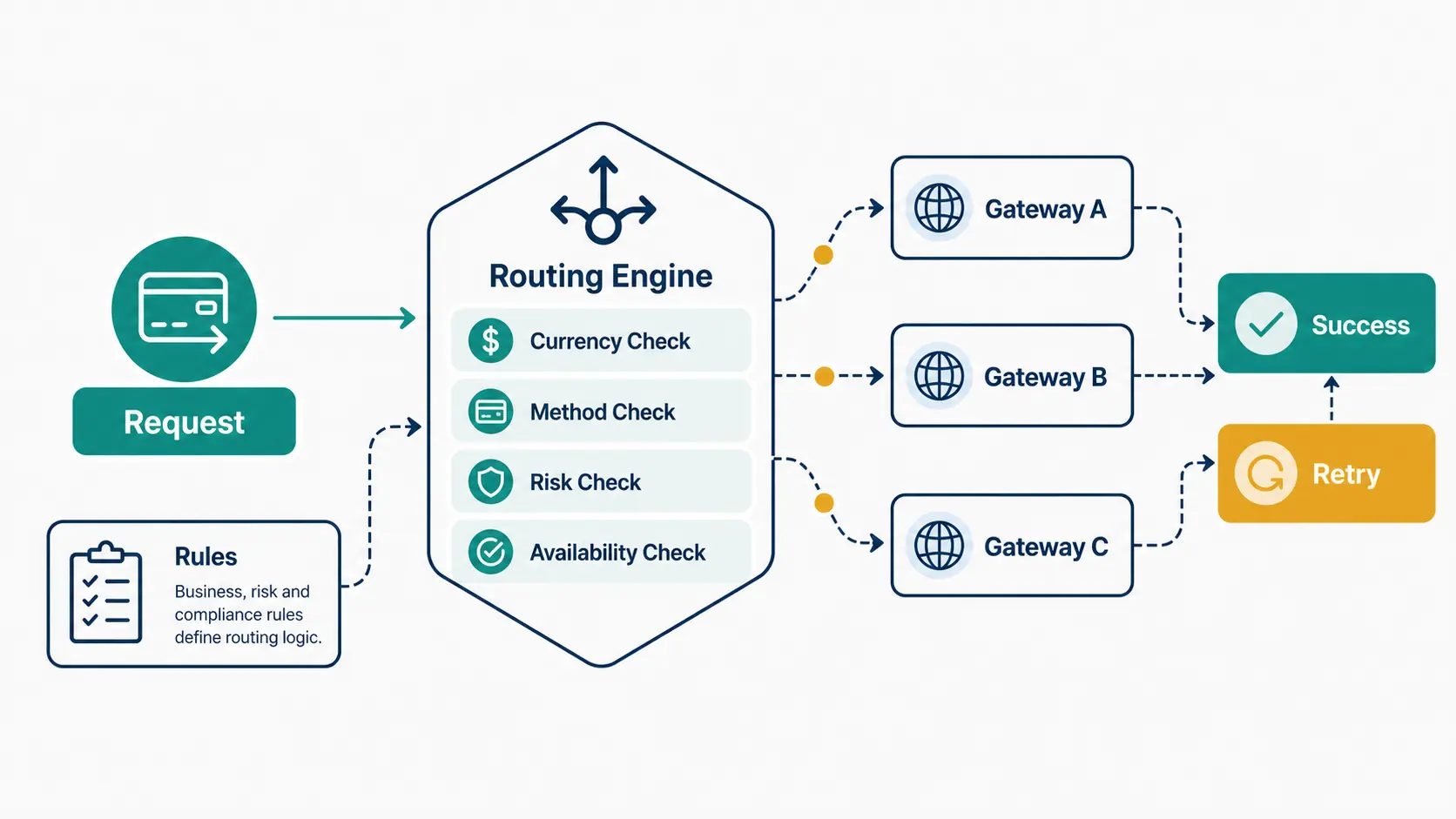
Payment orchestration iGaming workflow
| 의사결정 입력 | 예시 규칙 | 난간 |
|---|---|---|
| 환율 | Route a local currency to a compatible provider. | Do not convert silently. |
| 방법 | Use the provider enabled for the selected wallet or bank rail. | Keep user choice visible. |
| 위험 | Send a high-risk event to review or stronger authentication. | Do not bypass controls through retries. |
| 이용 가능 여부 (Availability) | Use a fallback after a defined technical failure. | Prevent duplicate capture. |
| 해결 | Prefer a route finance can reconcile. | Store provider reference and state. |
Routing and retry design
Define which errors are retryable. A timeout may justify status polling; a declined payment may require a player-visible alternative; a suspected fraud response should never be blindly retried. Add idempotency keys and a maximum retry count. Route changes should be explainable in an operations log.
For an illustrative example, 1,000 deposit attempts are divided among three routes by country and currency. If one provider reports a technical outage, the orchestration layer can pause that route and direct eligible new attempts elsewhere. The operator should still show the original payment state and reconcile the final result; the example is illustrative.
운영자 팁: Measure success by player journey and settled transaction, not only authorization response. A route that authorizes quickly but creates refund or reconciliation failures may not be the best route.
실패 시나리오
Common problems include retrying a payment after a successful but delayed response, routing a withdrawal to a method that cannot support it, creating mismatched currency records, and allowing a provider rule to override a responsible-gaming or AML hold. Make the orchestration layer respect the operator’s higher-order controls.
결론
Payment orchestration in iGaming can make a multi-provider stack more resilient when its rules, retries and settlement outcomes are transparent. Treat it as a payment-control system, not a black box that hides failures.
Our platform helps connect payment routing outcomes with player and operations workflows. Explore the iGaming을 위한 AI 기반 CRM.
What to monitor after implementation
Monitor route selection, authorization, settled success, retry rate, duplicate prevention, refund completion, provider latency and reconciliation exceptions. A route should be evaluated over the full transaction lifecycle.
Version routing rules and record the reason for every material change. When a provider is paused, operations should know which countries, methods and currencies are affected and whether in-flight transactions need polling. Keep a manual safe mode for incidents.
Test orchestration changes against anonymized events that include success, decline, timeout, duplicate, refund, compliance hold and provider outage states. This makes a routing change reviewable before it reaches live deposits.