Last Updated on September 13, 2026 by Caesar Fikson
Casino bonuses have one job: get you to play more.
Bonus terms have a second job: make sure you can’t game the bonus too easily.
Most “my winnings got confiscated” stories come down to a small set of rules that beginners either didn’t see, didn’t understand, or didn’t realize were being enforced automatically. Some casinos are genuinely shady, yes. But a depressing amount of drama is just people tripping on rules like max bet, excluded games, and deadlines while autoplaying at 2am like a raccoon with a credit card. 🦝💳
This guide is the clean explanation you wish casinos put on the bonus banner.
Why casinos void bonus winnings in the first place?
A bonus changes the math. It gives you extra bankroll and more attempts at hitting a good run. Without restrictions, experienced bonus hunters could minimize risk, grind low house-edge games, and turn bonuses into predictable profit. Casinos respond with guardrails.
The problem is that these guardrails don’t feel like “guardrails.” They feel like punishment when you discover them after winning.
So the goal here isn’t paranoia. It’s understanding. Once you know the common terms that trigger voided winnings, you can choose bonuses that fit your style or skip them entirely.
The big three terms that cause most voided winnings
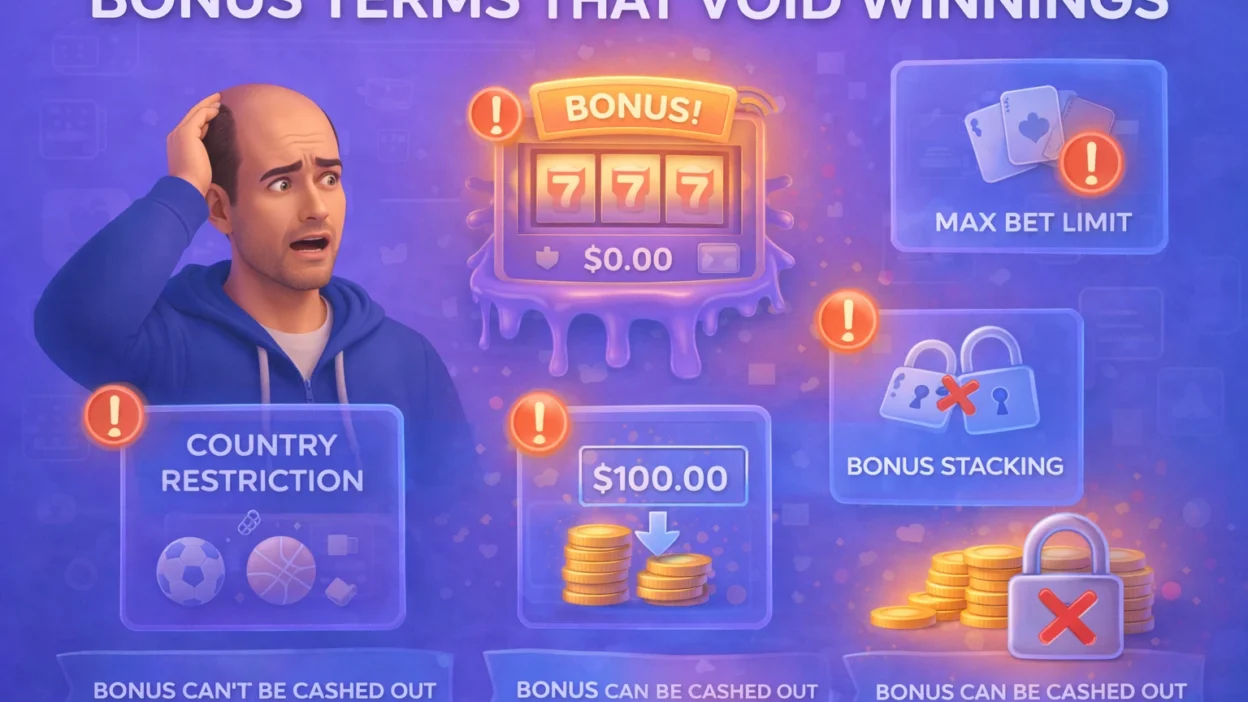
If you remember only three things, remember these: max bet rules, game contribution rules, and time limits. They’re the holy trinity of “why did my cashout disappear.”
1) Max bet rules: the easiest way to break a bonus without realizing it
A max bet rule sets the largest amount you’re allowed to wager per spin/hand/round while a bonus is active. It’s often something like €5 per spin, €10 per round, or a cap tied to your deposit level. Some casinos also cap how much you can increase your bet size during a bonus.
Why does this exist? Because big bets let you “shortcut” wagering. If you can bet €50 a spin, you can chew through wagering requirements quickly and reduce the casino’s edge over the required volume. Max bet rules force you to grind. That’s the whole point.
How players accidentally violate it is painfully predictable. They’re playing at €2 per spin, they hit a win, adrenaline spikes, and they increase to €10. Or they switch to a different slot where the default stake is higher. Or they turn on autoplay and forget the bet amount while doing literally anything else.
What happens next depends on the casino’s terms. Some will warn you. Some will reset your wagering progress. Some will remove the bonus. The harsher ones will void bonus-related winnings at withdrawal time, which feels like theft even when it’s technically in the rules.
The beginner-safe move is boring but effective: once you claim a bonus, set your bet and never touch it unless you’ve confirmed the max bet limit. And if the casino doesn’t show the max bet rule clearly in the bonus terms, that’s not “mysterious.” That’s a product choice, and it’s not for your benefit.
2) Game contribution rules: “You wagered €1,000 but only €100 counted”
Game contribution rules define what percentage of your bets count toward meeting the wagering requirement. Casinos apply this because some games are easier to “grind” with lower risk.
Slots usually count at or near 100% because they have higher variance and typically higher house edge. Table games often count partially, like 10%–20%, or not at all. Live casino and certain specialty games can be excluded or reduced too.
Here’s the part beginners miss: contribution affects how long you need to play, not just what games you’re allowed to touch.
If a game contributes 10% and you wager €500, only €50 goes toward clearing your wagering target. That means you can sit there “playing responsibly” and still not move the progress bar in any meaningful way. Then the deadline hits. Bonus gone. Rage ensues.
Casinos do this because table games can be exploited with conservative strategies to reduce variance and protect bankroll while still chipping away at wagering. Contribution rules are the casino saying: “If you want bonus value, you’re going to pay for it in volatility and time.”
Beginner advice: if you’re using a bonus and you don’t want surprises, stick to the games that clearly count 100% for that bonus. If the casino hides the contribution table, or buries it in a PDF labyrinth, take the hint and walk away.
3) Time limits: the deadline that turns “fun promo” into “behavioral trap”
Most bonuses expire. You might have 7 days, 14 days, 30 days—whatever the operator thinks will keep you active. If you don’t complete wagering in time, the casino can remove the bonus and sometimes the associated winnings.
Time limits exist because bonuses are marketing spend. Casinos want the activity now, not six months from now. But the psychological effect on players is the real issue: deadlines create urgency, and urgency makes people do stupid things.
This is the classic pattern. The player is halfway through wagering with two days left. Instead of reducing risk and playing normally, they start increasing stakes to “finish.” They chase losses. They play longer sessions when tired. They tilt. Suddenly the bonus isn’t entertainment anymore—it’s pressure.
If you ever catch yourself playing because the bonus is expiring, not because you actually want to play, you’re no longer the customer. You’re the mechanism.
The smartest beginner move is choosing bonuses with time limits that match your natural play habits. If you only play casually on weekends, a 7-day deadline is basically a trap. A longer window reduces pressure and reduces bad decisions.
Other common terms that void winnings
The big three cause most drama, but there are more rules that regularly nuke withdrawals. These are the ones that show up when you think you’re being clever… or when you’re just being normal.
Restricted and excluded games: “You can play it, but you shouldn’t”
Many casinos exclude certain games from bonus play or from wagering contribution. Sometimes you’re allowed to play them, but the wagers don’t count. Sometimes playing them invalidates the bonus entirely. Sometimes only specific versions of a game are excluded.
Why it exists is simple: certain games have payout patterns or mechanics that are easier to exploit for low-risk grinding.
How people get burned: they claim a bonus, open the lobby, and play whatever looks fun. Or they chase a big jackpot slot that doesn’t qualify. Or they switch to live dealer because it “feels safer.” Then, later, they learn those bets either didn’t count or violated terms.
Beginner rule: when a bonus is active, pretend the casino lobby is not a buffet. It’s a pre-approved menu. If you don’t know the menu, don’t order.
Max cashout caps: “Congrats, you won… but only up to €X”
Some bonuses cap how much you can withdraw from bonus-related winnings. Example: “Maximum cashout is 5x the bonus” or “Maximum cashout is €200.”
This rule exists because casinos want promotions to be predictable costs. If they give away a lot of bonus credit, they don’t want one lucky hit turning it into a huge payout.
Max cashout caps aren’t always evil, but they change the value of the bonus drastically. A “big” bonus with a low cashout cap is mostly just extra playtime. It’s not a real opportunity to cash out big.
If you care about withdrawals and not just entertainment, avoid capped bonuses. Or at least choose caps that wouldn’t feel insulting if you hit a decent win.
Bonus abuse / irregular play clauses: the “vibes-based disqualification” clause
Some casinos include broad language like “irregular play,” “bonus abuse,” or “prohibited betting patterns.” This is where things get murky.
The legitimate version of this rule targets behavior like:
Using low-risk hedging strategies across games to reduce variance while clearing wagering
Placing large bets only when bonus funds are at risk, then reverting to tiny bets
Trying to exploit game mechanics, loopholes, or known RTP quirks
Multi-accounting or collusion
The shady version of this rule is when the casino uses it as a catch-all excuse to deny payouts without providing meaningful proof.
As a beginner, you’re unlikely to trigger true “bonus abuse” unless you’re doing something weird on purpose. The bigger risk is simply playing in a way that looks strange to automated risk systems, like spiking bet sizes dramatically or rapidly switching games and stakes.
The safest play pattern is consistent: stable bet sizing, eligible games, normal session behavior. Boring is protective.
Withdrawal rules: “You can withdraw, but the bonus will be canceled”
Some casinos let you cancel a bonus at any time, but if you do, you may lose bonus funds and bonus-derived winnings. Others lock you into the bonus until conditions are met.
The newbie mistake is requesting a withdrawal mid-wagering because they saw a profit and thought “let’s cash out now.” In many systems, the withdrawal request triggers bonus cancellation automatically. The player then believes the casino removed winnings “for no reason.”
Rule of thumb: if you take a bonus, assume you’re in a closed system until wagering is completed, unless the terms clearly state otherwise.
Verification and KYC timing: “We’ll pay you… after you prove you’re you”
This one isn’t a “bonus term” but it causes the same emotional explosion.
Casinos usually require identity verification before withdrawals, and sometimes before large withdrawals or certain payment methods. If you win big on a bonus and then discover you can’t withdraw until verification is complete, it feels like a trick. It’s usually compliance, not trickery, but the user experience is awful.
The practical advice is simple: verify early, ideally before you deposit or immediately after. If you wait until you want to withdraw, you’re adding friction at the moment you’re most emotionally invested. That’s how arguments start.
How to read bonus terms fast without hating your life
You don’t need to read every word. You need to scan for the landmines.
Look for: wagering multiplier, what the wagering applies to, max bet, time limit, game contributions, excluded games, max cashout, withdrawal rules during active bonus, and any broad “irregular play” clauses.
If a casino doesn’t show these clearly, or makes you click through five layers to find them, that’s a signal. Transparent operators make it easy because clarity reduces support tickets and disputes.
Also, don’t rely on the promo banner text. Bonus banners are marketing. Terms are the contract.
A quick decision guide: should you even take the bonus?
If you want quick withdrawals, skip bonuses. Deposit, play, withdraw. Clean and calm.
If you want more playtime and you’re okay with restrictions, take bonuses that are low friction: reasonable wagering, longer deadlines, no crazy contribution restrictions, and no low max cashout caps.
If you’re the type who likes switching games, raising bets when excited, and playing sporadically, avoid strict bonuses. Not because you’re doing anything wrong—because the rules punish normal human behavior.
A realistic “safe bonus” profile for beginners
The beginner-friendly bonus usually looks like: bonus-only wagering rather than deposit+bonus, a multiplier that doesn’t scream “eternal grind,” a time limit that doesn’t force urgency, clear max bet rules, and slots or other eligible games that count fully toward playthrough.
If any one of those is missing, the bonus might still be fine, but the probability of frustration goes up. If several are missing, you’re not claiming a bonus—you’re entering a negotiation with a machine.
What to do if you think your winnings were voided unfairly
First, check whether you broke a clear rule like max bet or excluded games. If yes, it’s painful, but it’s usually final.
If you didn’t break a clear rule and the casino cites vague “irregular play,” ask for specifics: timestamps, bet history flags, the exact clause, and what behavior triggered enforcement. A legit operator will usually provide at least a coherent explanation. A sketchy one will drown you in generic language.
And yes: keep records. Screenshots of terms at the time you claimed the bonus, your bet history, and any communication. Gambling platforms change bonus terms and promos frequently; your evidence needs to match the moment you opted in.