Dernière mise à jour le 11 juin 2026 par César Fikson
Toute entreprise proposant une API de casino, un flux de paris sportifs ou un tableau de bord d'affiliation se qualifie de « fournisseur de solutions iGaming ». Ce terme est dénué de sens sans système de classification. Voici celui qui s'avère réellement utile :
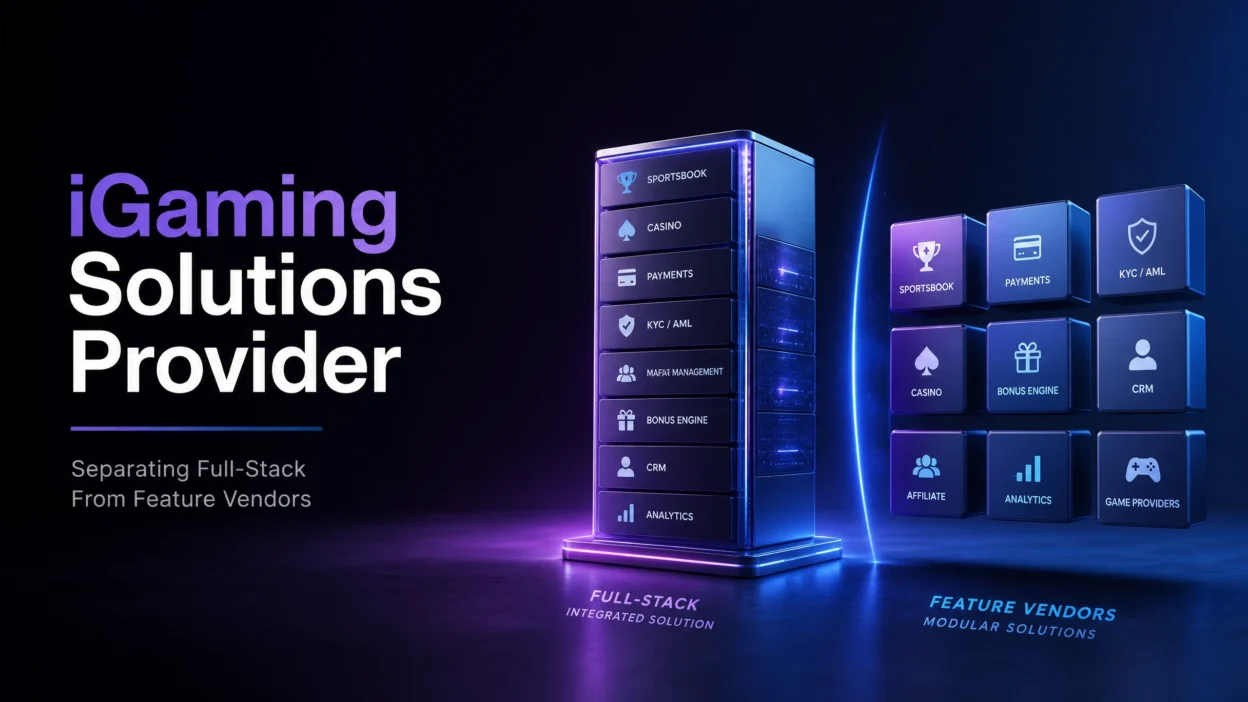
- Fournisseurs de plateformes complètes : Fourniture d'une infrastructure opérationnelle complète (PAM, jeux, paiements, back-office) via un fournisseur unique. Exemples : EveryMatrix, SoftSwiss, BetConstruct. Idéal pour les opérateurs souhaitant confier la gestion de leur plateforme à un seul fournisseur.
- Spécialistes verticaux : Ces plateformes excellent dans un domaine précis : paris sportifs uniquement (Altenar, Kambi), agrégation de jeux uniquement (Hub88, Relax Gaming), gestion des affiliés uniquement (Scaleo, MyAffiliates). Elles conviennent parfaitement aux opérateurs qui souhaitent constituer une offre complète et performante.
- Fournisseurs d'infrastructures : Fournir la couche invisible : données de cotes (Sportradar), infrastructure de paiement (Trustly, PaySafe), KYC (Jumio, Onfido), détection de fraude (Featurespace). Idéal pour les opérateurs propriétaires de leur plateforme qui doivent fournir des données ou des services spécifiques.
- Fournisseurs vedettes : Offre des fonctionnalités uniques : gamification (Smartico), CRM (Optimove, Fast Track), outils de jeu responsable (Mindway AI). Idéal pour les opérateurs disposant d’une plateforme mais souhaitant améliorer certaines fonctionnalités destinées aux joueurs ou liées à la conformité.
- L’erreur d’approvisionnement qui coûte le plus cher : Acheter une fonctionnalité auprès d'un fournisseur en pensant acheter une plateforme, ou acheter une plateforme complète alors qu'on n'avait besoin que d'un domaine spécialisé et qu'on se retrouve maintenant prisonnier d'une architecture dont on n'avait pas besoin.
Le Solutions de jeu en ligne Le secteur des fournisseurs de solutions iGaming souffre d'un problème spécifique et persistant : tous les acteurs de l'écosystème s'approprient le terme « solutions iGaming », indépendamment de leurs prestations réelles. Une entreprise fournissant des données de cotes aux bookmakers se présente comme fournisseur de solutions iGaming. Il en va de même pour une entreprise développant des casinos en marque blanche complets. Et c'est également le cas pour une entreprise vendant un module CRM aux opérateurs disposant déjà d'une plateforme. Ces offres ne sont pas comparables : elles ne visent pas le même budget, ne répondent pas au même besoin, et les évaluer dans une même liste de fournisseurs potentiels ne fait qu'accroître la confusion.
Ce guide propose un système de classification qui simplifie l'évaluation des fournisseurs de solutions iGaming. Il ne s'agit pas d'un classement : le « meilleur fournisseur de solutions iGaming » dépend entièrement de vos objectifs et de l'état d'avancement de votre projet. Ce guide offre un cadre pour catégoriser les offres des fournisseurs et les associer aux besoins spécifiques des opérateurs.
Les quatre archétypes de fournisseurs de solutions de jeux en ligne
Archétype 1 : Fournisseurs de plateformes complètes
Les fournisseurs de plateformes complètes offrent tout ce dont un opérateur a besoin pour gérer un casino ou une marque de jeux d'argent multi-secteurs : gestion des comptes joueurs (PAM), agrégation des contenus de jeux, traitement des paiements, système de bonus, reporting back-office et outils de conformité. Leur principal atout ? L'opérateur traite avec un seul fournisseur pour l'ensemble de la plateforme : un seul contrat, une seule intégration, un seul interlocuteur pour le support et une seule négociation commerciale.
L'attrait principal réside dans la simplicité. Un seul fournisseur à contacter en cas de problème. Une seule API à intégrer. Un seul contrat commercial à négocier. Les inconvénients sont tout aussi évidents : la profondeur fonctionnelle des composants individuels est généralement moindre que celle des solutions développées par des spécialistes, car les ressources d'ingénierie sont réparties entre plusieurs secteurs. La migration est plus complexe, car une plus grande partie de vos données opérationnelles est centralisée. Enfin, la dépendance au fournisseur est plus forte : si votre fournisseur de solutions complètes rencontre un problème, c'est l'ensemble de vos opérations qui est impacté.
Qui a sa place ici : EveryMatrix (plateforme complète avec option modulaire), SoftSwiss Casino Platform, BetConstruct, Slotegrator, Pragmatic Solutions (au sein de l'écosystème Pragmatic Play). Dans le secteur des paris sportifs : BetConstruct, Digitain (casino + paris sportifs), NSoft.
Archétype 2 : Spécialistes verticaux
Les spécialistes verticaux développent un composant spécifique de l'infrastructure iGaming avec une profondeur et une qualité inégalées par les fournisseurs full-stack, qui répartissent simultanément leurs efforts d'ingénierie entre casino, paris sportifs, paiements, affiliation et CRM. Un spécialiste des paris sportifs comme Altenar concentre l'intégralité de son ingénierie sur l'excellence de son infrastructure. Un agrégateur de jeux comme Hub88 ou Relax Gaming se concentre quant à lui exclusivement sur l'approvisionnement en contenu, les relations avec les studios et la qualité de l'intégration des jeux. Cette spécialisation se traduit par des résultats nettement supérieurs dans le secteur qu'ils ciblent.
Les opérateurs qui développent des solutions intégrées de pointe – combinant un bookmaker spécialisé, un agrégateur de jeux de casino spécialisé, une plateforme d'affiliation dédiée et un CRM sur mesure – offrent généralement un produit supérieur à tous les niveaux par rapport aux opérateurs utilisant une plateforme « full-stack » où chaque composant est correct sans être exceptionnel. Cette qualité a un prix : la complexité de l'intégration. Chaque composant spécialisé nécessite sa propre intégration, son propre service d'assistance et ses propres négociations commerciales.
Spécialistes des paris sportifs : Altenar (marchés réglementés de l'UE, spécialisation dans le sport), Kambi (entreprise), Sportradar MTS (infrastructure de gestion des données et des risques), Digitain (sport et casino pour le marché intermédiaire). Spécialistes de l'agrégation de jeux : Hub88 (relations avec des studios premium), Relax Gaming (contenu exclusif et agrégation), Evoplay (studio avec capacités d'agrégation). Spécialistes de la gestion des affiliés : Scaleo, MyAffiliates, Affilka, Income Access. Spécialistes des plateformes de casino : EveryMatrix CasinoEngine (infrastructure de casino modulaire), Slotegrator (casino accessible + agrégation).
Archétype 3 : Fournisseurs d’infrastructure
Les fournisseurs d'infrastructure fournissent les données et les services essentiels au fonctionnement des jeux en ligne, sans pour autant développer eux-mêmes l'interface utilisateur. Moins visibles que les plateformes et moins souvent mentionnés dans les évaluations d'opérateurs, ils sont pourtant indispensables à toute activité de jeu en ligne. Cette infrastructure comprend : les flux de données sportives et de cotes (Sportradar, Stats Perform, Betradar), les réseaux de traitement des paiements (Trustly, Paysafe, Nuvei), la vérification d'identité et la procédure KYC (Jumio, Onfido, Sumsub), la détection des fraudes et la surveillance des risques (Featurespace, Seon, DataDome), ainsi que l'infrastructure de reporting réglementaire (API de conformité de Kambi, outils de reporting spécifiques à chaque juridiction).
Comprendre l'infrastructure sous-jacente est crucial pour les opérateurs qui évaluent les fournisseurs de plateformes, car la qualité de cette infrastructure détermine en grande partie l'expérience des joueurs et la conformité opérationnelle. Une plateforme de casino utilisant un fournisseur de données de cotes de second ordre offrira une qualité de paris sportifs inférieure, quelle que soit la qualité de sa propre technologie. De même, une plateforme faisant appel à un prestataire KYC avec un faible taux de réussite risque de frustrer les joueurs légitimes. Interroger les fournisseurs de plateformes sur leurs prestataires de données de cotes, de KYC et de traitement des paiements permet d'évaluer la qualité de leurs choix d'infrastructure.
Principaux fournisseurs d'infrastructures par catégorie : Données sportives — Sportradar, Stats Perform. KYC/Identité — Jumio, Onfido, Sumsub, GBG. Infrastructure de paiement — Trustly (Open Banking), Paysafe (Skrill, Neteller), Nuvei, Worldpay. Fraude et risque — Featurespace (ARIC), Seon, Accertify. Jeu responsable — Mindway AI, Gamban, certification GamCare.
Archétype 4 : Fournisseurs de fonctionnalités
Les fournisseurs de fonctionnalités proposent des capacités spécifiques qui enrichissent une plateforme existante sans la remplacer. Les plateformes de gamification (Smartico, Solitics) ajoutent des mécanismes de fidélisation, des missions et des systèmes de succès à votre plateforme actuelle. Les plateformes CRM (Optimove, Fast Track) offrent une segmentation des joueurs plus poussée et une automatisation des campagnes. Les outils de jeu responsable (Mindway AI, intégrations API Gamban) renforcent la conformité au-delà des fonctionnalités de base de la plateforme. Les moteurs de personnalisation de contenu ajoutent des recommandations de jeux basées sur l'IA aux lobbies de jeux existants.
Les fournisseurs de fonctionnalités sont la catégorie la plus souvent mal classée dans les évaluations de jeux en ligne. Les opérateurs ayant besoin d'un CRM achètent parfois une plateforme complète alors qu'Optimove, connecté à leur PAM existant, aurait suffi. De même, ceux qui recherchent des fonctionnalités de gamification changent parfois de fournisseur alors que Smartico pourrait s'intégrer à leur infrastructure actuelle. Comprendre que les fournisseurs de fonctionnalités s'intègrent à l'infrastructure existante, plutôt que de la remplacer, ouvre la voie à des solutions bien plus économiques pour combler des lacunes spécifiques.
CRM et fidélisation : Optimove (entreprise), Fast Track (marché intermédiaire), Smartico (freemium à marché intermédiaire). Ludification : Gamify, Capitaine Up, Onyx. Jeu responsable : Mindway AI (outils de comportement cognitif), Gamban (API de blocage au niveau de l'appareil). Analyse : Analyttica, Everi Analytics, la couche prédictive d'Optimove. Personnalisation du contenu : Recombee, Dynamic Yield adapté au iGaming.
Comment faire correspondre vos besoins à l'archétype approprié
Le système de classification n'est utile que s'il permet de prendre une décision d'achat claire. Voici l'arbre de décision qui relie la situation de l'opérateur à l'archétype approprié :
| Situation de l'opérateur | Archétype droit | Archétype incorrect | Point de départ |
|---|---|---|---|
| Lancement du premier casino, pas d'équipe technique, mise en service impérative dans les 90 jours. | Plateforme complète | Spécialistes verticaux (complexité d'intégration) | BetConstruct, SoftSwiss, Slotegrator |
| Le casino fonctionne, mais la qualité des paris sportifs est insuffisante ; les joueurs partent chez la concurrence. | Spécialiste vertical (paris sportifs) | Remplacement complet de la pile (perturbation inutile) | Altenar, Digitain, Sportradar MTS |
| Nous disposons d'une plateforme, le suivi des affiliés engendre des litiges, et le rapprochement NGR est manuel. | Spécialiste vertical (affilié) | Remplacement complet de la pile (écraser une mouche avec un marteau-pilon) | Scaleo, MyAffiliates, Affilka |
| Développement d'une plateforme propriétaire, besoin de données sportives et de flux de cotes | Fournisseur d'infrastructure | Plateforme complète (vous êtes déjà en train de construire la vôtre) | Sportradar, Statistiques Perform |
| La plateforme fonctionne, le taux de rétention est inférieur à la moyenne du secteur et le taux de désabonnement est élevé. | Fournisseur de fonctionnalités (CRM) | Remplacement de la plateforme (et non un problème de plateforme) | Optimove, Fast Track, Smartico |
| Un opérateur européen réglementé en matière de jeu responsable présente des lacunes insuffisantes, selon l'autorité de régulation. | Vérification de la conformité de la plateforme et du fournisseur de fonctionnalités (RG) | Le fournisseur de fonctionnalités seul (il peut s'agir d'un problème d'architecture de plateforme) | Mindway AI, Gamban API, audit de conformité EveryMatrix |
| La ludothèque est trop restreinte, les joueurs cherchent des titres spécifiques ailleurs. | Spécialiste vertical (agrégation de jeux) | Remplacement complet de la pile (votre plateforme n'est pas le problème) | Hub88, Relax Gaming, agrégateur de Slotegrator |
| Opérateur multimarques, gérant plus de 3 marques sur des plateformes distinctes, la complexité opérationnelle est insoutenable. | Plateforme complète (centralisée) | Plus de fournisseurs de fonctionnalités par marque (ce qui aggrave le problème) | EveryMatrix, MyAffiliates (couche d'affiliation), Optimove (couche CRM) |
Le fournisseur affirme identifier la confusion des archétypes
Le fournisseur affirme identifier la confusion des archétypes
Les fournisseurs se décrivent souvent de manière à obscurcir plutôt qu'à clarifier ce qu'ils proposent réellement. Voici les affirmations qui révèlent le plus souvent une confusion chez un fournisseur :
« Solutions complètes de jeux en ligne »
Tous les fournisseurs utilisent cette expression. Sans précisions, elle ne veut rien dire. La bonne question : « Parmi les fonctionnalités suivantes, lesquelles proposez-vous nativement (gestion des comptes joueurs, agrégation de contenu de jeu, traitement des paiements, paris sportifs, gestion des affiliés et CRM) ? Lesquelles proposez-vous via des intégrations tierces ? » La réponse vous indiquera si vous vous adressez à un fournisseur de solutions complètes, à un spécialiste des intégrations partenaires ou à un fournisseur de fonctionnalités qui utilise un discours marketing ambitieux.
« Solution iGaming clé en main »
Cette expression est utilisée par les fournisseurs de plateformes complètes, les opérateurs de paris sportifs spécialisés et, parfois, les agrégateurs de jeux. Le terme « clé en main » a des significations différentes selon le contexte. Il est important de préciser : « Clé en main par rapport à quoi ? Cela inclut-il la gestion des actifs personnels (PAM), le traitement des paiements et les outils de conformité, ou s’agit-il d’une solution clé en main uniquement pour la partie paris sportifs ? » La réponse permettra de déterminer si vous recherchez une plateforme complète ou un composant spécifique.
« Nous nous intégrons à tout »
Cette affirmation est presque toujours vraie d'un point de vue technique (toute plateforme dotée d'une API peut théoriquement s'intégrer à n'importe quel système), mais presque toujours trompeuse d'un point de vue opérationnel. La question essentielle est la suivante : « Parmi vos intégrations, lesquelles sont certifiées et prêtes à l'emploi, et lesquelles nécessitent des développements sur mesure ? » Un fournisseur proposant 200 « intégrations », dont 190 sont des développements sur mesure commandés par l'opérateur, est très différent d'un fournisseur proposant 50 intégrations certifiées, testées et maintenues. Cette distinction est invisible en marketing, mais se révèle lors d'un test de transparence des intégrations.
Tout ce qui est « alimenté par l'IA »
Tout ce qui est « alimenté par l'IA »
En 2026, les arguments marketing concernant l'IA dans le secteur des jeux en ligne vont des véritables implémentations d'apprentissage automatique (comme les modèles prédictifs de désabonnement d'Optimove ou la détection de fraude en temps réel de Featurespace) au jargon marketing appliqué à des systèmes basés sur des règles et rebaptisés « IA ». La question qui les distingue est la suivante : « Sur quelles données le modèle est-il entraîné ? Quelle est la méthode de validation ? Et comment la précision des prédictions est-elle mesurée dans le temps ? » Seuls les fournisseurs proposant de véritables implémentations d'apprentissage automatique peuvent répondre précisément à ces questions. En revanche, ceux qui utilisent le terme « IA » comme argument marketing pour désigner une logique conditionnelle (si-alors) ne le peuvent pas.
Créer sa propre pile technologique ou acheter une plateforme : les aspects économiques
Le choix entre constituer une équipe de spécialistes (créer une pile technologique) et acquérir une plateforme complète est en définitive une question d'économie et de capacités. Voici le cadre qui permet de concrétiser ce choix :
Le facteur de coût d'intégration. Chaque composant spécialisé ajouté à une suite logicielle nécessite une intégration : temps de développement pour le connecter à votre système PAM, tests pour vérifier le bon fonctionnement des flux de données et maintenance continue en fonction de l’évolution des API des fournisseurs. Avec une estimation prudente de 15 000 € à 40 000 € par intégration et de 15 à 30 jours de maintenance par an, une suite logicielle de pointe composée de quatre composants (paris sportifs, casino, affiliation, CRM) représente un coût d’intégration de 60 000 € à 160 000 € la première année et un coût de maintenance annuel de 15 000 € à 30 000 €. Ce coût doit être justifié par l’amélioration de la qualité du produit apportée par les composants spécialisés par rapport à une solution complète équivalente.
Le calcul de la prime de qualité. Si une plateforme de paris sportifs spécialisée génère une fidélisation des joueurs supérieure de 15 % à celle d'une plateforme full-stack (grâce à une meilleure qualité des cotes, une offre de paris en direct plus complète et des outils de gestion nettement plus performants), et que votre plateforme génère 200 000 €/mois de revenu brut des jeux (RBJ), ce gain de 15 % représente 30 000 €/mois de revenus supplémentaires. À ce niveau, le coût d'intégration d'une plateforme spécialisée est amorti en 2 à 5 mois, et devient ensuite rentable. Si le gain de qualité est de 3 % (6 000 €/mois), l'amortissement se fait en 10 à 26 mois et la rentabilité est alors marginale. Ce calcul dépend de vos chiffres spécifiques ; il est donc préférable de l'effectuer avant la décision d'acquisition.
L'exigence de capacité. Les estimations de coûts d'intégration ci-dessus supposent que vous disposez des compétences de développement nécessaires. Si vous ne possédez pas de capacités de développement en interne, le coût d'intégration est plus élevé (le recours à une agence coûte généralement plus cher qu'un développement en interne) et le délai est plus long. Pour les opérateurs sans équipe technique, la plateforme complète est économiquement avantageuse même si la qualité de chaque composant est inférieure à celle des spécialistes, car ces derniers requièrent des compétences dont vous ne disposez pas.
Le paysage des solutions de jeux en ligne en 2026 : qui compte vraiment ?
Le paysage des solutions de jeux en ligne en 2026 : qui compte vraiment ?
En fonction des quatre archétypes, voici comment se positionnent les fournisseurs les plus pertinents du marché en 2026 :
| Vendeur | Archétype | Force primaire | Meilleur ajustement de l'opérateur |
|---|---|---|---|
| Chaque matrice | Compatibilité complète / Modulaire | Conformité européenne, portabilité des données, modularité | Moyennes et grandes entreprises, réglementées par l'UE |
| Softswiss | Un paquet entier | Infrastructure crypto, filiale intégrée (Affilka) | Multivertical et favorable aux cryptomonnaies |
| PariConstruire | Un paquet entier | Portée sur les marchés émergents, étendue multi-verticale | Nouveaux opérateurs, Amérique latine/Asie/Afrique |
| Alténar | Spécialiste vertical (paris sportifs) | Niveau de conformité des paris sportifs réglementés de l'UE | Sports-primary, opérateurs Royaume-Uni/SE/DE |
| Sportradar | Infrastructure | Meilleure couverture des données sportives et qualité des cotes au niveau mondial | Opérateurs développant leurs propres paris sportifs |
| Échelleo | Spécialiste vertical (affilié) | Affiliation native iGaming, détection de fraude par IA | Opérateurs de programmes d'affiliation pour le marché intermédiaire |
| Mes affiliés | Spécialiste vertical (affilié) | Flexibilité maximale de la structure des commissions | Programmes d'affiliation multimarques pour entreprises |
| Optimove | Fournisseur de fonctionnalités (CRM) | Analyse prédictive des joueurs, fidélisation des entreprises | Les grands opérateurs dotés de programmes de fidélisation |
| Fast Track | Fournisseur de fonctionnalités (CRM) | CRM pour le marché intermédiaire avec segmentation native iGaming | Les opérateurs du marché intermédiaire développent la fidélisation |
| Smartico | Fournisseur de fonctionnalités (gamification + CRM) | Des mécanismes de gamification à un prix accessible | Les opérateurs ajoutent un programme de fidélisation à leur plateforme existante |
| Mindway IA | Fournisseur vedette (jeu responsable) | Outils cognitifs pour un jeu responsable | Opérateurs réglementés de l'UE renforçant la conformité aux réglementations européennes |
| Jumio / Onfido | Infrastructure (KYC) | taux de réussite et conformité à la vérification d'identité | Les opérateurs s'approvisionnent directement en infrastructure KYC |
Les trois questions essentielles pour décrypter toute présentation de solutions iGaming.
Quel que soit le profil du fournisseur ou la sophistication de son argumentaire, trois questions permettent systématiquement d'obtenir les informations les plus utiles pour les décisions d'achat :
Question 1 : « Que ne faites-vous pas précisément ? » Chaque fournisseur de solutions iGaming vous expliquera ses services. Rares sont ceux qui vous diront ouvertement ce qu'ils ne font pas. Poser la question directement oblige à la précision : un agrégateur de jeux qui prétend également proposer des fonctionnalités PAM (gestion des accès aux plateformes de paiement) décrira précisément ces fonctionnalités ou révélera qu'il s'agit d'un argument marketing pour un système de gestion des utilisateurs simplifié, et non d'une véritable solution PAM. Un fournisseur qui répond clairement et honnêtement à cette question – « Nous proposons l'agrégation de jeux et l'intégration des paiements ; vous aurez besoin d'une plateforme PAM et d'une plateforme d'affiliation distinctes » – est bien plus digne de confiance que celui qui prétend offrir une couverture complète.
Question 2 : « Parmi vos clients actuels, lesquels nous ressemblent le plus, et pouvons-nous nous entretenir avec eux indépendamment ? » Les références fournies par le fournisseur sont souvent policées. Les communautés d'opérateurs (forums iGaming, groupes LinkedIn pour les opérateurs de casinos, événements du secteur) sont des lieux où les opérateurs s'expriment en toute transparence sur leurs relations avec les fournisseurs. Contacter un client actuel via votre réseau et l'interroger directement sur son expérience avec un fournisseur vous apportera des informations bien plus utiles que n'importe quelle référence proposée par ce dernier. Le fait que le fournisseur soit disposé à vous fournir les coordonnées de clients que vous pouvez trouver et contacter vous-même, plutôt que de faciliter une prise de contact spécifique, témoigne de sa confiance dans ces relations.
Question 3 : « À quoi ressemble notre relation au bout de trois ans ? » La plupart des ruptures de relations avec les fournisseurs de jeux en ligne surviennent non pas lors de la démonstration, ni même lors de la mise en œuvre, mais pendant la phase opérationnelle, lorsque le fournisseur se concentre sur les nouveaux clients et que votre compte est géré par des collaborateurs juniors. Posez des questions précises : quelle est la structure de gestion des comptes pour les clients existants ? Quel est le SLA pour les demandes de fonctionnalités par rapport aux corrections de bugs ? Et comment les clients influencent-ils la feuille de route produit ? Les fournisseurs qui fidélisent bien leur clientèle répondent précisément à ces questions. Ceux qui connaissent un fort taux de désabonnement se contentent de réponses vagues sur le « partenariat » et le « support continu ».
Pour en savoir plus sur des catégories de fournisseurs spécifiques : Guide des fournisseurs de plateformes de jeux en ligne couvre en détail les plateformes complètes. Comparaison des plateformes de casino couvre le paysage des fournisseurs spécifiques aux casinos, y compris la méthodologie d'évaluation des pièges à démo. Comparaison des fournisseurs de paris sportifs en marque blanche Ce document couvre les spécialistes des paris sportifs et les fournisseurs de solutions complètes pertinents pour les opérations principalement axées sur le sport. Pour mieux comprendre le marché plus large des plateformes et solutions de jeux en ligne du point de vue des opérateurs et des affiliés, consultez le site suivant : Guide des plateformes de jeux en ligne pour les opérateurs et les affiliés couvre les relations écosystémiques entre les fournisseurs de plateformes, les opérateurs et les programmes d'affiliation.
Questions fréquemment posées
Qu'est-ce qu'un fournisseur de solutions iGaming ?
Un fournisseur de solutions iGaming est un prestataire qui fournit des technologies, des données ou des services aux opérateurs de jeux en ligne. Ce terme englobe quatre archétypes distincts : les fournisseurs de plateformes complètes qui proposent une infrastructure de casino ou de paris sportifs exhaustive ; les spécialistes verticaux qui offrent une expertise pointue dans un domaine précis (paris sportifs, agrégation de jeux, gestion des affiliés) ; les fournisseurs d’infrastructure qui fournissent des couches de données et de services (données sportives, KYC, traitement des paiements) que les opérateurs intègrent à leurs plateformes ; et les fournisseurs de fonctionnalités qui ajoutent des capacités spécifiques (CRM, gamification, outils de jeu responsable) aux plateformes existantes. Identifier l’archétype auquel appartient un fournisseur est la première étape essentielle de toute évaluation de solutions iGaming.
Quelle est la différence entre un fournisseur de plateforme de jeux en ligne et un fournisseur de solutions de jeux en ligne ?
Un fournisseur de plateforme de jeux en ligne fournit spécifiquement la plateforme technologique opérationnelle qui gère un casino ou un site de paris sportifs, incluant la gestion des actifs payants (PAM), le contenu des jeux, les paiements et le back-office. Un fournisseur de solutions de jeux en ligne est un terme plus large qui englobe les fournisseurs de plateformes, mais aussi les prestataires spécialisés (logiciels d'affiliation, CRM, gamification), les fournisseurs d'infrastructures (données sportives, KYC, détection des fraudes) et les fournisseurs de fonctionnalités qui enrichissent les plateformes existantes. Cette distinction est cruciale pour les achats : considérer un fournisseur de CRM comme un fournisseur de plateforme, ou inversement, confondre un fournisseur de plateforme avec un fournisseur de fonctionnalités, c'est risquer d'avoir des attentes mal alignées et de prendre de mauvaises décisions d'achat.
Comment choisir entre une plateforme iGaming complète et une solution spécialisée de pointe ?
La décision repose sur trois facteurs : les capacités techniques (disposez-vous de développeurs capables d’intégrer et de maintenir plusieurs composants spécialisés ?), les exigences de qualité (la différence de qualité entre un composant spécialisé et une solution complète justifie-t-elle le coût d’intégration ?) et les délais (les plateformes complètes sont plus rapides à déployer, tandis que les solutions spécialisées sont plus longues à mettre en place). Les entreprises sans équipe de développement interne devraient privilégier les plateformes complètes. Celles qui disposent de capacités de développement et qui recherchent une expertise pointue dans un domaine spécifique devraient envisager de faire appel à des spécialistes de ce domaine, tout en utilisant une plateforme complète pour les autres composants. Calculez le coût d’intégration et le gain de qualité en fonction de votre situation, plutôt que de vous fier à des recommandations générales.
Que doit inclure un fournisseur de solutions iGaming B2B ?
Un fournisseur de solutions iGaming B2B doit impérativement inclure une spécification claire de ses prestations et des intégrations tierces qu'il propose, des intégrations certifiées avec les principaux fournisseurs de PAM et de plateformes du marché, des clauses de portabilité des données permettant aux opérateurs d'exporter leurs données en cas de changement de fournisseur, une documentation relative aux SLA (accords de niveau de service) couvrant la disponibilité et la gestion des incidents, ainsi que des références d'opérateurs au profil similaire au vôtre, que vous pouvez contacter indépendamment. Les composants spécifiques inclus (PAM, jeux, paris sportifs, affiliation, CRM) dépendent du type de fournisseur ; il est donc essentiel de bien comprendre le périmètre de l'offre avant d'évaluer si elle répond à vos besoins.
Quels sont les meilleurs fournisseurs de solutions iGaming pour les nouveaux opérateurs ?
Les nouveaux opérateurs sans équipe technique interne devraient privilégier les fournisseurs de plateformes complètes plutôt que d'assembler des composants spécialisés. BetConstruct, SoftSwiss et Slotegrator offrent la combinaison la plus accessible de fonctionnalités complètes, de tarifs d'entrée raisonnables et de délais d'intégration courts. Le choix optimal dépend du marché cible (BetConstruct est particulièrement performant en Amérique latine et en Asie, SoftSwiss dispose de la meilleure infrastructure crypto et Slotegrator propose les tarifs les plus avantageux), du secteur d'activité et des exigences de conformité. Sur les marchés européens réglementés, les nouveaux opérateurs devraient privilégier EveryMatrix pour son niveau de conformité supérieur, malgré un prix d'entrée plus élevé.
Combien coûtent les fournisseurs de solutions iGaming ?
Les coûts des fournisseurs de solutions iGaming varient énormément selon le type de solution. Les plateformes complètes proposent des modèles allant du partage des revenus (20 à 40 % du GGR) avec des frais d'installation réduits, à des forfaits mensuels de 3 000 à 15 000 euros, auxquels s'ajoutent des frais d'installation de 10 000 à 150 000 euros. Les plateformes spécialisées, comme les plateformes d'affiliation, coûtent entre 500 et 5 000 euros par mois ; les plateformes de paris sportifs spécialisées, entre 5 000 et 20 000 euros par mois. Les fournisseurs d'infrastructure, tels que les flux de données sportives, coûtent entre 3 000 et 25 000 euros par mois selon la couverture. Les fournisseurs de fonctionnalités, comme les plateformes CRM, coûtent entre 1 000 et 10 000 euros par mois selon le volume de joueurs et les fonctionnalités. Le coût total d'une solution pour un opérateur qui s'appuie sur des spécialistes est généralement plus élevé que celui d'une plateforme complète la première année, mais peut s'avérer plus rentable à grande échelle si le gain de qualité justifie l'investissement dans l'intégration.
Besoin d'approfondir vos connaissances sur des catégories de fournisseurs spécifiques ? Nous proposons des guides détaillés pour chaque niveau de la pile de solutions iGaming.
Consultez le guide complet des fournisseurs de plateformes de jeux en ligne →